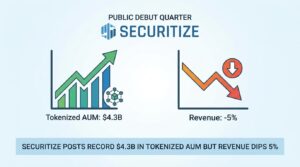
Securitize, the digital asset securities firm that recently transitioned to public trading, reported record average tokenized assets under management of $4.3 billion for the second quarter of 2025. That figure marks a 16% year-over-year increase. Yet revenue slipped 5% to $14.4 million, and the company’s net loss widened to $21.7 million, painting a more complicated picture than the headline AUM number might suggest.
What Securitize’s First Public Quarter Signals for Tokenization
The results land at an inflection point for the real-world asset tokenization sector, where institutional interest has surged but monetization pathways remain uneven. Before unpacking the numbers further, here are the strategic takeaways that matter most for market participants watching this space.
- AUM growth without proportional revenue: A 16% jump in tokenized assets under management did not translate into top-line gains, raising questions about fee compression or shifting revenue mix within the platform’s business model.
- Widening losses in a growth phase: The net loss expanding to $21.7 million suggests Securitize is investing heavily in infrastructure, compliance, and go-to-market operations ahead of anticipated scale.
- Revenue declining 5% to $14.4 million while AUM climbs could indicate that newer asset classes being tokenized carry lower margin profiles than legacy offerings.
- Public market scrutiny begins now: As a newly public company, Securitize faces quarterly disclosure obligations that will force greater transparency around unit economics in tokenization, something the broader sector has largely avoided.
The Revenue-AUM Disconnect
On the surface, managing $4.3 billion in tokenized assets while generating only $14.4 million in quarterly revenue implies a revenue yield of roughly 0.33% annualized. That’s thin by traditional asset management standards, though direct comparison is imperfect given that Securitize operates as infrastructure and issuance platform rather than a conventional fund manager. Still, the gap between asset growth and revenue contraction deserves attention.
One plausible explanation: the composition of tokenized assets has shifted. Early tokenization efforts concentrated on higher-fee private credit and real estate instruments. More recent growth has been driven by tokenized treasuries and money market products (a distinction that carries meaningfully different economics). These products tend to carry razor-thin margins, and their rapid proliferation across the industry has intensified competitive pressure on platforms like Securitize.
The 5% revenue decline, measured against a period of record AUM, suggests the company may be prioritizing volume and market share over near-term profitability. Whether that trade-off pays off depends on how quickly institutional adoption deepens beyond treasury products into higher-margin asset classes.
Why the Loss Widened
A net loss of $21.7 million in a single quarter is not trivial for a company of Securitize’s scale. But context matters. The firm has been building out regulatory infrastructure across multiple jurisdictions, maintaining SEC-registered transfer agent capabilities, and expanding its tokenization platform for institutional-grade digital securities. These are capital-intensive undertakings with long payback periods.
And the timing of the public listing itself likely added non-recurring costs. Legal, accounting, and advisory fees associated with going public tend to concentrate in the quarters immediately surrounding a listing. Separating structural operating losses from one-time transition costs will be critical when evaluating subsequent quarters.
How Tokenization Economics Are Evolving
Securitize’s results offer a useful lens into the broader tokenization market’s maturation. Consider the following comparison of key metrics:
| Metric | Q2 2024 | Q2 2025 | Change |
|---|---|---|---|
| Avg. Tokenized AUM | $3.7B | $4.3B | +16% |
| Revenue | $15.2M | $14.4M | -5% |
| Net Loss | Not disclosed (pre-public) | $21.7M | N/A |
| Implied Revenue Yield (annualized) | ~0.41% | ~0.33% | Compression evident |
The yield compression visible in this table is arguably the most telling data point. It mirrors a pattern seen across fintech infrastructure businesses: scale arrives before pricing power solidifies.
What This Means for Institutional Tokenization Adoption
Institutional players watching Securitize’s public performance will draw different conclusions depending on their vantage point. Asset managers exploring tokenization may see the AUM growth as validation that the market is real and expanding. But the revenue and profitability picture introduces a harder question: can tokenization platforms sustain themselves as standalone businesses, or will they eventually need to be absorbed into larger financial infrastructure groups?
BlackRock’s BUIDL fund, which uses Securitize as its tokenization partner, has been a significant driver of AUM growth. That relationship provides credibility and volume. It also creates concentration risk. How much of the $4.3 billion traces back to a single institutional relationship is something investors will want to understand as disclosure practices mature.
Even so, the broader trajectory points toward continued institutional engagement with tokenized assets. The question is less about whether tokenization will scale and more about who captures the economics when it does.
Frequently Asked Questions
What does Securitize do?
Securitize operates a platform for issuing, managing, and trading tokenized securities. It holds SEC-registered transfer agent status and serves as infrastructure for institutional-grade digital asset issuance, including partnerships with major asset managers.
Why did revenue fall despite record AUM?
The most likely driver is a shift in asset mix toward lower-fee products such as tokenized treasuries and money market instruments, which have grown rapidly across the industry but carry thinner margins than private credit or real estate tokenization. Fee compression in a competitive market compounds the effect.
Is Securitize profitable?
No. The company reported a net loss of $21.7 million in Q2 2025. Some portion of that loss likely reflects one-time costs associated with its public listing, though the company has not broken out recurring versus non-recurring expenses in detail.
What is the significance of being publicly traded?
Public listing subjects Securitize to quarterly reporting requirements, giving the market its first consistent window into the unit economics of a pure-play tokenization platform. For an industry that has operated largely behind private fundraising rounds, that transparency carries weight well beyond one company’s results.



