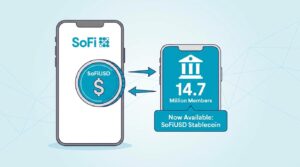
SoFi Technologies has rolled out its branded stablecoin, SoFiUSD, directly within its banking app, granting access to roughly 14.7 million members. The publicly traded US neobank announced the integration on Wednesday, allowing users to buy, sell, hold, and convert the stablecoin without leaving the platform. Full availability across the member base is expected to follow in phases. The move positions SoFi among a small but growing cohort of regulated financial institutions embedding stablecoin functionality into mainstream consumer products.
What SoFi’s Stablecoin Push Signals for Digital Banking
Before unpacking the strategic detail, it’s worth framing what this launch actually represents for the broader fintech and crypto landscape. SoFi isn’t a crypto-native company. It’s a diversified financial services platform with lending, investing, and banking products already under one roof. Adding a proprietary stablecoin to that mix carries implications that go well beyond a product update.
- SoFi becomes one of the first major US neobanks to offer a branded stablecoin natively inside a regulated banking app, blurring the line between traditional finance and digital assets
- With 14.7 million members already on the platform, the distribution advantage is immediate and substantial compared to standalone crypto wallets or exchanges
- The ability to convert SoFiUSD within the app suggests tight integration with existing fiat rails, potentially reducing friction for users unfamiliar with crypto on-ramps
- Competitive pressure on incumbents: traditional banks and rival fintechs now face a concrete example of stablecoin-embedded consumer banking
- Regulatory positioning matters here. SoFi holds a national bank charter through SoFi Bank, N.A., which arguably gives it more latitude (and scrutiny) than non-bank crypto firms
How the Integration Works
According to the company’s announcement, members can interact with SoFiUSD through four core functions: purchasing, selling, holding, and converting the stablecoin. All of this happens within the existing SoFi mobile banking and investing app, meaning users don’t need a separate wallet or third-party exchange account.
That’s a deliberate design choice. By keeping stablecoin activity inside the same interface where members already check balances and manage loans, SoFi reduces the cognitive leap that has historically kept mainstream consumers away from digital assets. Whether this translates into meaningful adoption is another question entirely.
Full rollout is still underway. The company indicated that availability would expand progressively, though it did not specify a completion timeline or detail any geographic restrictions within the US.
Why a National Bank Charter Changes the Equation
SoFi’s bank charter, granted in early 2022, is not incidental to this launch. Operating as a nationally chartered bank subjects SoFi to oversight by the Office of the Comptroller of the Currency (OCC), which has issued interpretive letters permitting certain stablecoin activities by national banks. Still, the regulatory environment for stablecoins remains unsettled at the federal level, with Congress continuing to debate comprehensive legislation.
What the charter does provide is a foundation of regulatory credibility that most crypto-native firms lack. For consumers weighing whether to hold a stablecoin, the distinction between a product offered by a chartered bank and one issued by an offshore entity is not trivial (a distinction regulators have been slow to codify into clear consumer-facing labels).
Competitive Landscape at a Glance
| Company | Stablecoin Offering | Regulatory Status | User Base |
|---|---|---|---|
| SoFi Technologies | SoFiUSD (in-app) | National bank charter (OCC) | 14.7 million members |
| PayPal | PYUSD | State money transmitter licenses | 400+ million accounts globally |
| Circle (USDC) | USDC | State-regulated, pursuing federal framework | Distributed via third-party platforms |
| Tether | USDT | Offshore, limited US regulatory engagement | Largest stablecoin by market cap |
PayPal launched PYUSD in 2023, but its approach differs. PayPal distributes through a payments-first interface rather than a banking app with deposit accounts and lending products. SoFi’s integration arguably creates a tighter loop between stablecoin holdings and traditional banking activity.
The Behavioral Shift SoFi Is Betting On
Beyond the technical and regulatory dimensions, there’s a psychological layer worth examining. Mainstream adoption of stablecoins has been hampered less by technology and more by perception. For most consumers, crypto still carries associations with volatility, complexity, and risk. SoFi’s strategy appears designed to reframe stablecoins as just another feature within a trusted financial app.
This aligns with core principles from behavioral design and neuro-linguistic programming: context shapes meaning. When a stablecoin sits alongside a savings account and a student loan refinance option, the mental model shifts. It stops being “crypto” and starts being “another way to hold dollars.” The framing effect is powerful. Users who would never download a crypto exchange may engage with a stablecoin that appears inside an environment they already associate with safety and routine.
And there’s a subtler dynamic at work. By naming the stablecoin SoFiUSD rather than adopting a third-party token, the company anchors trust to its own brand identity. That naming convention triggers familiarity bias. Members who trust SoFi with their direct deposits are more likely to extend that trust to a SoFi-branded digital dollar than to an unfamiliar ticker symbol. Whether consciously or not, SoFi is leveraging identity-level anchoring to lower the adoption barrier.
The phased rollout itself may serve a similar function. Scarcity and exclusivity, even when manufactured through staged access, tend to increase perceived value. Early adopters become internal advocates. By the time full availability arrives, the product may already carry social proof within the platform’s community forums and referral networks.
Frequently Asked Questions
What is SoFiUSD?
SoFiUSD is a stablecoin offered by SoFi Technologies within its banking app. It is designed to maintain a stable value pegged to the US dollar, and members can buy, sell, hold, or convert it directly on the platform.
Do I need a separate crypto wallet to use SoFiUSD?
No. The stablecoin is integrated into the existing SoFi app, so members interact with it alongside their other financial products without needing external wallets or exchanges.
Is SoFi regulated?
SoFi operates SoFi Bank, N.A. under a national bank charter supervised by the OCC. This places it under a different regulatory framework than most crypto-native companies, though stablecoin-specific federal legislation remains in development.
When will all SoFi members have access?
The company has stated that full availability is expected soon but has not disclosed a specific completion date. Access is being expanded in phases across its 14.7 million member base.



