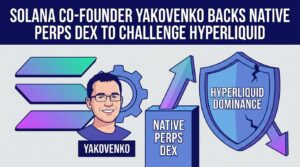
Solana co-founder Anatoly Yakovenko has thrown his weight behind the development of a perpetuals decentralized exchange built natively on the Solana Virtual Machine (SVM), setting the stage for a direct confrontation with Hyperliquid’s grip on onchain derivatives trading. The endorsement signals a deliberate strategic escalation within the Solana ecosystem, one aimed at reclaiming market share in a segment that has grown rapidly over the past year. With Hyperliquid commanding significant volume in perpetual futures, Yakovenko’s public backing suggests the Solana camp views this vertical as too important to cede.
What Yakovenko’s Endorsement Means for Onchain Derivatives
Before unpacking the competitive dynamics, it’s worth isolating the core strategic signals embedded in this move.
- Direct competitive framing: Yakovenko is not simply advocating for more DeFi tooling on Solana. He is explicitly positioning a native perpetuals DEX as a counterweight to Hyperliquid, which operates its own Layer 1 chain optimized for derivatives.
- Ecosystem retention play: Traders and liquidity currently flowing to Hyperliquid represent capital leaving the Solana ecosystem entirely. A native SVM-based alternative would keep that activity (and its fees) within Solana’s orbit.
- The timing coincides with broader momentum in onchain perpetuals, where volumes have surged across multiple platforms in 2025
- Infrastructure confidence: Backing a perpetuals DEX on SVM implies Yakovenko believes Solana’s throughput and latency profile can match or exceed what Hyperliquid offers on its purpose-built chain.
- Developer signal: Public endorsement from a co-founder carries weight with builders. Expect increased developer attention and possibly grant funding directed toward this vertical.
Why Perpetuals Have Become the Battleground
Perpetual futures are, arguably, the single most traded instrument in crypto. They dominate centralized exchange volume, and their migration onchain has been one of DeFi’s most closely watched narratives. Hyperliquid capitalized on this trend by building a chain specifically tuned for order book-based perpetuals trading, attracting billions in cumulative volume since its launch.
Solana, for its part, already hosts several derivatives protocols. But none have achieved the kind of concentrated liquidity and user loyalty that Hyperliquid commands. That gap is what Yakovenko appears intent on closing.
The challenge is not purely technical. Hyperliquid’s advantage rests on a combination of low-latency execution, deep liquidity, and a trader community that has coalesced around its platform. Replicating the infrastructure is one thing. Pulling traders away from an ecosystem where they’ve already deposited capital and built positions is a harder problem entirely.
Solana’s Technical Edge and Its Limits
Solana’s architecture gives it certain advantages that matter for derivatives trading. Sub-second block times, parallel transaction processing via Sealevel, and relatively low fees create a foundation that can, at least on paper, support high-frequency trading activity. The Solana Virtual Machine’s parallel execution model is particularly relevant here, as perpetuals trading demands rapid state updates across multiple accounts simultaneously.
Still, Solana has faced criticism for network congestion during periods of peak demand. Outages and degraded performance in prior cycles raised questions about reliability for latency-sensitive applications like derivatives. Whether recent network upgrades (including the Firedancer validator client under development by Jump Crypto) have sufficiently addressed these concerns remains an open question among institutional-grade traders.
And then there’s the order book question. Hyperliquid runs a fully onchain order book, a design choice that appeals to traders accustomed to centralized exchange mechanics. Most Solana-native DEXs have relied on AMM or hybrid models. A competitive perpetuals platform would likely need to match Hyperliquid’s order book experience, which demands sustained engineering investment.
How Hyperliquid Built Its Moat
Hyperliquid’s purpose-built Layer 1 for derivatives was not an accident of timing. The team made deliberate architectural decisions: a custom consensus mechanism optimized for trading workloads, an onchain order book with sub-second finality, and a points-based incentive system that bootstrapped early liquidity. The result has been a platform that processes substantial daily volume with execution quality that rivals centralized venues.
What makes displacing Hyperliquid particularly difficult is the reflexive nature of liquidity. Traders go where the spreads are tightest. Tight spreads attract more traders. Breaking that cycle requires either a superior product, aggressive incentives, or both (a distinction the Solana ecosystem will need to resolve quickly if it intends to compete seriously).
The Broader DeFi Derivatives Landscape in 2025
This isn’t happening in isolation. Multiple ecosystems are vying for derivatives market share.
| Platform / Ecosystem | Approach | Key Differentiator |
|---|---|---|
| Hyperliquid | Custom L1, onchain order book | Purpose-built chain with deep liquidity |
| Solana (proposed) | SVM-native perpetuals DEX | Leverages existing Solana throughput and ecosystem |
| dYdX (Cosmos) | App-chain on Cosmos SDK | Established brand, governance token, dedicated chain |
| GMX / Arbitrum | AMM-based perps on L2 | Strong community, oracle-based pricing model |
| Drift Protocol (Solana) | Hybrid order book + AMM | Already live on Solana with growing volume, though smaller scale |
Each approach carries trade-offs. App-chains offer customization but fragment liquidity. Layer 2 solutions inherit Ethereum’s security but face latency constraints. Solana’s pitch is that it can deliver app-chain-like performance without requiring traders to bridge to a separate network.
What Traders and Builders Should Watch
Several questions will determine whether this initiative gains real traction or remains aspirational.
First, which team or protocol will actually build the DEX Yakovenko envisions? A public endorsement without a named project leaves room for multiple contenders, but also ambiguity about execution timelines. Second, how will liquidity be bootstrapped? Incentive programs, market maker partnerships, and integration with existing Solana DeFi protocols will all matter. Third, can Solana’s network reliability hold under the specific stress patterns that derivatives trading generates? Spot trading and perpetuals impose different loads on infrastructure.
Even so, the signal from Yakovenko carries real weight. Co-founder endorsements in crypto tend to mobilize capital and talent in ways that pure market opportunity alone does not.
Frequently Asked Questions
What is a perpetuals DEX?
A perpetuals DEX is a decentralized exchange that allows traders to open leveraged long or short positions on crypto assets using perpetual futures contracts, which have no expiry date. These platforms operate without a central intermediary.
Why is Solana targeting Hyperliquid specifically?
Hyperliquid has emerged as the dominant venue for onchain perpetuals trading, capturing significant volume that might otherwise flow through Solana-based protocols. Yakovenko’s endorsement frames this as a competitive priority for the ecosystem.
Does Solana already have perpetuals protocols?
Yes. Protocols like Drift Protocol and Zeta Markets already offer perpetuals trading on Solana. But none have reached the scale or liquidity depth that Hyperliquid commands, which is precisely the gap this initiative aims to address.
When might a new SVM-native perpetuals DEX launch?
No specific timeline or project name has been confirmed. Yakovenko’s endorsement is a directional signal rather than a product announcement, so development timelines remain uncertain.



