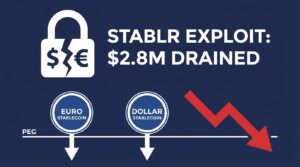
StablR, a European stablecoin issuer with backing from Tether, saw its minting contract exploited on Saturday, resulting in approximately $2.8 million in drained funds. The breach, first identified on-chain by security firm Blockaid, triggered sharp de-pegging events for both StablR’s euro-denominated and dollar-denominated tokens. The incident raises fresh questions about smart contract security across the growing European stablecoin landscape, particularly as MiCA-regulated issuers compete for market share.
What the StablR Breach Reveals About Stablecoin Infrastructure Risk
Before unpacking the broader implications, here are the critical points that matter most for industry stakeholders:
- Approximately $2.8 million was extracted from StablR’s minting contract, according to Blockaid’s initial on-chain analysis
- Both StablR’s euro-pegged and dollar-pegged stablecoins lost their peg following the exploit, signalling a systemic vulnerability in the issuer’s contract architecture
- The attack targeted the minting mechanism specifically, not user wallets or reserves directly, which narrows the vector but amplifies concerns about issuance-layer security
- Tether-backed stablecoin projects now face heightened scrutiny, even though the exploit appears unrelated to Tether’s own infrastructure
- European regulators already monitoring stablecoin compliance under MiCA will likely view this as a case study in operational risk
How the Exploit Unfolded
Blockaid flagged suspicious activity tied to StablR’s minting contract during routine on-chain monitoring on Saturday. The attacker exploited a vulnerability in the contract responsible for issuing new tokens, siphoning funds before the team could intervene. Within hours, both of StablR’s stablecoins traded well below their intended pegs.
That sequence matters. A minting contract exploit differs meaningfully from a reserve hack or a bridge attack. It suggests the attacker found a flaw in the logic governing token creation, which in turn allowed them to extract value without needing direct access to collateral pools. Whether the vulnerability was introduced during deployment or through a subsequent upgrade remains unclear; StablR has not published a detailed post-mortem at the time of this report.
The company has not confirmed whether affected users will be made whole.
Tether’s Proximity and the Reputational Ripple
StablR operates as a MiCA-compliant European stablecoin issuer with financial backing from Tether, the world’s largest stablecoin operator. Yet the exploit does not appear to involve Tether’s own systems or reserves. Still, the association creates a reputational adjacency that Tether’s competitors will not ignore.
For Tether, the calculus is straightforward but uncomfortable. Backing early-stage European issuers is part of a broader strategy to extend influence into the EU’s regulated stablecoin market. When one of those issuers suffers a security breach, the narrative shifts from strategic expansion to risk exposure (a distinction Tether’s communications team will need to manage carefully in the coming days).
MiCA and the Regulatory Lens
Europe’s Markets in Crypto-Assets regulation, which came into full effect in late 2024, imposes specific requirements on stablecoin issuers around reserve management, governance, and operational resilience. Smart contract security sits at the intersection of all three.
Regulators have, at least on paper, the authority to scrutinise whether an issuer’s technical infrastructure meets the operational resilience standards MiCA demands. But enforcement has been uneven. And while MiCA’s framework addresses reserve adequacy and redemption rights in detail, the regulation’s treatment of smart contract audit standards remains less prescriptive than many security professionals would prefer.
This exploit could accelerate that conversation. If a licensed, backed, and ostensibly compliant issuer can lose $2.8 million through a contract-level flaw, what does that say about the baseline security expectations embedded in the regulatory framework?
Stablecoin Security: A Pattern That Keeps Repeating
The StablR incident is not an isolated event. Across DeFi and CeFi alike, minting and bridge contracts have been persistent targets throughout 2024 and into 2025. The attack surface is well understood. The defences, arguably, have not kept pace.
Several factors contribute to this gap:
- Audit coverage varies widely across issuers; some undergo multiple independent reviews, others rely on a single assessment before deployment
- Upgrade mechanisms in smart contracts, while necessary for maintenance, introduce re-entry points that attackers actively probe
- Smaller issuers often lack the in-house security teams that larger protocols maintain, creating a resource asymmetry that attackers exploit
What separates this case from many others is the regulatory wrapper. StablR positioned itself as a compliant, institutional-grade issuer. That framing raises the bar for what the market expects in terms of security posture.
Frequently Asked Questions
What exactly was exploited in the StablR breach?
The attacker targeted StablR’s minting contract, which governs how new stablecoin tokens are created. This allowed funds to be extracted without directly compromising user wallets or the underlying reserves.
Are user funds at risk?
StablR has not yet issued a comprehensive statement on user impact or potential reimbursement. The de-pegging of both tokens suggests market confidence was immediately affected, but the full scope of user losses depends on factors the company has not disclosed.
Does this affect Tether directly?
No. The exploit targeted StablR’s own smart contract infrastructure. Tether is a backer of StablR but its systems and reserves were not involved in the breach. The reputational link, however, is harder to sever than the technical one.
What does MiCA say about incidents like this?
MiCA requires operational resilience from stablecoin issuers, but its prescriptive guidance on smart contract auditing and security standards remains limited. This incident may prompt regulators to tighten expectations around technical due diligence for licensed issuers.
What Comes Next for European Stablecoin Issuers
The immediate fallout centres on StablR’s response. A transparent post-mortem, a clear remediation plan, and a credible path to restoring peg stability will determine whether the project retains any market trust. Silence, or a vague acknowledgment without technical detail, would be damaging.
Beyond StablR itself, the incident sends a signal to every stablecoin issuer operating under MiCA. Regulatory compliance is necessary but not sufficient. Licence holders who treat smart contract security as a checkbox exercise rather than a continuous discipline are carrying risk they may not fully appreciate. And the market, as Saturday demonstrated, reprices that risk in minutes.



