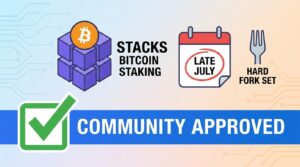
The Stacks community has greenlit SIP-045, a pivotal Bitcoin Staking upgrade, with more than 99% of votes cast in favor. Stacks co-creator Muneeb Ali confirmed the result, which triggers a hard fork targeted for approximately July 29, coinciding with Bitcoin block 907,740. Formally titled “PoX-5: Bitcoin Staking and Emission Schedule,” the upgrade represents a significant shift in how the Stacks network interacts with Bitcoin’s base layer and distributes rewards to participants.
What the SIP-045 Approval Means for Stacks and Bitcoin DeFi
Before diving into the specifics, it’s worth framing the scale of consensus here. A 99%-plus approval rate in a decentralized governance vote is rare, and it signals something beyond routine protocol maintenance. This is a community aligning decisively around a structural change to its economic model.
- The hard fork introduces a revamped Proof of Transfer (PoX-5) mechanism, directly tying staking rewards more tightly to Bitcoin’s security model
- An updated emission schedule will alter how new STX tokens enter circulation, with potential implications for long-term supply dynamics
- The targeted activation at Bitcoin block 907,740 (around July 29) gives node operators and ecosystem participants roughly a month to prepare
- Near-unanimous approval reduces the risk of a contentious fork, which historically can fragment communities and dilute network effects
- For institutional observers watching Bitcoin-adjacent DeFi, this positions Stacks as one of the more governance-mature Layer 2 ecosystems
Inside the PoX-5 Mechanism
Proof of Transfer has been the backbone of Stacks since its inception. Miners spend BTC to mine STX blocks, and stackers (those who lock their STX) receive a portion of that BTC as yield. It’s an unusual arrangement in the broader crypto landscape, one that creates a direct economic bridge between Bitcoin and a programmable smart contract layer.
SIP-045 refines this bridge. The upgrade adjusts how stacking rewards are calculated and distributed, and it modifies the emission curve for new STX tokens. While the full technical specification runs deep, the practical effect is straightforward: participants who stake STX should see a more predictable and sustainable reward structure tied to actual Bitcoin expenditure by miners.
That predictability matters. In a market where yield sources are often opaque or unsustainable (a distinction regulators have been increasingly willing to scrutinize), a mechanism anchored to verifiable on-chain Bitcoin spending carries a different kind of credibility.
Governance as a Competitive Advantage
A 99% approval rate is striking. But what arguably matters more is the process itself. Stacks’ on-chain governance framework for protocol upgrades has now delivered a major structural change through transparent community voting, without the behind-closed-doors dynamics that characterize some competing networks.
Still, near-unanimity can cut both ways. It demonstrates alignment, yes. Whether it also reflects a lack of meaningful dissent or simply a well-designed proposal is harder to parse from the outside.
Timeline and Preparation for the Hard Fork
Node operators, wallet providers, and exchanges supporting STX will need to upgrade their software before Bitcoin block 907,740. The approximate July 29 target gives the ecosystem a window that, while not generous, should be sufficient for coordinated deployment.
| Detail | Specification |
|---|---|
| Proposal | SIP-045 (PoX-5: Bitcoin Staking and Emission Schedule) |
| Approval Rate | Over 99% |
| Fork Type | Hard fork |
| Target Bitcoin Block | ~907,740 |
| Estimated Date | Around July 29, 2025 |
| Key Changes | Revised stacking rewards, updated STX emission curve, PoX-5 activation |
How This Shapes Perception of Bitcoin Layer 2 Ecosystems
Bitcoin’s Layer 2 landscape has grown crowded. Lightning Network dominates payments. Various rollup and sidechain projects compete for developer attention. And Stacks occupies a somewhat distinct niche: a full smart contract platform that settles to Bitcoin without requiring changes to Bitcoin’s own protocol.
SIP-045 reinforces that positioning. By tightening the staking mechanism and adjusting emissions, the network is signaling fiscal discipline at the protocol level. For projects building on Stacks, this creates a more stable foundation. For investors evaluating STX as an asset, the emission schedule change deserves close reading, particularly its impact on inflation rates over the next several reward cycles.
Whether this translates into meaningful capital inflows or developer migration remains an open question. But the governance signal alone sets a benchmark few Bitcoin-adjacent projects have matched.
Frequently Asked Questions
What is SIP-045?
SIP-045, also known as PoX-5, is a protocol upgrade for the Stacks network that revises Bitcoin staking mechanics and the STX token emission schedule. It was approved by the community with over 99% support.
When will the Stacks hard fork happen?
The hard fork is targeted for around July 29, 2025, at approximately Bitcoin block 907,740. Exact timing depends on Bitcoin’s block production rate.
Do STX holders need to take action?
Holders using wallets or exchanges that support the upgrade should not need to act manually, though it’s worth confirming with your specific provider. Node operators, on the other hand, must update their software before the fork activates.
How does Proof of Transfer work?
Miners spend actual BTC to participate in Stacks block production. Stackers who lock their STX tokens receive a share of that BTC as yield. SIP-045 adjusts how those rewards flow and how new STX tokens are minted over time.



