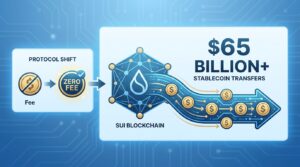
The Sui blockchain has recorded close to $65 billion in stablecoin transfer volume over just five days, a staggering throughput figure tied directly to a protocol upgrade that eliminated transaction fees for stablecoin movements. The milestone arrives as Mysten Labs, the core development studio behind Sui, positions the network as a credible alternative to legacy payment infrastructure. That kind of volume in such a compressed window puts Sui squarely in conversations previously reserved for Ethereum, Tron, and Solana.
What Sui’s $65 Billion Stablecoin Surge Signals for the Industry
Numbers this large demand context. The five-day throughput figure reflects transfer volume rather than unique economic activity, meaning some portion likely involves automated flows, liquidity rebalancing, and protocol-level recycling. Still, the sheer scale of what Sui’s infrastructure handled without congestion or degraded performance tells a story about where blockchain-based payments are heading.
- Zero-fee stablecoin transfers removed the single biggest friction point for high-frequency and micropayment use cases on Sui
- The $65 billion figure, while measuring throughput rather than net settlement, demonstrates that Sui’s object-centric architecture can absorb massive transaction loads
- Mysten Labs is explicitly framing this capability as a payments play, targeting traditional finance corridors where speed and cost remain pain points
- Competing Layer 1 networks that still charge per-transaction fees for stablecoin movement now face a direct competitive challenge
- Whether this volume sustains or proves to be a burst driven by novelty and bot activity will determine how seriously institutional players engage
How the Zero-Fee Mechanism Actually Works
Sui’s approach to eliminating stablecoin fees is not a blanket subsidy. The protocol change targets specific token transfers, allowing sponsored transactions where gas costs are absorbed at the network level rather than passed to end users. In practice, this means a merchant receiving USDC on Sui, or a remittance sender moving funds cross-border, pays nothing for the transfer itself.
That design choice carries trade-offs. Validators still need economic incentives, and a network that processes billions in value without generating proportional fee revenue raises sustainability questions (a tension Mysten Labs has not fully addressed in public documentation). But the short-term effect is unmistakable: volume flooded in.
The Sui network’s object-centric data model handles parallel transaction execution natively, which is partly why the infrastructure held up under this kind of load. Unlike account-based chains where state contention creates bottlenecks, Sui treats each asset as an independent object that can be processed concurrently.
Where This Fits in the Broader Stablecoin Landscape
Stablecoin transfer volume across all chains has been climbing steadily through 2025. Tron continues to dominate raw USDT throughput. Ethereum remains the settlement layer of choice for institutional-grade transactions. Solana has carved out a niche in consumer-facing payments.
Sui’s entry into this hierarchy is recent but aggressive. Consider the competitive dynamics:
| Network | Primary Stablecoin Use Case | Fee Structure | Transaction Finality |
|---|---|---|---|
| Tron | USDT retail transfers, especially in emerging markets | Low (variable) | ~3 seconds |
| Ethereum | Institutional settlement, DeFi collateral | Gas-dependent, often $1–$15+ | ~12 seconds (with finality gadget) |
| Solana | Consumer payments, point-of-sale integrations | Fractions of a cent | ~400ms |
| Sui | Zero-fee transfers, high-throughput payment rails | Zero for sponsored stablecoin transfers | Sub-second |
The zero-fee column is what separates Sui here. Even Solana’s near-zero costs are not literally zero, and at scale, fractions of a cent compound into meaningful overhead for payment processors handling millions of daily transactions.
The Sustainability Question Nobody Can Dodge
Free is compelling. Free is also, historically, temporary.
Every network that has subsidized transaction costs eventually faces a reckoning when usage patterns mature and validator economics demand recalibration. Mysten Labs has suggested that the broader ecosystem activity generated by zero-fee stablecoins (DeFi interactions, NFT minting, gaming transactions) will produce sufficient fee revenue from adjacent use cases to sustain the network. Whether that cross-subsidization model holds under stress remains, arguably, the most important open question in Sui’s roadmap. If stablecoin users arrive but never touch fee-generating applications, the math breaks down.
Reframing Value: What This Means for Payment Infrastructure Thinking
Beyond the raw numbers, Sui’s move reflects a broader cognitive shift in how blockchain networks define their value proposition. Traditional payment networks like Visa and SWIFT derive revenue from per-transaction fees and interchange. Blockchain protocols have largely mimicked that model, treating gas fees as both a spam-prevention mechanism and an economic engine.
Sui is testing a different frame entirely. By treating stablecoin transfers as a loss leader, the network bets that the real value lies in ecosystem density: the applications, liquidity pools, and developer activity that accumulate around a high-throughput, zero-friction base layer. This is, in essence, a platform economics play borrowed from the playbook of consumer tech companies that offered free core services to monetize adjacent engagement. And while that analogy is imperfect when applied to decentralized infrastructure, the strategic logic tracks.
For enterprises evaluating blockchain payment rails, the implication is practical. A zero-fee transfer layer changes the unit economics of cross-border remittances, payroll disbursement, and B2B settlement in ways that even low-fee alternatives cannot fully replicate. The question shifts from “how much does each transaction cost?” to “what does the total cost of integration and operation look like over 12 months?” That reframing alone could accelerate enterprise pilots on Sui through the second half of 2025.
Frequently Asked Questions
How did Sui achieve $65 billion in stablecoin volume so quickly?
The protocol eliminated fees for stablecoin transfers through a sponsored transaction model, which removed the primary cost barrier and attracted massive throughput within days of implementation.
Does the $65 billion figure represent unique economic activity?
Not entirely. The number measures gross transfer throughput, which includes automated flows, arbitrage, and liquidity movements alongside genuine person-to-person or commercial transfers. Distinguishing organic volume from programmatic activity at this stage is difficult.
Is zero-fee stablecoin transfer sustainable long-term?
Mysten Labs argues that fee revenue from other on-chain activities will offset the cost of subsidizing stablecoin transfers. That model has not yet been tested through a full market cycle, and validator incentive alignment remains an area to watch closely.
Which stablecoins are supported on Sui?
USDC has been the primary stablecoin driving volume on Sui, though the network’s architecture supports any token standard built on its Move-based framework.



