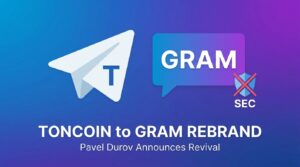
Telegram founder Pavel Durov revealed on Monday that The Open Network’s native cryptocurrency will shed its Toncoin identity and adopt the name Gram, a designation that carries significant historical baggage. The transition, announced via Durov’s personal Telegram channel, is expected to unfold over the next three weeks. The move resurrects a name first introduced in Telegram’s 2018 whitepaper, one that the U.S. Securities and Exchange Commission effectively killed when it halted the original token sale in 2020. Whether this rebrand signals confidence or provocation depends on who you ask.
What the Gram Rebrand Signals for TON’s Strategic Direction
Before unpacking the implications, here are the core takeaways from Durov’s announcement and the broader context surrounding this decision:
- Name revival with regulatory history: Gram was the original token name from Telegram’s $1.7 billion ICO in 2018, which the SEC halted, arguing the tokens constituted unregistered securities. Telegram ultimately returned $1.2 billion to investors and paid an $18.5 million penalty.
- The rebranding from Toncoin to Gram suggests Durov and the TON ecosystem believe the regulatory landscape has shifted enough to reclaim the name without triggering fresh enforcement action
- Timeline is aggressive: A three-week window for a full cryptocurrency rebrand across exchanges, wallets, and integrations is unusually tight, raising questions about coordination with major platforms like Binance and OKX
- Brand equity play: Gram carries more name recognition among early crypto adopters and Telegram’s massive user base than Toncoin, which was adopted as a workaround after the SEC action
- Market positioning: The move aligns with Telegram’s broader push to embed financial services directly into its messaging platform, which now claims over 950 million monthly active users
A Name That Regulators Once Refused to Let Exist
The original Gram token was central to one of the most high-profile SEC enforcement actions in crypto history. In October 2019, the SEC obtained a temporary restraining order preventing Telegram from distributing Gram tokens to investors who had participated in the company’s two private funding rounds. The regulator argued that Grams were securities under the Howey test, and a federal judge agreed in March 2020.
Telegram walked away from the project entirely. The company settled, and the open-source community eventually picked up the codebase, rebranding it as The Open Network with Toncoin as its native asset (a distinction regulators have been slow to formally acknowledge). That separation between Telegram-the-company and TON-the-network has been a legal and narrative firewall ever since.
Now Durov is pulling that old name back into the light. And doing so publicly, on his own channel, with his own voice.
Why Timing Matters More Than the Name Itself
This isn’t just a cosmetic change. The decision arrives during a period of notable regulatory recalibration in the United States. The SEC under its current leadership has signalled a less adversarial posture toward certain digital assets, withdrawing or settling several high-profile cases. Whether that softer stance extends to a token name the agency once went to court to block remains an open question.
Durov’s announcement also comes as The Open Network’s ecosystem has been expanding rapidly, with DeFi protocols, NFT marketplaces, and mini-apps proliferating inside Telegram. TON’s total value locked crossed $300 million earlier this year, and the network has attracted developers building payment rails that could theoretically serve Telegram’s near-billion-user base. Rebranding the token to Gram arguably sharpens the identity at a moment when the ecosystem needs mainstream legibility more than technical credibility.
Still, three weeks is not a lot of runway. Exchange listings, wallet interfaces, smart contract references, block explorer labels, CoinGecko and CoinMarketCap taxonomies: all of these need updating. The logistics alone could create temporary confusion for traders and developers.
What Exchanges and Infrastructure Providers Face
| Area | Impact | Expected Timeline |
|---|---|---|
| Centralized exchanges (Binance, OKX, Bybit) | Ticker symbol change, trading pair updates, UI relabeling | Days to weeks, depending on internal processes |
| Decentralized protocols on TON | Smart contract references, front-end updates | Variable; some may lag behind |
| Wallet providers | Display name and metadata changes across mobile and desktop clients | Likely coordinated with TON Foundation |
| Data aggregators | CoinGecko, CoinMarketCap, DefiLlama taxonomy updates | Typically reactive, not proactive |
The Psychology Behind Reclaiming a Blocked Name
From a neuro-linguistic programming perspective, the choice to revive “Gram” rather than introduce an entirely new name is a deliberate act of reframing. NLP practitioners would recognize this as an anchoring technique: Gram already occupies mental real estate among early Telegram users and crypto-native audiences who followed the 2018 ICO saga closely. By reactivating that anchor, Durov taps into pre-existing associations of ambition, scale, and defiance.
There is also a pattern interrupt at work here. The crypto community had settled into the Toncoin identity. Disrupting that settled expectation forces attention, re-engagement, and reappraisal. In communication strategy terms, this is not a rebrand so much as a reclamation narrative: the implication being that what was once taken away is now being restored, and that the ecosystem has earned the right to use its original name.
Consider the framing effect as well. “Toncoin” sounds technical, derivative, a placeholder. “Gram” sounds intentional. It carries weight, brevity, and a unit-of-measure quality that subtly positions the token as a medium of exchange rather than a speculative asset. That distinction matters when your distribution channel is a messaging app used by nearly a billion people, many of whom have never interacted with a blockchain.
The subtext is confidence. Naming a token after the very thing a regulator once blocked communicates that the project’s leadership believes the threat has passed, or at least diminished enough to be worth the signal. Whether that confidence is warranted will depend on how U.S. regulators respond in the coming months.
Frequently Asked Questions
Is Gram a new cryptocurrency?
No. Gram is the new name for Toncoin, the existing native token of The Open Network. The underlying blockchain and token mechanics remain unchanged; only the branding is shifting.
Why was the name Gram abandoned in the first place?
The SEC sued Telegram in 2019 to prevent distribution of Gram tokens, arguing they were unregistered securities. Telegram settled in 2020, paid $18.5 million in penalties, and stepped away from the project. The community later relaunched it as Toncoin.
Will this affect my existing Toncoin holdings?
Holders should not need to take any action. The rebrand is a naming change, not a token migration or chain fork. Exchanges and wallets are expected to update their interfaces over the announced three-week period.
Could the SEC take action again over the Gram name?
That remains unclear. The current SEC leadership has adopted a less aggressive enforcement posture toward crypto, but no public statement has addressed the Gram name specifically. The legal settlement in 2020 concerned the token distribution, not the name itself, though the two were closely linked in the original case.



