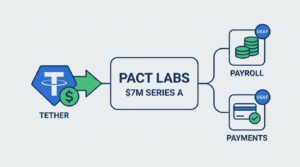
Tether, the world’s largest stablecoin issuer, announced Tuesday that it led a $7 million Series A funding round in Pact Labs, a financial infrastructure startup building rails for payroll and payments. The investment, disclosed via Tether’s official X account at 1:09 p.m. UTC, is designed to accelerate adoption of USA₮, the company’s newer dollar-pegged stablecoin. It marks another deliberate step by Tether to extend its reach beyond trading desks and into the everyday financial plumbing that businesses and workers rely on.
What Tether’s Pact Labs Bet Signals for Stablecoin Strategy
Before diving into the specifics, it helps to frame what this deal actually represents. Tether isn’t simply writing a check. It’s placing a strategic wager that stablecoins can displace legacy payment infrastructure in verticals like payroll, where speed, cost, and cross-border friction remain persistent pain points. Here are the key takeaways:
- Direct infrastructure play: By funding Pact Labs, Tether gains a distribution channel purpose-built for embedding USA₮ into recurring financial workflows, not just one-off transactions.
- USA₮ differentiation: The investment signals Tether’s intent to carve out a distinct identity for USA₮ separate from its flagship USDT, potentially targeting compliance-sensitive use cases in the United States.
- Payroll as a beachhead: Payroll is a high-frequency, high-trust financial function. Gaining traction here could normalize stablecoin usage among employers and employees who have never interacted with digital assets.
- Competitive positioning: With Circle’s USDC already embedded in several fintech platforms, Tether’s move into payments infrastructure suggests a race to lock in enterprise-grade partnerships before regulatory frameworks fully crystallize.
Why Payroll Is the Battleground
Payroll might seem mundane compared to DeFi yields or tokenized treasuries. But that’s precisely the point. The global payroll market processes trillions of dollars annually, and cross-border payroll alone remains riddled with intermediary fees, multi-day settlement windows, and currency conversion friction. For migrant workers sending wages home, or for companies managing distributed teams across jurisdictions, the inefficiencies are not abstract. They’re expensive.
Pact Labs appears to be building the connective tissue between stablecoin liquidity and employer payment systems. What remains less clear is how deep that integration goes (whether Pact Labs handles only the last-mile disbursement or manages the full payroll cycle from calculation to compliance to settlement).
Still, the logic holds. Stablecoins settle in minutes, not days. They don’t require correspondent banking chains. And for workers in countries with volatile local currencies, receiving wages in a dollar-pegged token can function as a de facto savings mechanism.
How This Fits Tether’s Broader Playbook
Tether has been on an investment spree. The company has poured capital into Bitcoin mining, AI infrastructure, and communications platforms over the past 18 months. Each investment shares a common thread: extending Tether’s relevance beyond the crypto-native ecosystem and into sectors where stablecoin utility can be demonstrated to mainstream audiences.
The Pact Labs deal fits that pattern but sharpens the focus. Payroll and payments are arguably the most tangible, most defensible use case for stablecoins in the real economy. If Tether’s stablecoin infrastructure can handle a worker’s biweekly paycheck reliably, the argument for broader adoption becomes far harder to dismiss.
USA₮ vs. USDT: A Quiet Divergence
One detail worth watching closely is the specific emphasis on USA₮ rather than USDT. Tether launched USA₮ as a separate product, and while public details about its reserve structure and regulatory positioning remain sparse, the naming convention alone suggests a token designed with U.S. market sensitivities in mind.
That distinction matters. USDT dominates global stablecoin volume but has faced persistent scrutiny from U.S. regulators over reserve transparency and compliance. By channeling Pact Labs’ payroll infrastructure toward USA₮, Tether may be constructing a cleaner narrative for domestic regulators (a distinction regulators have been slow to enforce but could eventually demand).
Whether USA₮ ultimately operates under a different compliance framework than USDT, or whether it’s primarily a branding exercise, is a question the market hasn’t fully answered yet.
The Competitive Landscape in Stablecoin Payments
| Issuer | Primary Stablecoin | Payments Strategy | Key Partnerships |
|---|---|---|---|
| Tether | USDT / USA₮ | Payroll and cross-border payments via Pact Labs | Pact Labs (Series A lead) |
| Circle | USDC | Embedded fintech integrations, programmable wallets | Visa, Coinbase, Stripe |
| PayPal | PYUSD | Consumer payments within PayPal/Venmo ecosystem | Internal distribution |
| Ripple | RLUSD | Institutional cross-border settlement | Banking partners globally |
Circle’s head start with enterprise partners like Visa and Stripe gives USDC a structural advantage in merchant-facing payments. But Tether’s sheer volume dominance and willingness to fund infrastructure startups directly could offset that gap over time, particularly in emerging markets where USDT already circulates as a quasi-dollar substitute.
What Employers and Workers Should Understand About Stablecoin Payroll
For businesses considering stablecoin-based payroll, the appeal is straightforward: faster settlement, lower fees, and simplified cross-border disbursement. But the operational reality involves layers of complexity that a single $7 million investment won’t resolve overnight.
Tax reporting obligations don’t disappear because wages arrive in a stablecoin. Employers still need to calculate withholdings, comply with local labor laws, and ensure that employees can convert tokens to local currency without excessive friction. And regulatory clarity around wage payments in digital assets varies dramatically by jurisdiction.
Even so, the direction of travel is unmistakable. Stablecoins are migrating from speculative infrastructure to functional financial tools. The question is no longer whether they’ll be used for payroll. The question is which issuer’s token becomes the default.
Frequently Asked Questions
What is Pact Labs?
Pact Labs is a financial infrastructure startup focused on enabling stablecoin-based payroll and payment solutions. Tether led its $7 million Series A round.
How does USA₮ differ from USDT?
USA₮ is a separate dollar-pegged stablecoin issued by Tether, seemingly positioned for the U.S. market. Full details on its reserve structure and regulatory treatment have not been publicly disclosed, though the product appears designed to address compliance expectations that USDT has historically faced criticism over.
Can employees actually receive wages in stablecoins?
In some jurisdictions, yes. However, legality depends on local labor and tax regulations. Employers must still handle withholdings, reporting, and ensure workers have practical off-ramp options to convert stablecoins into fiat currency.
Why is Tether investing in payroll infrastructure?
Payroll represents a high-frequency, high-trust use case that could normalize stablecoin adoption among mainstream users. For Tether, it’s a way to expand USA₮ distribution beyond crypto-native channels and into real-economy financial flows.



