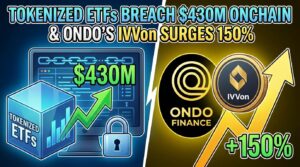
Tokenized exchange-traded funds have crossed a combined onchain market capitalization of $430 million, a milestone that underscores the accelerating convergence of traditional asset management and blockchain infrastructure. Ondo Finance’s IVVon token, which tracks BlackRock’s iShares Core S&P 500 ETF (IVV), has been the standout performer, climbing 150% over the past month on Ethereum. The figure marks a sharp inflection point for a product category that barely existed eighteen months ago. And while the absolute numbers remain modest relative to the $10 trillion global ETF market, the trajectory is drawing attention from institutional allocators and protocol developers alike.
What the $430 Million Milestone Signals for Institutional DeFi
Before parsing the individual tokens and protocols driving this growth, the broader pattern deserves framing. Tokenized ETFs sit at the intersection of two powerful forces: the regulatory normalization of crypto-native financial products and the institutional appetite for onchain yield and settlement efficiency. The following takeaways capture the strategic weight of this moment:
- Ondo Finance’s IVVon token alone accounts for a significant share of the total market cap, suggesting that demand is concentrating around familiar, blue-chip index exposure rather than exotic or niche strategies.
- A 150% monthly surge in IVVon reflects more than speculative interest; it points to growing confidence in the tokenization wrapper itself, including custody, redemption mechanics, and regulatory positioning.
- Ethereum remains the dominant settlement layer for tokenized ETFs, reinforcing its role as the default institutional blockchain despite competition from Solana, Avalanche, and purpose-built chains.
- The $430 million figure, while small in ETF terms, represents a proof of concept that could unlock trillions in assets if regulatory clarity continues to improve
- Traditional asset managers watching this space now face a strategic question: build, partner, or wait.
Ondo Finance and the Mechanics Behind IVVon’s Rally
Ondo Finance has positioned itself as a bridge between TradFi asset management and decentralized finance. The protocol offers tokenized versions of real-world financial products, and Ondo’s tokenized fund products have attracted substantial capital by targeting investors who want onchain exposure to conventional indices without leaving the blockchain ecosystem.
IVVon tracks BlackRock’s IVV, one of the most liquid and widely held ETFs globally with over $500 billion in assets under management. The tokenized version allows holders to gain synthetic or backed exposure to S&P 500 returns while settling transactions on Ethereum. That 150% monthly gain isn’t driven by a change in the underlying index (the S&P 500 hasn’t doubled). Instead, it reflects a rapid expansion in the token’s market cap as new capital flows into the product.
This distinction matters. The rally is a demand-side phenomenon, not a price-appreciation story in the traditional sense.
How Tokenized ETFs Differ from Traditional ETF Wrappers
| Feature | Traditional ETF | Tokenized ETF |
|---|---|---|
| Settlement | T+1 (moving from T+2) | Near-instant on Ethereum |
| Trading Hours | Market hours only | 24/7 onchain |
| Custody | Broker-dealer / custodian bank | Smart contract + institutional custodian |
| Minimum Investment | One share (varies) | Fractional, often no minimum |
| Composability | Limited to brokerage ecosystem | Integrates with DeFi lending, staking, and liquidity protocols |
| Regulatory Framework | SEC-registered, well-established | Evolving; varies by jurisdiction and token structure |
The composability row is arguably the most consequential. Once an ETF exists as a token, it can serve as collateral in lending protocols, be paired in automated market makers, or plugged into structured products that don’t exist in traditional finance. That optionality is what draws DeFi-native capital into these instruments.
Why This Growth Is Happening Now
Several converging forces explain the timing. The SEC’s gradual shift toward approving spot crypto ETFs in 2024 created a psychological permission structure for institutions to engage more seriously with onchain financial products. BlackRock’s own entry into tokenization through its BUIDL fund (a tokenized money market product on Ethereum) signaled that the world’s largest asset manager sees blockchain rails as operationally viable, not just experimental.
Simultaneously, yields in DeFi have compressed. Protocols that once offered double-digit APYs on stablecoins now compete for basis points. Tokenized ETFs offer something different: real-world equity exposure with the operational advantages of blockchain settlement. For a DeFi treasury or DAO looking to diversify beyond stablecoins and governance tokens, a tokenized S&P 500 tracker is a compelling addition.
Still, regulatory ambiguity hasn’t vanished. The legal status of tokenized securities varies sharply across jurisdictions, and the SEC has not issued specific guidance on tokenized ETF wrappers (a distinction regulators have been slow to enforce). Whether these products qualify as securities, derivatives, or something else entirely remains an open question in most markets.
Reframing Risk: What Investors and Builders Should Watch
The enthusiasm around tokenized ETFs carries real risks that the headline numbers can obscure. Smart contract vulnerabilities, oracle failures, and redemption bottlenecks during market stress are not theoretical concerns. They are engineering challenges that have not yet been tested at scale under adverse conditions.
Liquidity is another variable. A $430 million market cap spread across multiple tokens means individual products may have thin secondary markets. During a sharp equity selloff, the ability to exit a tokenized ETF position at fair value depends on infrastructure that hasn’t faced that kind of pressure.
Yet the direction of travel seems clear. Every major custodian, several top-ten asset managers, and a growing number of blockchain protocols are building toward a future where traditional financial instruments live natively onchain. Whether that future arrives in two years or ten depends less on technology than on regulatory frameworks that are still being written.
Frequently Asked Questions
What is a tokenized ETF?
A tokenized ETF is a blockchain-based representation of a traditional exchange-traded fund. It allows investors to hold, trade, and use ETF exposure within decentralized finance ecosystems, typically on Ethereum or other smart contract platforms.
How did Ondo Finance’s IVVon gain 150% in a month?
The gain reflects a surge in capital inflows into the token rather than a 150% rise in the S&P 500 itself. As more investors minted or purchased IVVon tokens, the onchain market capitalization expanded rapidly. Think of it as adoption growth, not index appreciation.
Are tokenized ETFs regulated?
Regulation varies by jurisdiction and product structure. In the United States, the SEC has not issued specific rules governing tokenized ETF wrappers. Some products operate under existing securities exemptions, while others exist in a grey area that regulators are still evaluating.
Why does Ethereum dominate tokenized ETF issuance?
Ethereum offers the deepest institutional liquidity, the most mature smart contract tooling, and the broadest DeFi composability. For issuers targeting institutional capital, these network effects outweigh the lower transaction costs available on alternative chains.