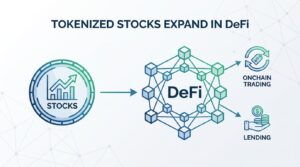
Tokenized equities are carving out a measurable, if still modest, footprint across decentralized finance protocols. Data published on July 16 by Token Terminal, an onchain analytics provider, shows that spot DEX trading volume for tokenized stocks has climbed alongside early adoption of these assets as lending collateral. Both use cases remain a fraction of broader DeFi activity, but the trajectory signals something worth watching for institutional players and protocol builders alike.
Why Tokenized Stocks in DeFi Matter Right Now
The convergence of traditional equities and decentralized infrastructure has been discussed for years, often in speculative terms. What’s different here is that real onchain data now backs the trend. Before diving into the specifics, these are the strategic takeaways that matter most for market participants:
- Spot DEX trading volume for tokenized stocks has grown enough to register on analytics dashboards, suggesting early but genuine market demand
- Tokenized equities are beginning to function as collateral in DeFi lending protocols, a use case that could unlock significant capital efficiency if it scales
- Both activities still represent a small share of total DeFi volume, meaning the infrastructure is being tested rather than stress-tested
- The data comes from Token Terminal’s public dashboard, giving institutional observers a verifiable benchmark rather than anecdotal claims
- Regulatory clarity (or the lack of it) around tokenized securities remains the single largest variable shaping how fast this segment can grow
What the Onchain Data Actually Shows
Token Terminal’s dashboard tracks trading activity across decentralized exchanges where tokenized versions of publicly listed stocks change hands. The volumes are real, settled onchain, and growing. Yet context matters here. Compared to the billions flowing through major DeFi protocols daily in crypto-native assets, tokenized stock trading is still a rounding error.
That doesn’t make it irrelevant.
Early-stage adoption curves in DeFi have historically looked exactly like this: small volumes, limited participants, and then a sharp inflection point once infrastructure matures or a catalyst arrives. Stablecoins followed this pattern. So did liquid staking tokens. Whether tokenized equities follow the same arc depends on several factors that remain unresolved, from regulatory frameworks to the willingness of traditional brokerages to acknowledge onchain settlement as legitimate.
Collateral Use: A Quiet but Significant Shift
Perhaps more consequential than trading volume is the emerging use of tokenized stocks as collateral in lending protocols. In traditional finance, equities serve as collateral across margin accounts, prime brokerage, and structured products. Bringing that same functionality onchain introduces composability (a distinction regulators have been slow to engage with) and programmable risk management that centralized systems struggle to replicate at the same speed.
Still, the risks are non-trivial. Tokenized stocks carry counterparty exposure to the issuer or custodian backing the token. If the entity holding the underlying shares fails or freezes redemptions, the collateral’s value becomes uncertain regardless of what the smart contract says. Lending protocols accepting these assets need robust oracle infrastructure and liquidation mechanisms calibrated for assets that behave differently from ETH or wrapped Bitcoin.
How Traditional Finance and DeFi Protocols Are Positioning
Several protocols and platforms have been building the rails for tokenized real-world assets, including equities. The broader RWA sector has attracted significant attention in 2024 and 2025, with tokenized treasuries and credit products leading adoption. Stocks, however, sit in a more complex regulatory zone because they are explicitly classified as securities in most jurisdictions.
Firms exploring this space must navigate securities law, custody requirements, and cross-border compliance simultaneously. Token Terminal’s onchain analytics platform provides one of the few transparent windows into how these assets actually perform in decentralized environments, which makes its data particularly valuable for compliance teams and risk managers trying to assess feasibility.
| Metric | Tokenized Stocks in DeFi | Broader DeFi Market |
|---|---|---|
| Spot DEX Volume | Growing but small share | Billions in daily volume across major pairs |
| Collateral Usage | Early-stage adoption in select protocols | Dominated by ETH, stablecoins, and LSTs |
| Regulatory Status | Classified as securities in most jurisdictions | Varies widely by asset type and geography |
| Infrastructure Maturity | Emerging; oracle and custody dependencies remain | Battle-tested across multiple market cycles |
The Structural Barriers That Could Slow Adoption
Scaling tokenized stock trading onchain requires solving problems that crypto-native assets never had to face. Issuance compliance, dividend distribution, corporate action handling, and KYC/AML requirements all add layers of complexity that pure DeFi protocols were not designed for. And while some projects have built permissioned pools or hybrid models to address these constraints, the solutions remain fragmented.
Liquidity is another bottleneck. Without deep order books or concentrated liquidity pools, tokenized stocks suffer from wide spreads and thin markets. Market makers who operate comfortably in crypto-native pairs have little incentive to provide liquidity for tokenized equities unless the regulatory picture clarifies and volume justifies the operational overhead.
Which raises a harder question: will institutional capital flow into these markets before or after regulators provide explicit guidance?
What This Means for the Next Phase of DeFi
The fact that tokenized stocks are being traded and used as collateral onchain, even in small volumes, establishes a proof of concept that was purely theoretical two years ago. For protocol developers, the signal is clear enough to justify continued investment in RWA infrastructure. For regulators, the data provides a concrete basis for engagement rather than hypothetical risk modeling.
But the gap between proof of concept and mainstream adoption is wide, and it is filled with legal, technical, and market structure challenges that no single protocol can solve alone. What Token Terminal’s data captures is a beginning, not an inflection point. At least not yet.
Frequently Asked Questions
What are tokenized stocks?
Tokenized stocks are blockchain-based representations of traditional equity shares. Each token is typically backed by the underlying stock held by a custodian, allowing the asset to be traded and used within decentralized finance protocols.
Can tokenized stocks be used as collateral in DeFi?
Yes, though adoption is early. Select lending protocols have begun accepting tokenized equities as collateral, but the practice carries additional risks related to custody, oracle accuracy, and the regulatory status of the underlying securities. It’s a space where caution still outweighs enthusiasm for most participants.
Why is trading volume for tokenized stocks still low?
Regulatory uncertainty, limited liquidity, and the complexity of securities compliance all constrain growth. Most DeFi trading volume remains concentrated in crypto-native assets like ETH, stablecoins, and governance tokens, which carry fewer legal and operational requirements.
Where can I track tokenized stock activity onchain?
Token Terminal offers a public dashboard that tracks DEX trading volumes and other metrics for tokenized equities across supported protocols, providing one of the more transparent data sources available.



