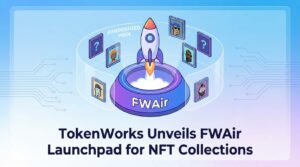
TokenWorks, the two-person team behind the Fake World Assets (FWA) protocol, has announced FWAir, a mechanism that will allow artists to launch entirely new NFT collections directly into FWA’s randomized trading pool. The move marks a significant expansion for the protocol, which until now has focused exclusively on trading existing NFTs. Co-founder Adam, who goes by Rhynotic on X, revealed the feature as a bridge between primary issuance and the protocol’s distinctive pooled discovery model. For a market still searching for sustainable NFT distribution channels, FWAir introduces a structure worth watching closely.
What FWAir Means for NFT Creators and Collectors
Before unpacking the strategic implications, here’s what matters most at a glance:
- Primary issuance meets randomized pools: Artists can now mint new collections that feed directly into FWA’s existing randomized trading mechanism, blurring the line between launch and secondary market activity.
- Lower friction for emerging creators: By plugging into an established pool rather than building standalone mint infrastructure, artists reduce the overhead typically associated with NFT drops.
- The protocol’s scope shifts from a trading venue to something closer to a full-lifecycle platform for NFT distribution and discovery.
- Two-person operation: TokenWorks remains a lean team, which raises questions about scalability but also signals capital efficiency in a sector that has burned through runway at alarming rates.
- Market timing: NFT trading volumes remain well below 2021–2022 peaks, making any new issuance mechanism a bet on future demand rather than current momentum.
How FWA’s Randomized Pool Actually Works
Fake World Assets operates on a concept that deliberately rejects the curated, gallery-style model most NFT marketplaces use. Instead of browsing specific collections or sniping individual listings, participants interact with a pooled system where assets are randomized. Think of it less like an auction house and more like a structured discovery engine.
FWAir extends this logic to the point of creation. Rather than artists minting a collection and then listing it on a marketplace, new works enter the pool at issuance. Collectors encounter them alongside existing assets, which in theory creates organic exposure without requiring the artist to drive external traffic or manage a whitelist campaign.
That shift matters because it addresses one of the most persistent pain points in NFT launches: the cold-start problem. Even talented artists struggle to generate attention for a mint when they lack an established community or marketing budget. By embedding new collections into an active trading environment, Fake World Assets’ randomized pool structure offers a distribution channel that doesn’t depend on the creator’s existing reach.
A Lean Team in a Bloated Sector
TokenWorks operates with just two people. In an industry where NFT platforms have historically raised eight-figure rounds and hired aggressively before proving product-market fit, this restraint is notable (a distinction that cuts both ways). The upside: minimal burn rate, faster iteration, and fewer stakeholders to satisfy. The risk: a protocol handling both trading and primary issuance with limited engineering bandwidth faces real bottlenecks if adoption accelerates.
Still, the NFT infrastructure space has seen enough cautionary tales of overfunded teams collapsing under their own weight. Whether TokenWorks can sustain this model depends less on headcount and more on how robust the smart contract architecture proves under stress.
Why Distribution Models Matter More Than Ever
NFT market volumes on major platforms have contracted sharply from their peaks. OpenSea, Blur, and other established venues have all seen declining activity through much of 2024 and into 2025. Against that backdrop, the question isn’t just whether new NFTs can be created, but whether anyone will encounter them.
FWAir’s randomized injection model sidesteps the discoverability crisis by design. It doesn’t guarantee demand, but it does guarantee exposure within the pool’s active user base. For artists, that’s arguably a more honest value proposition than the promise of a trending mint page that may never materialize.
Behavioral Dynamics: What Drives Participation in Randomized Systems
Randomized discovery taps into well-documented behavioral patterns. The uncertainty of what asset a participant might receive activates reward anticipation circuits in ways that curated browsing simply does not. This isn’t speculation; variable reward schedules have been studied extensively in behavioral psychology and are foundational to engagement design across gaming, retail, and digital platforms.
In the context of NFTs, this creates a loop where the act of participation itself carries intrinsic appeal beyond the specific asset received. Collectors aren’t just buying art; they’re engaging with a process that feels more like unwrapping than shopping. That distinction shapes retention. Users who find the mechanism itself rewarding return more frequently than those motivated solely by asset value, which tends to fluctuate with broader market sentiment.
For artists entering through FWAir, this behavioral layer provides a cushion. Even during periods of softer demand, the pool’s engagement mechanics can sustain a baseline level of interaction with new works. The randomized format also reduces the social comparison dynamics that plague traditional drops, where floor price becomes the dominant metric within hours of launch. Inside a pool, individual collection performance is less visible, which may actually benefit creators whose work needs time to find its audience.
What remains less clear is how TokenWorks plans to manage quality control as more artists gain access to FWAir. An open floodgate could dilute the pool’s appeal; too restrictive a curation process would undermine the permissionless ethos the protocol appears to embrace.
Frequently Asked Questions
What is FWAir?
FWAir is a new mechanism from TokenWorks that enables artists to launch NFT collections directly into Fake World Assets’ randomized trading pool, combining primary issuance with the protocol’s existing discovery system.
How does Fake World Assets differ from traditional NFT marketplaces?
Rather than letting users browse and select specific NFTs, FWA uses a randomized pool model. Participants interact with the pool and receive assets through a structured but unpredictable process, which changes how both trading and discovery function. It’s closer to a lottery-meets-marketplace hybrid than a conventional storefront.
Is TokenWorks a large operation?
No. The team consists of two people, which keeps operational costs low but raises legitimate questions about how the protocol would handle rapid scaling.
When will FWAir be available?
TokenWorks has announced the feature but specific launch dates have not been confirmed publicly. Artists and collectors should monitor the team’s communications on X for updates.



