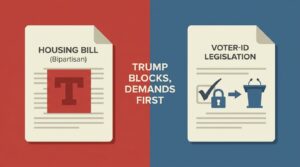
President Trump abruptly canceled a signing ceremony for the bipartisan 21st Century ROAD to Housing Act on Wednesday, refusing to put pen to paper until Congress passes separate voter-ID legislation. The bill had cleared both chambers with veto-proof majorities, a rare feat in today’s polarized legislative environment. Its provisions include a four-year ban on a controversial housing policy, making the sudden holdup all the more striking for lawmakers who had already gathered at the White House expecting a routine ceremony.
What the Housing Bill Standoff Signals for Policy and Markets
The decision to hold a popular, bipartisan bill hostage to an unrelated legislative demand reshapes the calculus for several stakeholders at once. Here’s what matters most:
- Legislative leverage redefined: By conditioning his signature on voter-ID legislation, Trump is testing whether veto-proof margins in Congress translate into actual political will to override a presidential refusal.
- Housing market uncertainty: The bill’s four-year ban on a specific housing policy had already been priced into industry expectations. Delay introduces fresh ambiguity for developers, lenders, and municipal planners.
- Bipartisan coalitions, even those with overwhelming support, now face a new procedural vulnerability when the White House ties unrelated demands to otherwise consensus legislation.
- Regulatory ripple effects: Federal agencies preparing to implement the bill’s provisions are left in limbo, potentially stalling rulemaking timelines that were already underway.
A Bill That Wasn’t Supposed to Be Controversial
The 21st Century ROAD to Housing Act is, by most accounts, a pragmatic piece of legislation. It earned support across party lines in both the House and Senate, passing with margins that would, at least on paper, be sufficient to override a veto. That kind of consensus is vanishingly rare. And yet the bill now sits unsigned, caught in a political transaction that has nothing to do with housing.
The core of the legislation addresses structural gaps in federal housing policy. Its centerpiece provision establishes a four-year moratorium on a housing-related policy that had drawn criticism from advocacy groups, industry associations, and local governments alike. Supporters argued the ban would provide stability for communities navigating affordability pressures and give regulators time to develop more durable frameworks.
Still, the substance of the bill matters less in this moment than the precedent being set. When a president withholds a signature on legislation that has already achieved bipartisan supermajorities, the question shifts from policy to power.
Why Voter-ID Became the Condition
Trump’s insistence on voter-ID legislation as a precondition is not new in theme but is novel in method. Voter-ID requirements have been a persistent priority for the administration and Republican leadership more broadly, though proposals have struggled to gain traction in the Senate. By linking the issue to an unrelated, popular bill, the White House appears to be manufacturing urgency where the legislative calendar had not provided it.
Whether this gambit works depends on how congressional leaders respond. Democrats, who supported the housing bill, have shown little appetite for the voter-ID measures Trump favors. Republicans face a different bind: back the president’s demand and risk delaying a bill their own members championed, or push for a clean signing and publicly break with the White House on strategy (a distinction that carries real political cost heading into the next election cycle).
How This Plays Out: Scenarios and Stakeholder Calculus
Three paths forward seem plausible. Congress could attempt a veto override, which would require holding together the same coalition that passed the bill. Alternatively, lawmakers could negotiate some version of voter-ID language into a separate vehicle to satisfy the White House demand without amending the housing bill itself. Or the standoff drags on, and the bill simply doesn’t become law in the near term.
| Scenario | Likelihood | Impact on Housing Policy |
|---|---|---|
| Veto override attempt | Moderate | Bill becomes law without White House support; political fallout likely |
| Separate voter-ID deal | Uncertain | Housing bill signed, but timeline unclear and dependent on unrelated negotiations |
| Prolonged stalemate | Possible | Regulatory uncertainty persists; planned implementations stall indefinitely |
Each scenario carries distinct consequences for the housing sector. Developers tracking federal policy signals through platforms like The Defiant’s coverage of policy and governance developments will find the coming weeks particularly consequential.
The Broader Pattern: Legislation as Bargaining Chip
What makes this episode worth watching beyond its immediate policy implications is the template it creates. Presidents have historically used signing ceremonies as political theater, but withholding a signature on a bill that already has supermajority support is a different kind of move. It reframes the signing power not as a constitutional formality but as active leverage in unrelated negotiations.
Arguably, this approach could become more common if it proves effective. Future bipartisan bills, no matter how broadly supported, may face similar conditional demands. That possibility alone changes how congressional leaders will approach coalition-building and timing on major legislation.
Frequently Asked Questions
What is the 21st Century ROAD to Housing Act?
It is a bipartisan housing bill that passed both the House and Senate with veto-proof margins. Its key provision includes a four-year ban on a specific federal housing policy that had drawn widespread criticism from multiple stakeholder groups.
Can Congress override Trump’s refusal to sign?
Yes, in theory. The bill passed with margins sufficient for a veto override, which requires two-thirds support in both chambers. But holding that coalition together for an override vote carries political risks that a routine passage does not, and some members may be reluctant to publicly challenge the White House.
Why is voter-ID legislation connected to a housing bill?
There is no policy connection. The linkage is purely strategic. The administration is using the housing bill’s popularity as leverage to pressure Congress on voter-ID measures that have stalled through conventional legislative channels.
What happens to housing policy while the bill remains unsigned?
Federal agencies that had begun preparing for implementation are effectively paused. The longer the delay, the more uncertainty filters into local planning decisions, lending practices, and development timelines.



