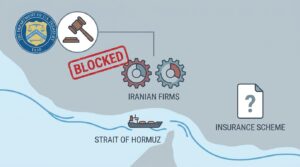
The U.S. Treasury’s Office of Foreign Assets Control (OFAC) moved on Wednesday to sanction two Iranian entities accused of running a coercive maritime insurance operation in one of the world’s most critical shipping chokepoints. HormuzSafe Marine Services Authority and the Persian Gulf Marine Insurance Company were designated for allegedly compelling commercial vessels to purchase mandatory “insurance” as a condition of transiting the Strait of Hormuz. The action targets what Washington describes as a revenue-extraction mechanism operating under the guise of maritime safety, raising fresh questions about enforcement in congested international waterways.
What the Strait of Hormuz Sanctions Signal for Global Shipping
Before diving into specifics, it’s worth framing why this matters beyond the headline. The Strait of Hormuz handles roughly 20% of the world’s daily oil supply and remains the single most strategically sensitive maritime corridor on the planet. Any disruption to transit norms there reverberates across energy markets, insurance pricing, and geopolitical risk calculations simultaneously.
- OFAC’s designation freezes any U.S.-based assets held by HormuzSafe Marine Services Authority and the Persian Gulf Marine Insurance Company, while prohibiting American persons from transacting with either entity
- The sanctions frame the mandatory insurance scheme as a form of economic coercion rather than a legitimate maritime service, a distinction that could influence how allied nations treat similar arrangements
- Commercial shipping operators transiting the strait now face heightened compliance obligations, particularly those with exposure to U.S. financial systems
- Energy and commodity traders should anticipate potential short-term volatility in freight and insurance rates for Persian Gulf routes
- The move fits a broader pattern of Treasury actions targeting Iranian revenue streams that operate in regulatory grey zones
How the Alleged Scheme Worked
According to OFAC’s designation, HormuzSafe Marine Services Authority positioned itself as a quasi-governmental body offering transit “protection” to vessels passing through the strait. But the service was not optional. Commercial ships were reportedly required to purchase coverage from the Persian Gulf Marine Insurance Company before being permitted safe passage, effectively creating a toll system dressed up as an insurance product.
That’s a meaningful distinction. Legitimate marine insurance operates through competitive markets where shipowners select coverage based on risk profiles and underwriting terms. What Treasury describes here is closer to a compulsory levy imposed by an entity with no recognized international regulatory standing (a distinction regulators have been slow to enforce in other contested waterways as well).
The revenues generated through this mechanism allegedly flowed back into Iranian state-linked networks, though the precise financial scale of the operation has not been publicly disclosed by Treasury.
Compliance Ripple Effects Across Maritime Insurance
For shipowners, P&I clubs, and marine insurers, the sanctions introduce a new layer of due diligence. Any entity that has previously transacted with HormuzSafe or the Persian Gulf Marine Insurance Company must now assess whether those transactions create secondary sanctions exposure under U.S. law.
This is not a theoretical concern. The U.S. Department of the Treasury has consistently demonstrated willingness to pursue enforcement actions against non-U.S. parties who facilitate sanctioned transactions, even indirectly. Shipping companies registered in Europe, Asia, and the Gulf states will need to scrub their counterparty records and update sanctions screening protocols accordingly.
| Entity | Designation Basis | Immediate Impact |
|---|---|---|
| HormuzSafe Marine Services Authority | Operating coercive transit insurance scheme in Strait of Hormuz | Asset freeze; U.S. persons prohibited from dealings | Persian Gulf Marine Insurance Company | Providing mandatory insurance product linked to HormuzSafe operations | Asset freeze; counterparties face secondary sanctions risk |
Still, what remains less clear is how enforcement will function in practice for vessels flagged under non-Western registries. Many ships transiting the strait operate under flags of convenience with limited regulatory overlap with OFAC’s jurisdictional reach.
Geopolitical Context: Why This Action Arrived Now
Washington’s decision did not emerge in a vacuum. Tensions in the Persian Gulf have escalated intermittently over the past eighteen months, with Iranian naval forces conducting seizures and harassment of commercial vessels. The sanctions arguably serve a dual purpose: disrupting a specific revenue channel while sending a broader signal about U.S. willingness to target Iranian maritime infrastructure short of military action.
And while the immediate financial impact on Iran may be modest relative to oil sanctions, the reputational effect on entities doing business with these firms could prove more consequential. International banks and insurers tend to over-comply with OFAC designations, cutting ties preemptively rather than risk enforcement exposure.
One question lingers beneath the surface: whether allied maritime nations, particularly those in Europe and the Gulf Cooperation Council, will mirror these designations or chart their own course.
What Shipping Operators Should Do Next
The operational guidance here is straightforward but urgent. Companies with vessels transiting the Strait of Hormuz should take several immediate steps to mitigate sanctions risk and ensure compliance continuity.
- Screen all existing and recent counterparties against the updated OFAC Specially Designated Nationals (SDN) list
- Review any payments made to entities operating under similar names or affiliated structures in Iranian-controlled ports
- Consult with sanctions counsel on whether prior transactions trigger reporting obligations
- Brief vessel masters and fleet managers on updated transit protocols, including refusal of any compulsory insurance demands from unrecognized entities
- Monitor for additional designations, as OFAC frequently follows initial actions with expanded targeting of affiliated networks
Frequently Asked Questions
What is HormuzSafe Marine Services Authority?
HormuzSafe is an Iranian entity that, according to OFAC, operated a mandatory transit insurance scheme in the Strait of Hormuz, requiring commercial vessels to purchase coverage before being allowed safe passage through the waterway.
Does this affect all ships passing through the Strait of Hormuz?
Not directly. The sanctions prohibit U.S. persons and entities from transacting with the designated firms. However, non-U.S. companies with exposure to the American financial system face secondary sanctions risk, which in practice broadens the impact considerably.
Could freight rates increase as a result?
Possibly. Sanctions on maritime entities in the Persian Gulf tend to push war risk and transit insurance premiums higher, at least temporarily. The magnitude depends on whether additional designations follow and how quickly the market recalibrates.
Are other countries expected to impose similar sanctions?
No coordinated allied action has been announced. European and Gulf state regulators may choose to align with OFAC’s designations, but that decision will likely hinge on diplomatic considerations that extend well beyond this specific case.



