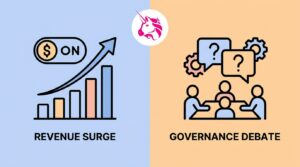
Uniswap activated its long-anticipated fee switch on the protocol’s newest liquidity pools this week, and the early financial results have been striking. Protocol revenue has nearly tripled since the July 27 activation, with approximately $325,000 directed toward UNI token burns in the initial days. But the windfall has not arrived without friction: a public dispute has erupted over who ultimately bears the cost of these new fees, pitting liquidity providers against token holders in a governance standoff that could shape decentralized finance fee models for years.
What the Fee Switch Activation Means for UNI Holders and LPs
Before diving into the numbers, it helps to understand why this moment matters. The fee switch has been one of the most debated governance proposals in DeFi history, with years of discussion preceding any on-chain action. Its activation represents a philosophical shift: Uniswap, the largest decentralized exchange by volume, is now extracting protocol-level revenue from trading activity and channeling it toward UNI token holders through a burn mechanism.
- Protocol revenue has approximately tripled since the fee switch went live on July 27, signaling immediate financial impact
- Around $325,000 has already flowed toward UNI burns, creating direct value accrual for token holders
- Liquidity providers face potential margin compression, as the protocol-level fee sits on top of existing LP fee tiers
- The governance debate is intensifying over whether LPs or traders are the ones effectively subsidizing UNI holder returns
- This activation covers Uniswap’s newest pools specifically, leaving open the question of broader rollout across legacy liquidity venues
Revenue Mechanics: Where the Money Flows
The fee switch works by layering a protocol-level charge on top of the swap fees that liquidity providers already collect. In practice, this means a portion of every trade executed through affected pools generates revenue that bypasses LPs entirely. That revenue is then used to buy and burn UNI tokens, reducing circulating supply.
A near-tripling of protocol revenue in under a week is notable by any measure. Yet what remains less clear is whether this pace is sustainable or whether it reflects a temporary surge driven by curiosity-fueled trading volume on newly activated pools. Early DeFi fee experiments have a pattern of front-loaded enthusiasm followed by normalization.
The $325,000 figure, while modest compared to Uniswap’s total trading volume, establishes a proof of concept. If extrapolated across the protocol’s full pool infrastructure, annualized revenue could reach meaningful scale (a distinction that has not escaped governance participants on both sides of the debate).
The LP Pushback Is More Than Noise
Not everyone sees this as a clean win.
Liquidity providers have raised pointed objections, arguing that the fee switch effectively taxes their capital without offering compensation. In a competitive AMM landscape where protocols like Curve, Balancer, and newer entrants on platforms such as Uniswap’s own v4 architecture are vying for LP deposits, any margin erosion carries real migration risk. LPs can move capital. And they have done so before when economics shifted unfavorably.
The counterargument from UNI holders is straightforward: the fee is paid by traders through slightly wider effective spreads, not extracted from LP earnings. Which side is correct depends on market elasticity. If traders are price-insensitive enough to absorb the additional cost without reducing volume, LPs feel minimal impact. If volume drops, LPs earn less in absolute terms even if their per-trade share remains unchanged.
Elasticity Is the Variable Nobody Has Pinned Down
This is the core tension. Uniswap’s governance has not published rigorous elasticity analysis for its trading pairs, and the early data window is too narrow to draw durable conclusions. The protocol is, in effect, running a live experiment with real capital.
| Stakeholder | Position on Fee Switch | Primary Concern |
|---|---|---|
| UNI Token Holders | Strongly supportive | Revenue accrual and token value appreciation through burns |
| Liquidity Providers | Mixed to opposed | Margin compression and competitive positioning against rival DEXs |
| Traders | Largely unaware or indifferent so far | Effective execution cost on swaps may rise incrementally |
| Competing Protocols | Watching closely | Opportunity to attract displaced LPs if economics shift |
Governance Dynamics and the Broader DeFi Precedent
Arguably the most consequential aspect of this activation is not the revenue itself but the governance precedent it sets. For years, DeFi protocols have debated whether to turn on fee switches, with most opting to delay indefinitely. Uniswap’s move gives other protocols both a template and a dataset to reference. Aave, Compound, and MakerDAO have all faced similar internal discussions about protocol-level revenue extraction.
Still, Uniswap occupies a unique position. Its dominance in spot DEX volume gives it pricing power that smaller protocols simply lack. A fee switch on a protocol commanding 60% of decentralized exchange volume is a fundamentally different proposition than one on a protocol with 5% market share. The competitive moat matters here.
How Behavioral Framing Shapes the Debate
What makes this governance dispute particularly instructive is how each side frames the same economic event. UNI holders describe the fee switch as “value alignment” and “sustainable protocol economics.” LPs frame it as “rent extraction” and “misaligned incentives.” Both descriptions map onto the same cash flow, filtered through different reference points.
This framing effect, well-documented in behavioral economics and decision science, explains why the debate generates more heat than light. When stakeholders anchor on different baselines, they can look at identical data and reach opposing conclusions about fairness. The resolution will not come from rhetoric but from observable outcomes: does LP capital stay, does trading volume hold, and does the burned UNI translate into sustained token price support?
Governance participants would benefit from reframing the question entirely. Rather than asking “who pays,” the more productive inquiry is whether the total value created by the fee switch exceeds the friction it introduces. If protocol revenue funds development, security audits, and ecosystem growth that ultimately increases trading volume, even LPs could end up better off in absolute terms. That feedback loop, however, takes quarters to materialize, not days.
Frequently Asked Questions
What is Uniswap’s fee switch?
It is a protocol-level mechanism that directs a portion of trading fees toward UNI token holders, separate from the fees earned by liquidity providers. The current implementation channels this revenue into UNI token burns.
How much revenue has the fee switch generated so far?
Approximately $325,000 has flowed toward UNI burns since the July 27 activation, with protocol revenue nearly tripling compared to pre-activation levels.
Does the fee switch affect all Uniswap pools?
No. The activation currently applies to Uniswap’s newest pools. Whether it extends to legacy liquidity venues remains an open governance question that has not been formally decided.
Why are liquidity providers concerned?
LPs worry that the additional protocol fee compresses their margins or reduces trading volume, making their capital less productive compared to competing decentralized exchanges that do not impose similar charges.



