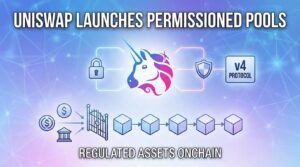
Uniswap has unveiled Permissioned Pools, a hook standard built for its v4 protocol that enables regulated assets to trade through automated market makers while enforcing compliance rules directly onchain. The announcement, made Thursday via a company blog post, marks a significant shift in how decentralized finance infrastructure might accommodate institutional and regulatory requirements. Rather than gating access at the frontend level, the new standard embeds permissioning logic into the pool itself. It’s a distinction that could reshape how tokenized real-world assets interact with DeFi liquidity.
What Permissioned Pools Mean for Institutional DeFi Adoption
Before diving into the strategic implications, it’s worth grounding what this development actually changes for market participants navigating the intersection of decentralized trading and regulatory compliance.
- Permissioned Pools enforce compliance at the smart contract layer, removing reliance on frontend-only restrictions that are easier to circumvent
- The standard is designed specifically for Uniswap v4’s modular hook architecture, allowing pool deployers to define who can provide liquidity or execute swaps
- Regulated asset issuers, including those working with tokenized securities and real-world assets, gain a native DeFi venue that satisfies onchain compliance checks
- This positions Uniswap to capture institutional flow that has historically stayed off decentralized exchanges due to compliance friction
- The move signals a broader industry trend: protocol-level compliance rather than application-level gatekeeping
How the Hook Standard Actually Works
Uniswap v4 introduced a hooks framework that allows developers to attach custom logic to pools at various lifecycle points, including before and after swaps, liquidity additions, and removals. Permissioned Pools leverage this architecture to enforce access control rules without modifying the core AMM logic.
In practice, a pool deployer can configure a hook that checks whether a wallet address meets specific criteria before allowing interaction. Those criteria might include KYC verification status, jurisdiction-based restrictions, or accredited investor checks. The enforcement happens at the protocol level, not at the interface level (a distinction regulators have been slow to formally acknowledge but one that carries meaningful legal weight).
This matters because frontend-based restrictions have long been criticized as performative compliance. Anyone with technical knowledge can bypass a website gate and interact directly with a smart contract. By moving the permissioning logic into the pool’s hook, Uniswap’s v4 permissioned pool infrastructure closes that gap.
Why Tokenized Real-World Assets Need This
The tokenized asset market has grown rapidly, with estimates from multiple industry reports placing the total value of tokenized real-world assets (RWAs) above $10 billion in 2024. Yet most of this activity has remained siloed on permissioned blockchains or centralized platforms, precisely because public DeFi protocols lacked native compliance tooling.
Issuers of tokenized treasuries, private credit instruments, and equity tokens face a hard constraint: they cannot allow unrestricted trading of regulated securities. Traditional DeFi pools, by design, are open to anyone. That openness, which is a feature for most crypto-native assets, becomes a liability when securities law applies.
Permissioned Pools offer a middle path. They preserve the capital efficiency and composability of Uniswap’s AMM while layering in the access controls that regulated issuers require. And while the initial use cases will likely center on tokenized treasuries and compliant stablecoins, the framework is flexible enough to support more complex instruments over time.
Competitive Landscape and Protocol-Level Compliance
Uniswap is not the only protocol exploring this space. Aave has experimented with permissioned lending markets through Aave Arc, and several newer protocols have launched with built-in compliance features targeting institutional users. But Uniswap’s move carries outsized weight because of its dominance in decentralized exchange volume.
| Protocol | Compliance Approach | Target Users | Status |
|---|---|---|---|
| Uniswap v4 | Onchain hooks (Permissioned Pools) | RWA issuers, institutions | Launched (hook standard live) |
| Aave Arc | Permissioned lending pools with KYC | Institutional lenders/borrowers | Limited traction since launch |
| Centrifuge | Native RWA tokenization with compliance | Credit markets, asset originators | Active, growing TVL |
| Ondo Finance | Tokenized treasuries with transfer restrictions | Yield-seeking institutions | Expanding product suite |
What separates Uniswap’s approach is composability. Because hooks are modular, third-party compliance providers can build standardized verification modules that any pool deployer can plug in. That creates a potential ecosystem of compliance tooling rather than a single proprietary gate.
Reframing DeFi’s Relationship with Regulation
For years, the dominant narrative in decentralized finance positioned regulation and permissionlessness as fundamentally opposed. Builders optimized for openness; regulators pushed for control. The result: a market caught between two frameworks that rarely acknowledged each other’s logic.
Permissioned Pools don’t resolve that tension entirely. But they do something arguably more useful: they create a technical surface where both sides can operate without requiring the other to fully capitulate. A regulated issuer can deploy a pool that enforces their compliance obligations. A DeFi user who meets those requirements can access it without leaving the onchain environment. Neither side gets everything it wants, and that might be exactly why it works.
Still, questions linger. Will regulators treat onchain permissioning as equivalent to traditional compliance infrastructure? How will identity verification standards evolve to support this model without creating centralized chokepoints? These are not theoretical concerns. They will determine whether Permissioned Pools become a meaningful bridge or remain a niche experiment.
Frequently Asked Questions
What are Uniswap Permissioned Pools?
They are a new hook standard within Uniswap v4 that allows pool deployers to enforce access control rules, such as KYC checks or jurisdiction restrictions, directly at the smart contract level rather than through frontend interfaces.
Who benefits from this feature?
Primarily issuers of regulated and tokenized assets who need compliance enforcement to offer their products through decentralized liquidity venues. Institutional participants seeking DeFi exposure within a compliant framework also stand to gain.
Does this make Uniswap a permissioned protocol?
No. The core protocol remains permissionless. Permissioned Pools are an optional configuration that individual deployers can choose to implement. Open, unrestricted pools continue to function as before.
How does this differ from Aave Arc?
Aave Arc required a centralized whitelisting process managed by a single entity. Uniswap’s approach is modular: any compliance provider can build a hook, and any deployer can select which compliance logic to apply. The architecture is more decentralized by design, though real-world adoption will test that claim.



