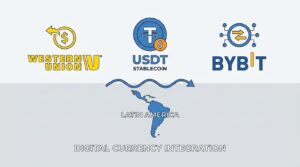
Western Union and Bybit have partnered to make the USDPT stablecoin accessible through Bybit’s fiat on-ramp channels in Latin America. The integration, announced Thursday, positions Bybit as the first major cryptocurrency exchange to support USDPT, a dollar-pegged stablecoin issued by Western Union. With Bybit claiming over 80 million users and ranking as the world’s second-largest crypto exchange by trading volume, the move signals a deliberate push by legacy financial services firms into digital asset infrastructure across emerging markets.
What the USDPT-Bybit Integration Means for Crypto in Latin America
Before diving into the specifics, it helps to frame why this partnership matters beyond the headline. Latin America has become one of the fastest-growing regions for stablecoin adoption, driven by currency volatility, remittance demand, and limited access to dollar-denominated financial products. Western Union’s decision to channel USDPT through a major exchange’s fiat rails is less about crypto speculation and more about real-world utility.
- Remittance corridor expansion: Western Union already dominates cross-border money transfers in the region. USDPT on Bybit gives users a digital alternative that bypasses traditional settlement delays.
- Fiat-to-stablecoin bridge: By integrating with Bybit’s fiat channels, USDPT becomes directly purchasable with local currencies, reducing friction for first-time crypto users.
- The partnership effectively turns Bybit into a distribution layer for Western Union’s stablecoin ambitions, not the other way around.
- Competitive positioning: With Tether (USDT) and Circle’s USDC already entrenched, USDPT enters a crowded field. Western Union’s brand recognition in Latin America is arguably its strongest differentiator.
- Regulatory signal: A publicly traded company like Western Union attaching its name to a stablecoin product suggests internal confidence that regulatory frameworks in the region are moving toward accommodation rather than restriction.
Why Latin America, and Why Now?
Stablecoin transaction volumes in Latin America surged past $100 billion in 2024, according to Chainalysis data. Argentina, Brazil, and Mexico account for the bulk of that activity, with users increasingly treating dollar-pegged tokens as savings instruments rather than trading tools. In Argentina alone, where annual inflation has exceeded 100%, stablecoins have become a parallel financial system for millions.
Western Union processes billions of dollars in remittances annually across the region. That existing infrastructure (a distinction regulators have been slow to replicate in the digital asset space) gives USDPT a distribution advantage that purely crypto-native stablecoins lack. Still, whether brand trust translates into on-chain adoption remains an open question.
Bybit’s role here is straightforward but critical. The exchange provides the technical rails, the liquidity, and the user base. For Western Union, building its own consumer-facing crypto platform would have been slower and costlier. Partnering with Bybit’s global crypto trading infrastructure lets the company test stablecoin demand without overcommitting capital to a new vertical.
How USDPT Stacks Up Against Established Stablecoins
| Feature | USDPT (Western Union) | USDT (Tether) | USDC (Circle) |
|---|---|---|---|
| Issuer type | Legacy financial services company | Crypto-native | Crypto-native / regulated fintech |
| Primary use case | Remittances, fiat on-ramp | Trading, DeFi, payments | Institutional settlement, payments |
| Latin America presence | Strong (via Western Union brand) | Dominant by volume | Growing, particularly in Brazil |
| Exchange availability | Bybit (first major listing) | Nearly all exchanges | Most major exchanges |
| Regulatory posture | Backed by publicly traded entity with existing compliance infrastructure | Under ongoing scrutiny in multiple jurisdictions | Proactively seeking regulatory alignment |
The table reveals something worth sitting with: USDPT’s early-stage distribution is a clear weakness, but its issuer profile could become an asset as Latin American regulators tighten stablecoin oversight.
The Behavioral Economics Behind Stablecoin Trust
Adoption of any financial product hinges on perceived safety, and this is where neuro-linguistic framing plays a measurable role. When users in Buenos Aires or São Paulo see the Western Union brand behind a dollar-pegged stablecoin, they process that association through years of accumulated trust. That cognitive shortcut matters enormously in markets where crypto fraud has eroded confidence.
Research in behavioral finance consistently shows that familiarity bias drives early adoption curves. People gravitate toward products wrapped in names they already know. And in a region where Western Union storefronts are physical landmarks in thousands of neighborhoods, the brand carries a weight that no crypto-native issuer can replicate overnight. This is not just marketing. It is anchoring, a well-documented cognitive bias where initial reference points shape subsequent decisions.
But trust alone does not guarantee stickiness. Users will compare transaction fees, redemption speed, and yield opportunities against USDT and USDC. If USDPT cannot match or exceed the practical experience of its competitors, brand recognition becomes a diminishing asset. The real test arrives when a user who bought USDPT through Bybit tries to spend it, send it, or convert it back to local currency. Friction at any of those points collapses the trust advantage.
What makes this psychologically interesting is the dual identity USDPT must maintain: familiar enough to attract conservative users, yet technically credible enough to satisfy crypto-native ones. Bridging those two audiences requires messaging precision that few legacy brands have managed in the digital asset space.
Frequently Asked Questions
What is USDPT?
USDPT is a dollar-pegged stablecoin issued by Western Union, designed primarily for remittance and fiat on-ramp use cases in emerging markets.
Where can I buy USDPT?
Currently, Bybit is the first major crypto exchange to list USDPT, available through its fiat channels in Latin America. Broader exchange availability has not been announced.
How does USDPT differ from USDT or USDC?
The core difference is the issuer. Western Union brings decades of remittance infrastructure and regulatory compliance history. Whether that translates into a better product for end users depends on execution, not pedigree.
Is USDPT regulated?
Western Union operates under financial services regulations in multiple jurisdictions. Specific regulatory approvals for USDPT in individual Latin American countries have not been publicly detailed, though the company’s existing compliance framework provides a foundation that purely crypto-native issuers typically lack.



