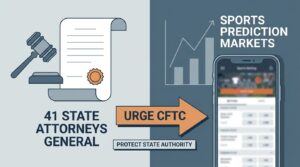
A bipartisan coalition of 41 state Attorneys General, led by Maryland’s Anthony Brown, has sent a joint letter to the Commodity Futures Trading Commission demanding the federal agency respect longstanding state jurisdiction over sports-related prediction markets. The letter targets what the coalition views as a dangerous regulatory drift: the CFTC’s growing tolerance of event contract platforms that, in practice, function much like sports betting. With platforms such as Kalshi and Polymarket rapidly expanding their user bases and product offerings, the states argue that federal inaction threatens to hollow out consumer protections built over decades. The dispute lays bare a fundamental tension between innovation in derivatives markets and the constitutional prerogative of states to regulate gambling within their borders.
What This Coalition Letter Signals for the Prediction Market Industry
This isn’t a routine regulatory complaint. When 41 of 50 state AGs align across party lines, the political weight is difficult to dismiss. The letter represents the most coordinated state-level pushback yet against the federal government’s handling of prediction markets, and it carries implications that stretch well beyond any single platform.
- The coalition frames event contracts on sports outcomes as functionally identical to sports wagering, a classification that would place them squarely under state gambling statutes rather than CFTC oversight.
- State regulators fear that if the CFTC permits these contracts without restrictions, it effectively creates a parallel, federally sanctioned sports betting channel that bypasses state licensing, taxation, and consumer safeguards.
- Platforms operating in this space face growing legal uncertainty; even if the CFTC greenlights certain products, state enforcement actions could follow independently.
- The bipartisan nature of the coalition removes the possibility of dismissing this as a partisan maneuver, strengthening its credibility with both Congress and the CFTC commissioners.
- For the broader fintech and prediction market ecosystem, the letter is a clear warning that regulatory arbitrage between federal and state frameworks carries real enforcement risk.
The Jurisdictional Tug-of-War: States vs. Federal Derivatives Oversight
At the heart of this dispute sits a deceptively simple question: when does a prediction market contract stop being a derivative and start being a bet? The Commodity Exchange Act grants the CFTC authority over futures and event contracts traded on designated exchanges. But the same law contains provisions, notably Section 745 of the Dodd-Frank Act, that restrict the CFTC from approving contracts that involve activity unlawful under state law, including gambling.
States have regulated gambling for well over a century. The 2018 Supreme Court decision in Murphy v. NCAA struck down the federal ban on sports betting, returning that authority explicitly to the states. Since then, more than 30 states have legalized some form of sports wagering, each with its own licensing regime, tax structure, and responsible gambling requirements. The AGs’ letter argues that allowing prediction market platforms to offer sports-outcome contracts without state approval effectively reverses that devolution of power (a distinction regulators have been slow to enforce).
And the stakes are not abstract. States collectively generate billions in tax revenue from regulated sports betting. A federally sanctioned alternative that skirts those frameworks would erode both revenue and regulatory coherence.
How Platforms Like Kalshi and Polymarket Fit In
Kalshi, a CFTC-regulated exchange, has aggressively expanded its catalog of event contracts, covering everything from economic indicators to weather events to, controversially, political and sports-adjacent outcomes. The platform secured a legal victory in 2023 when a federal court ruled that the CFTC could not block its election-related contracts, a decision that emboldened the broader prediction market sector. Kalshi’s event contract marketplace now lists hundreds of active markets, and its user base has grown sharply.
Polymarket’s blockchain-based prediction platform operates differently, using cryptocurrency-settled contracts and largely serving a non-U.S. user base, though its visibility in American media during the 2024 election cycle was enormous. Still, its model raises parallel questions about whether decentralized platforms can sidestep both federal and state jurisdiction.
What remains less clear is whether either platform’s current product offerings actually cross the line into sports betting as defined by individual state statutes. That ambiguity is precisely what concerns the AGs. Without a bright-line rule, enforcement becomes reactive rather than preventive.
Revenue, Consumer Protection, and the Regulatory Gap
| Dimension | State-Regulated Sports Betting | CFTC-Regulated Event Contracts |
|---|---|---|
| Licensing | State-issued, operator-specific | Federal exchange designation |
| Taxation | State-level, varies (typically 10–51% of gross revenue) | No state gambling tax applied |
| Consumer Safeguards | Self-exclusion lists, deposit limits, age verification mandated by state law | Exchange-level compliance; no uniform responsible gambling framework |
| Enforcement Authority | State gaming commissions and AGs | CFTC Division of Enforcement |
| Revenue to States (2023 est.) | Over $3 billion in combined state tax receipts | Negligible direct state revenue |
The gap in that final row matters enormously. States have built budgets around sports betting tax revenue. A competing federal channel that captures the same consumer demand without contributing to state coffers creates a fiscal problem that no AG, regardless of party, can afford to ignore.
Consumer Protection Isn’t Just a Talking Point
Beyond revenue, the coalition’s letter emphasizes that state gambling laws exist to protect vulnerable populations. Compulsive gambling programs, self-exclusion registries, and advertising restrictions are all products of state-level regulation. Arguably, the CFTC’s derivatives-focused oversight model was never designed to address these concerns. The agency regulates market integrity and systemic risk. It does not run problem gambling hotlines.
What Happens If the CFTC Doesn’t Act?
The coalition has not explicitly threatened litigation, but the subtext is hard to miss. State AGs possess independent enforcement authority under their own consumer protection and gambling statutes. If the CFTC declines to restrict sports-related event contracts, individual states could pursue platform-specific enforcement actions, cease-and-desist orders, or even coordinate multi-state investigations.
Congress could also intervene. Several legislative proposals have circulated in recent sessions that would clarify the boundary between prediction markets and gambling. But legislative timelines are unpredictable, and the 41-AG letter may be designed in part to accelerate that conversation by demonstrating the breadth of state-level concern.
Frequently Asked Questions
Are prediction markets the same as sports betting?
Legally, the answer depends on who you ask. The CFTC treats event contracts as derivatives products. State regulators, as this coalition letter makes clear, view sports-outcome contracts as functionally equivalent to sports wagers. The classification determines which rules apply, and right now, no single authority has settled the question definitively.
Can states ban prediction market platforms from operating within their borders?
Yes, at least on paper. States retain authority to enforce their own gambling laws. Even if a platform holds a federal exchange designation from the CFTC, that does not automatically preempt state gambling statutes. Enforcement, however, is complicated when platforms operate online and across jurisdictions.
Why did 41 Attorneys General sign this letter instead of pursuing individual state actions?
Collective action amplifies political pressure and signals to the CFTC that this is not a fringe concern. It also lays groundwork for potential coordinated enforcement if the federal response proves insufficient. The bipartisan composition makes it harder to characterize the effort as ideologically motivated.
What should prediction market users watch for?
Regulatory clarity, or the lack of it, will shape which contracts remain available and where. Users should monitor both CFTC rulemaking proceedings and state-level enforcement actions, because the legal landscape could shift quickly in either direction.



