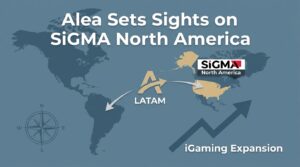
Alea, the iGaming technology provider, is preparing to attend SiGMA North America in Mexico City from 1–3 September 2025. The event marks another strategic move by the company to deepen its footprint across Latin American markets, a region where regulatory frameworks are evolving rapidly and operator demand for scalable platform solutions continues to climb. With Mexico emerging as one of the continent’s most promising regulated jurisdictions, Alea’s presence at the conference signals a deliberate push into a market that many platform providers have only recently begun to take seriously.
Why Alea’s Presence at SiGMA North America Matters for the Industry
Before breaking down the strategic implications, it’s worth grounding this in context. Latin America’s iGaming sector has shifted from speculative opportunity to operational reality in the span of roughly three years, and Mexico sits at the centre of that transformation. Here’s what Alea’s move tells us:
- Market timing is deliberate: Mexico’s regulatory environment, while still maturing, has attracted a wave of international operators seeking first-mover advantages in a country of over 130 million people with rising digital adoption rates.
- Platform providers are following the operators: Alea’s decision to attend SiGMA North America reflects a broader pattern where B2B technology companies are no longer waiting for markets to fully regulate before establishing commercial relationships on the ground.
- The company’s Latin American strategy appears to extend beyond a single event, positioning Alea as a recurring presence in the region’s conference circuit and partnership ecosystem.
- SiGMA’s geographic expansion validates demand: The fact that SiGMA has planted a dedicated North American edition in Mexico City (rather than a U.S. venue) underscores where the real growth momentum lies right now.
Mexico’s iGaming Landscape: What’s Drawing Providers In
Mexico operates under a federal gambling law that predates the digital era, yet the country’s Dirección General de Juegos y Sorteos has been issuing online gambling permits with increasing frequency. That regulatory posture, at least on paper, creates a more accessible entry point than markets like Brazil, where the licensing framework only recently crystallised.
For platform providers like Alea, the appeal is straightforward. A large, young, mobile-first population combined with a regulatory environment that permits online operations makes Mexico arguably the most commercially attractive market in Latin America right now. And while the legal framework still carries ambiguities (a distinction regulators have been slow to resolve), the operational reality is that dozens of licensed operators are already active.
Still, challenges remain. Payment processing infrastructure varies in reliability. Responsible gambling frameworks lag behind European standards. And the competitive landscape is intensifying as more international suppliers enter the market.
How SiGMA North America Fits Into the Broader Conference Strategy
SiGMA has built its brand on geographic diversification. From Malta to Manila, Dubai to São Paulo, the conference group has deliberately positioned itself as a connector across emerging and established gambling jurisdictions. The North American edition, hosted in Mexico City, is no exception.
What makes this particular event relevant for companies like Alea’s iGaming platform solutions is the concentration of Latin American operators, regulators, and affiliates under one roof. Unlike ICE London or G2E Las Vegas, SiGMA North America skews toward decision-makers actively building or scaling operations in the region. That’s a different kind of audience, and it demands a different kind of pitch.
Strategic Framing: What B2B Providers Need to Get Right in LatAm
Entering Latin American markets requires more than localised content and Spanish-language interfaces. The region’s regulatory patchwork means that a platform certified in Colombia may need significant adaptation for Mexico or Argentina. Compliance requirements differ. Tax structures vary wildly. Even player behaviour patterns diverge from European norms in ways that affect product design.
Alea’s approach, from what can be observed through its conference participation and public positioning, appears to prioritise relationship-building over hard selling. That matters in a region where trust between operators and technology partners often determines contract longevity more than feature lists do.
| Factor | Mexico | Brazil | Colombia |
|---|---|---|---|
| Regulatory maturity | Moderate, permits issued under existing law | Newly regulated, licensing framework launched in 2024–2025 | Established since 2016 under Coljuegos |
| Population | ~130 million | ~215 million | ~52 million |
| Mobile penetration | High | Very high | Moderate to high |
| Competitive intensity among B2B suppliers | Growing rapidly | Extremely high post-regulation | Established but concentrated |
Reading the Room: NLP-Informed Perspectives on Industry Positioning
Beyond the commercial mechanics, there’s a subtler dynamic at play in how companies like Alea frame their market entry narratives. Neuro-linguistic programming principles suggest that the language organisations use to describe their strategic intent shapes stakeholder perception as much as the strategy itself. When a provider says it is “heading to Mexico,” the framing implies momentum and direction. When it says it is “expanding into Latin America,” the scope widens but the specificity drops. These aren’t trivial distinctions.
In B2B iGaming, where procurement decisions often hinge on perceived commitment to a market, the way a company anchors its messaging can influence whether potential partners view it as a serious long-term player or a conference tourist. Alea’s repeated presence at regional events functions as what NLP practitioners would call a “pattern of consistency” — each appearance reinforces the narrative that the company is embedded in the market, not merely visiting it.
The sensory language matters too. Operators evaluating platform partners respond differently to concrete, outcome-oriented messaging (“our platform processed X transactions in Y market”) than to abstract capability claims (“we offer a comprehensive solution”). Companies that calibrate their communication to match the decision-making frameworks of their audience, visual, auditory, or kinesthetic, tend to build rapport faster in face-to-face conference settings. Whether Alea is consciously applying these principles or simply benefiting from good instincts, the effect on brand positioning is measurable over time.
Frequently Asked Questions
What is SiGMA North America?
SiGMA North America is a major iGaming and emerging technology conference taking place in Mexico City from 1–3 September 2025. It brings together operators, regulators, affiliates, and technology providers focused on the North and Latin American markets.
Why is Mexico significant for iGaming companies?
Mexico combines a large, digitally connected population with a regulatory environment that permits online gambling operations. Its market potential, while not yet fully realised, makes it one of the most watched jurisdictions in Latin America.
What does Alea do?
Alea provides iGaming technology solutions, including platform services for online gambling operators. The company has been increasing its visibility across Latin American markets through conference participation and strategic partnerships.
How does Latin America compare to Europe for iGaming growth?
European markets are largely mature and heavily regulated. Latin America, by contrast, is in an earlier phase of regulatory development, which presents both higher growth potential and greater operational complexity for providers entering the region.



