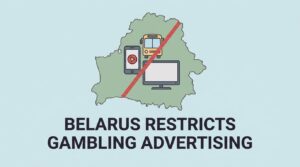
Belarus is weighing sweeping restrictions on gambling advertising that would span online media, public transport networks, television, and radio. The Ministry of Antimonopoly Regulation and Trade has drafted amendments to the country’s advertising law, signalling a regulatory posture that could reshape how gambling operators reach consumers across the Belarusian market. If enacted, the proposed rules would represent one of the most comprehensive advertising clampdowns in the post-Soviet gambling landscape, affecting both domestic operators and international platforms targeting Belarusian audiences.
What the Draft Amendments Actually Propose
The draft legislation targets multiple advertising channels simultaneously. Rather than a piecemeal approach, the Belarusian authorities appear intent on closing gaps that operators have historically exploited when one medium gets restricted but others remain open. Television and radio would face explicit prohibitions, while digital platforms and public transport advertising (a surprisingly effective channel in Belarusian urban centres) would also fall under the new framework.
This is not a soft nudge.
The Ministry of Antimonopoly Regulation and Trade, which oversees advertising standards in Belarus, has positioned the draft as a consumer protection measure. Gambling advertising in the country has grown more visible in recent years, particularly across online channels where regulatory enforcement has lagged behind market activity (a distinction regulators have been slow to enforce in many Eastern European jurisdictions). The proposed amendments would bring Belarus closer to the restrictive advertising regimes already operating in countries like Italy and Belgium, though enforcement mechanisms remain unspecified in the current draft.
Strategic Implications for Gambling Operators in Belarus
Before examining the broader market effects, several immediate takeaways stand out for operators, regulators, and industry observers tracking this development:
- Multi-channel advertising bans compress operator acquisition strategies — companies that rely on broadcast and transit advertising will need to pivot toward owned channels, affiliate networks, or sponsorship models not yet covered by the draft
- Online media restrictions could affect affiliate marketing ecosystems — if broadly defined, the rules may capture content marketing, influencer partnerships, and programmatic display campaigns
- The timing aligns with a wider Eastern European trend toward tighter gambling controls, suggesting regional regulatory convergence rather than an isolated policy decision
- Enforcement clarity is absent — the draft outlines prohibitions but has not yet detailed penalties, compliance timelines, or oversight structures, which leaves operators in a planning vacuum
- Domestic operators may face disproportionate impact compared to offshore platforms that already operate outside Belarusian regulatory reach
A Regional Pattern Takes Shape
Belarus does not exist in a regulatory vacuum. Across Eastern Europe and the broader CIS region, governments have been tightening gambling advertising rules with increasing urgency. Ukraine overhauled its gambling framework in 2020 and has since layered on advertising restrictions. Russia maintains some of the strictest gambling advertising prohibitions in the region. And Poland has progressively narrowed the channels through which licensed operators can promote their services.
What makes the Belarusian proposal notable is its breadth. Rather than targeting a single channel or medium, the Belarusian Ministry of Antimonopoly Regulation and Trade appears to be drafting a framework that addresses the full advertising ecosystem in one legislative action. Whether that ambition survives the consultation and amendment process is another question entirely.
Still, the direction is unmistakable. Governments in the region increasingly view gambling advertising as a public health issue, not merely a commercial regulation matter. That framing shifts the political calculus considerably.
How Operators Might Reframe Their Market Approach
Advertising restrictions rarely eliminate demand. They redirect it. And for gambling operators accustomed to navigating fragmented regulatory environments, the Belarusian proposal presents both a constraint and a strategic inflection point. Operators who have built diversified acquisition funnels — relying less on paid media and more on product-led retention, CRM sophistication, and brand equity — will arguably weather these changes more comfortably than those dependent on high-volume broadcast and display campaigns.
The behavioural dimension matters here too. When advertising channels narrow, consumer attention doesn’t vanish; it migrates. Operators who understand the psychological triggers behind player acquisition — the framing effects, the anchoring of promotional offers, the social proof embedded in community-driven platforms — can adapt their messaging even within tighter regulatory corridors. This is where principles drawn from behavioural science and neuro-linguistic programming become operationally relevant, not as manipulation tools, but as frameworks for understanding how restricted communication environments change the way audiences process and respond to brand signals.
Consider the difference between a television spot that broadcasts a generic bonus offer and a targeted digital touchpoint that mirrors the language patterns and decision frameworks of a specific player segment. The latter survives regulatory compression better because it operates through precision rather than volume. Operators who invest in understanding cognitive biases — loss aversion in lapsed-player reactivation, the endowment effect in loyalty programme design, or the role of scarcity framing in compliant promotional messaging — will find that advertising restrictions, paradoxically, reward sophistication over spend.
But this requires a fundamental shift in how marketing teams think about reach. Volume-based metrics give way to engagement depth. Brand recall, measured through aided and unaided awareness studies, becomes more valuable than impression counts. And the operators who treat regulatory change as a catalyst for strategic refinement rather than a barrier to growth will be the ones still standing when enforcement begins.
What Remains Unresolved
The draft amendments raise as many questions as they answer. Key details remain open:
| Area | Current Status |
|---|---|
| Scope of “online media” | Undefined — could range from display ads to social media content and affiliate sites |
| Penalties for non-compliance | Not specified in the current draft |
| Implementation timeline | No effective date announced |
| Exemptions for licensed operators | Not addressed; unclear whether licensed domestic operators receive any carve-outs |
| Enforcement mechanism | No designated enforcement body or process detailed beyond the Ministry’s oversight role |
The absence of penalty structures is particularly telling. Without clear consequences, advertising bans risk becoming aspirational rather than operational. Operators in other markets have learned to test enforcement boundaries when penalties are ambiguous or delayed.
Frequently Asked Questions
Does the proposed law ban all gambling advertising in Belarus?
The draft amendments target advertising across online media, public transport, television, and radio. Whether it constitutes a total ban depends on how broadly “online media” is defined and whether exemptions emerge during the legislative process.
When would these restrictions take effect?
No implementation date has been announced. The amendments remain in draft form and will likely undergo further consultation before any timeline is set.
How does this compare to gambling advertising rules in neighbouring countries?
The scope is broadly consistent with trends across Eastern Europe, though the simultaneous targeting of multiple channels in a single legislative action is more aggressive than the incremental approaches seen in Poland or Ukraine. Russia’s existing framework is arguably stricter in enforcement, if not in statutory language.
Will offshore operators be affected?
In practice, enforcement against offshore platforms operating outside Belarusian jurisdiction has historically been limited. The draft does not appear to introduce new extraterritorial enforcement tools, which means domestic operators may bear the brunt of compliance costs while offshore competitors continue to reach Belarusian consumers through less regulated channels.