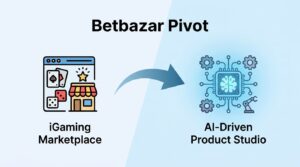
Betbazar, the iGaming marketplace that launched in 2019 as a bridge between operators and solution providers, is repositioning itself around proprietary technology and artificial intelligence. The shift marks a deliberate departure from the company’s original aggregation model toward building its own products, starting with AI Cricket and an expanded sports betting suite. It’s a bet that the next phase of iGaming growth won’t be won by distribution alone, but by differentiated, in-house technology that operators can’t easily replicate or source elsewhere.
What Betbazar’s Strategic Pivot Signals for the iGaming Supply Chain
The company’s evolution from sales house to product studio reflects a broader tension in the iGaming B2B space: as operator sophistication grows, the value of simply connecting buyers with off-the-shelf solutions diminishes. Betbazar appears to have read that signal early. Below are the key strategic takeaways from this transition.
- From aggregator to creator: Betbazar is no longer content to sit between operators and providers. The company is building proprietary products, a move that changes its competitive positioning entirely.
- AI Cricket represents the company’s first major proprietary vertical, targeting a sport with massive global betting volume but relatively thin technological coverage from incumbent providers.
- Operator demand has shifted. The market no longer rewards access to the same catalogue everyone else carries. Differentiation now drives procurement decisions.
- Betbazar Sports, the company’s expanded suite, suggests ambitions beyond a single product launch toward a full-stack betting technology offering.
- The timing aligns with a wider industry pattern: B2B iGaming firms are increasingly verticalising, moving from horizontal platforms to specialised, defensible product lines.
Why Cricket, and Why AI?
Cricket generates enormous betting handle globally, particularly across South Asia, Australia, and the United Kingdom. Yet the sport has historically been underserved by the kind of granular, real-time data modelling that football or basketball enjoy from established providers. That gap is precisely where Betbazar has aimed its resources.
AI Cricket, as the product is branded, applies machine learning to match modelling, odds generation, and in-play market creation for cricket events. The approach isn’t entirely novel in concept (several firms have explored AI-driven odds compilation), but applying it specifically to cricket’s complex, session-based structure is a narrower and arguably more defensible play. Cricket’s format variability alone, spanning T20, ODI, and Test matches, creates modelling challenges that generic AI frameworks struggle with.
Whether the product can deliver the accuracy and latency that top-tier operators demand remains the open question.
The Marketplace Model Hits a Ceiling
Betbazar’s original value proposition was straightforward. Operators needed content. Providers needed distribution. The company sat in the middle, curating a marketplace of sports, esports, platform infrastructure, and betting technology. For a time, that worked well.
But marketplace businesses in iGaming face a structural problem: margins compress as operators build direct relationships with providers, and switching costs stay low. Betbazar’s pivot acknowledges this reality without abandoning the relationships it built during its marketplace phase. Those operator connections now become the distribution channel for its own products, a classic platform-to-product transition that, at least on paper, gives the company a warmer sales pipeline than a typical startup would enjoy.
How This Fits the Broader B2B iGaming Trend
Betbazar is not operating in isolation. Across the B2B iGaming landscape, companies are consolidating vertically, acquiring or building proprietary technology rather than relying on partnership networks. The logic is simple: owning the product means owning the margin.
| Model | Revenue Driver | Key Risk | Example Trajectory |
|---|---|---|---|
| Marketplace / Aggregator | Commission on transactions | Margin compression, disintermediation | Betbazar (2019–2024) |
| Proprietary Product Studio | Licensing fees, revenue share on product usage | R&D cost, product-market fit uncertainty | Betbazar (2025 onward) |
| Full-Stack Platform | End-to-end operator dependency | Regulatory complexity across jurisdictions, high capital requirements | Several major incumbents |
Still, the transition carries risk. Building technology is fundamentally different from selling it. The iGaming marketplace that Betbazar built over five years gave the company commercial intelligence and operator relationships, but engineering capability and product iteration speed are different muscles entirely.
What Operators Should Watch For
For operators evaluating their content and technology supply chains, Betbazar’s shift raises practical questions worth tracking. First, how quickly can AI Cricket move from concept to production-grade deployment across regulated markets? Regulatory approval timelines for new betting products vary wildly by jurisdiction, and a product built on AI-generated odds will face scrutiny from integrity bodies and gambling commissions alike.
Second, operators should assess whether Betbazar Sports will compete with or complement existing provider relationships. If the suite targets underserved sports and markets rather than going head-to-head with established data giants, the adoption path becomes smoother. A direct challenge to incumbents in football or basketball odds, by contrast, would require a level of data infrastructure and latency performance that takes years to build.
And third: pricing. Proprietary products from smaller studios often enter the market at aggressive price points to win initial traction. Operators with flexible integration architectures may find early-mover advantages in testing these products before the pricing normalises upward (a pattern the industry has seen repeatedly with emerging content providers).
Frequently Asked Questions
What is Betbazar’s new strategic direction?
Betbazar is transitioning from an iGaming marketplace and aggregator into a proprietary product studio, with AI-powered betting technology as its core focus. The company’s first major product under this model is AI Cricket.
How does AI Cricket differ from existing cricket betting products?
AI Cricket uses machine learning for odds generation and in-play market creation specifically tailored to cricket’s unique format variability, including T20, ODI, and Test matches. Most existing solutions apply more generic modelling frameworks that weren’t purpose-built for the sport’s session-based structure.
Will Betbazar continue operating its marketplace?
The company has not indicated a full shutdown of its marketplace operations. Its existing operator relationships are expected to serve as the initial distribution channel for its new proprietary products, suggesting a gradual transition rather than an abrupt exit from aggregation.
What risks does this pivot carry?
The primary risks include R&D execution, regulatory approval for AI-generated betting products across multiple jurisdictions, and the challenge of competing with established data and odds providers who have deeper infrastructure and longer track records. Whether Betbazar can scale its engineering capabilities fast enough to match its commercial ambitions is the central uncertainty.