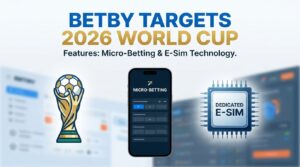
Betby, the B2B sportsbook provider, has unveiled plans to enhance its platform ahead of the 2026 FIFA World Cup with two notable additions: micro-betting capabilities and a dedicated e-sim solution. The moves signal the company’s intent to capture operator demand during what will be the most commercially significant sporting event of the year. With the tournament expanding to 48 teams across the United States, Canada, and Mexico, the addressable market for in-play wagering is set to grow substantially.
What Betby’s World Cup Strategy Means for B2B Operators
The convergence of micro-betting technology and connectivity infrastructure reflects a broader shift in how sportsbook suppliers are preparing for major tournaments. Rather than simply scaling existing products, Betby appears to be building event-specific tooling designed to meet the operational realities of a geographically dispersed World Cup.
- Micro-betting integration positions Betby to serve operators targeting the fastest-growing segment of in-play wagering, where bets are placed on individual plays, possessions, or moments within a match
- The dedicated e-sim offering addresses latency and connectivity challenges that have historically plagued live betting during high-traffic global events
- A 48-team format means more matches, more concurrent fixtures, and significantly higher demand on data feeds and trading engines
- Operators partnering with Betby gain access to infrastructure purpose-built for the tournament’s scale, arguably reducing the need for costly in-house development
Why Micro-Betting Is the Battleground
Micro-betting has moved from novelty to necessity in the North American sports betting market. The format thrives on speed. A single football match can generate hundreds of individual betting opportunities when broken down to the level of corners, throw-ins, shots on target, and even pass completions. For the World Cup, where casual viewers swell the audience far beyond the typical football fanbase, micro-betting offers a low-barrier entry point that keeps engagement high throughout 90 minutes of play.
But the technical demands are considerable. Each micro-market requires real-time data ingestion, automated risk management, and near-instantaneous settlement. Latency of even a few seconds can create arbitrage vulnerabilities or, worse, erode bettor trust. That Betby is pairing micro-betting with an e-sim solution suggests the company recognizes connectivity as the bottleneck, not just the trading logic.
Still, not every operator will need or want the full suite. Smaller B2B clients may prioritize pre-match and standard in-play markets, making the modularity of Betby’s offering a quiet but important detail.
The E-Sim Layer: Solving a Problem Most Suppliers Ignore
Dedicated e-sim technology for sportsbook operations is an unconventional move. In practice, it means Betby can provide operators with a connectivity layer that bypasses congested public networks during peak event traffic. When tens of millions of users are streaming, betting, and browsing simultaneously during a World Cup knockout match, network reliability becomes a competitive advantage rather than a background assumption.
This is particularly relevant for the 2026 tournament. Matches will be played across 16 venues in three countries, each with different telecommunications infrastructure and regulatory environments. Betby’s sportsbook platform would need to maintain consistent performance regardless of where the data originates or where the end user places a bet.
Whether this e-sim approach becomes an industry standard or remains a differentiator for Betby alone is a question the market hasn’t answered yet.
How the Expanded World Cup Format Changes Operator Calculus
The jump from 32 to 48 teams isn’t just a sporting decision. It reshapes the commercial landscape for sportsbook providers in measurable ways.
| Factor | 32-Team Format (2022) | 48-Team Format (2026) |
|---|---|---|
| Total matches | 64 | 104 |
| Group stage matches | 48 | 72 |
| Tournament duration | 29 days | 39 days (projected) |
| Host countries | 1 | 3 |
| Potential micro-bet markets per match | Hundreds | Hundreds, across more concurrent fixtures |
The sheer volume of additional content creates both opportunity and operational strain. Suppliers who can automate market creation and settlement at scale will hold a distinct edge. Those relying on manual trading desks for even a fraction of their coverage will find the 2026 schedule unforgiving.
Framing the Opportunity: What Operators Should Consider
For operators evaluating B2B sportsbook partnerships ahead of 2026, the decision framework extends beyond product features. Understanding the psychological drivers behind bettor behavior during a World Cup (a concept well-studied in behavioral economics and, more practically, in how NLP principles apply to user engagement) can sharpen strategic choices. Bettors during major tournaments exhibit different patterns than regular-season punters. They are more impulsive, more responsive to visual cues, and more likely to engage with simplified market structures.
Micro-betting, at its core, taps into these tendencies. The rapid feedback loop of placing a bet and seeing it settled within seconds mirrors the reward cycles that NLP practitioners describe as anchoring. Each successful micro-bet reinforces engagement, creating a pattern of continued interaction that standard pre-match betting simply cannot replicate. Operators who understand this behavioral layer can design front-end experiences that complement the back-end capabilities Betby is building.
And there’s a retention dimension worth noting. Tournament betting often attracts first-time users who may never return after the final whistle. Micro-betting, with its game-within-a-game structure, gives operators a mechanism to demonstrate product depth early in the customer lifecycle. The question isn’t just whether the technology works during the World Cup. It’s whether it converts a four-week spike into lasting platform loyalty.
Frequently Asked Questions
What is micro-betting in sports wagering?
Micro-betting allows users to place wagers on granular, real-time events within a match, such as the outcome of a single play, the next corner kick, or whether a shot will be on target. Markets open and close in seconds.
Why is Betby introducing an e-sim for sportsbook operations?
The e-sim provides a dedicated connectivity layer that reduces reliance on congested public networks during high-traffic events like the World Cup. It’s designed to minimize latency for live betting data feeds and ensure consistent platform performance across multiple host countries with varying telecom infrastructure.
How does the 48-team World Cup format affect sportsbook providers?
More teams mean more matches, more concurrent fixtures, and exponentially more betting markets to manage. Providers need automated trading and settlement systems capable of handling this volume without degradation in speed or accuracy. The 2026 tournament will test that capacity like no previous edition.



