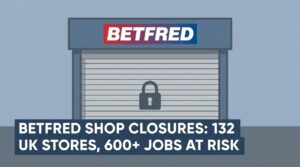
Betfred has confirmed plans to close 132 betting shops across the United Kingdom beginning in September, a move that will place more than 600 employees at risk of redundancy. The closures represent a significant contraction for one of Britain’s largest independent bookmakers and reflect mounting pressure on the high-street gambling sector. While the company has pointed to rising operational costs and shifting consumer behaviour, the scale of the cuts signals something deeper than routine portfolio trimming.
What Betfred’s Shop Closures Mean for the UK Betting Landscape
The decision arrives at a moment when the economics of brick-and-mortar betting have become increasingly difficult to defend. Before examining the broader implications, here are the core strategic takeaways from the announcement:
- Scale of impact: 132 shops closing simultaneously marks one of the largest single-wave reductions by a UK bookmaker in recent years, affecting communities across multiple regions
- More than 600 staff face potential redundancy, though Betfred has indicated it will seek redeployment opportunities where possible
- Cost pressures are compounding: rising business rates, wage inflation, and regulatory levies have eroded margins on physical retail betting to a point where many locations are no longer viable
- The closures underscore a broader industry migration toward digital channels, where customer acquisition costs are lower and margins more sustainable
- Remaining high-street operators will face intensified scrutiny over whether their own estates can withstand similar pressures
Why Now? The Pressures Behind the Decision
Betfred’s announcement did not emerge in a vacuum. The UK’s high-street betting sector has been under sustained strain since the government slashed maximum stakes on fixed-odds betting terminals (FOBTs) from £100 to £2 in April 2019. That single regulatory intervention removed a critical revenue stream that had, for years, subsidised the operating costs of many shops (a distinction regulators have been slow to fully reckon with in subsequent policy reviews).
Layer on top of that the post-pandemic acceleration of online gambling, and the arithmetic becomes stark. Footfall in betting shops has not recovered to pre-2020 levels in many towns. Meanwhile, the cost base has moved in the opposite direction: energy bills, staff wages following minimum wage increases, and local authority business rates have all climbed. For a privately held company like Betfred’s retail betting operation, absorbing those costs without the capital market flexibility of listed rivals adds another layer of difficulty.
Still, the timing raises questions about whether additional regulatory changes on the horizon played into the calculus.
The Human Cost Deserves More Than a Footnote
Six hundred jobs is not an abstraction. These are roles concentrated in towns and suburban high streets where alternative employment options are often limited. Betting shop staff typically include long-tenured employees who have built careers in retail gambling, and the transferability of those skills to other sectors is not always straightforward.
Betfred has stated it will consult with affected employees and explore redeployment within its remaining estate. But with 132 shops disappearing, the pool of available positions will inevitably be smaller than the number of displaced workers. Trade unions and local representatives are expected to press for clarity on redundancy terms and support packages in the coming weeks.
A Shrinking High Street: Industry-Wide Trajectory
Betfred is far from alone. The UK’s total number of licensed betting shops has declined steadily over the past decade. Consider the trajectory:
| Year | Approximate UK Betting Shops | Key Driver of Change |
|---|---|---|
| 2014 | ~8,900 | Peak estate before regulatory tightening |
| 2019 | ~7,700 | FOBT stake reduction to £2 |
| 2022 | ~6,800 | Post-pandemic footfall decline and cost inflation |
| 2025 | Estimated below 6,200 | Ongoing consolidation; Betfred closures contribute to further reduction |
William Hill, Ladbrokes, and Coral have all trimmed their estates in recent years. What distinguishes Betfred’s move is the proportion it represents relative to the company’s total footprint, arguably signalling a more aggressive strategic pivot toward digital.
Digital Migration and the Reframing of Retail Value
The gravitational pull toward online betting is reshaping how operators think about physical presence. For years, shops served a dual purpose: revenue generation and brand visibility. That second function has diminished as digital marketing, sponsorship deals, and mobile app penetration have taken over customer acquisition.
Yet not all customer segments have migrated online. Older bettors, cash-preferring customers, and those in areas with limited broadband access still rely on physical shops. Closing 132 locations raises a harder question about whether Betfred risks abandoning a demographic that competitors might also neglect, creating service deserts in certain communities.
And while digital margins look attractive on paper, the online market carries its own cost burdens: affordability checks, enhanced due diligence requirements, and an increasingly crowded competitive field where customer retention spending keeps rising.
How Stakeholders Can Navigate Uncertainty
Periods of industry contraction generate anxiety, but they also create space for strategic recalibration. For employees, communities, and even competing operators, the response to Betfred’s announcement can be shaped by how the situation is framed internally.
Affected staff benefit from reframing the disruption not as a personal failure but as an industry-level structural shift. Seeking transferable skill recognition early, particularly in customer service, compliance, and cash handling, positions individuals more effectively in adjacent retail or hospitality roles. Local authorities, meanwhile, should consider proactive engagement rather than reactive commentary. Empty betting shop units can be repurposed, but only if planning and economic development teams move quickly to attract alternative tenants or community uses.
For remaining operators, the lesson is less about whether to close shops and more about which shops to keep. The ones that survive will likely be those embedded in high-footfall locations with diversified service offerings, not those sustained purely by legacy leases. Operators who invest in understanding their customers’ emotional drivers, their sense of routine, belonging, and social connection to physical venues, will make sharper decisions about where to maintain presence and where to withdraw.
Betfred’s leadership, for its part, faces a communication challenge. How the company frames these closures internally will shape employee morale across its entire remaining workforce. Transparency about the rationale, paired with genuine investment in transition support, will matter more than any press statement.
Frequently Asked Questions
When will Betfred’s 132 shops close?
The closures are planned to begin from September 2025, though specific timelines for individual locations have not all been confirmed publicly.
How many Betfred employees are affected?
More than 600 jobs are at risk. Betfred has indicated it will explore redeployment options within its remaining shop network, but the net reduction in positions is expected to be substantial.
Why is Betfred closing so many shops?
The company has cited rising costs, including business rates, wages, and energy, alongside declining footfall and the continued shift of customers toward online betting platforms. The 2019 FOBT stake cut also removed a significant revenue pillar that many shops depended on.
Will other bookmakers follow with similar closures?
The structural pressures Betfred faces are not unique. Whether competitors announce comparable reductions depends on their individual estate economics, but the industry trend points firmly toward further consolidation of physical retail betting in the UK.



