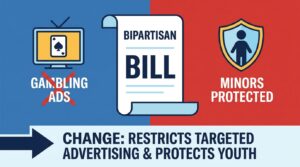
A new bipartisan bill introduced in the U.S. Congress seeks to restrict gambling operators from directing targeted advertising at minors. The legislation, backed by lawmakers from both parties, responds to mounting concern over the surge in sports betting promotions reaching younger audiences through digital platforms and social media. If enacted, it would mark one of the most direct federal interventions into gambling advertising practices in years.
Why Federal Action on Gambling Ads Is Gaining Traction Now
The timing here is not accidental. Since the Supreme Court’s 2018 decision in Murphy v. NCAA struck down the federal ban on sports betting, more than 30 states have legalized some form of sports wagering. That expansion brought with it a flood of advertising spend from operators competing aggressively for market share. And while state-level regulations vary widely (a distinction regulators have been slow to harmonize), there has been no comprehensive federal framework governing how gambling ads reach consumers, particularly children and teenagers.
Digital advertising compounds the problem. Algorithms on platforms like Instagram, YouTube, and TikTok do not reliably distinguish between a 15-year-old and a 25-year-old when serving sponsored content. Gambling brands have poured billions into digital campaigns, and the collateral exposure of minors to these ads has become difficult to ignore.
Core Provisions of the Proposed Legislation
The bill’s central mechanism would prohibit gambling companies from using data-driven targeting tools to serve advertisements to individuals under 21. That threshold is notably higher than the legal gambling age in most states, which sits at 18 or 21 depending on jurisdiction. The legislation would also require platforms hosting gambling ads to implement age-verification safeguards before delivering targeted content.
Several additional provisions shape the bill’s scope:
- Platform accountability: Social media companies and ad networks would share liability for delivering gambling promotions to verified minors, shifting responsibility beyond the advertiser alone.
- Operators would be required to maintain auditable records of their ad targeting parameters and demographic filters.
- Penalties: Violations could trigger fines enforced through the Federal Trade Commission, though specific penalty amounts have not yet been disclosed in the bill’s public summary.
- The bill carves out exemptions for general-audience broadcast advertising that is not individually targeted, focusing its restrictions on programmatic and algorithmic delivery.
The Industry’s Uncomfortable Position
Major operators like DraftKings and FanDuel have publicly stated their commitment to responsible gambling. But the gap between stated policy and actual ad delivery remains wide. A 2023 study published in the Journal of Gambling Studies found that nearly 1 in 4 social media users aged 13–17 reported seeing gambling advertisements at least weekly. That figure alone suggests self-regulation has not kept pace with the scale of digital ad deployment.
Industry trade groups, including the American Gaming Association, have historically argued that existing voluntary codes of conduct are sufficient. Still, voluntary frameworks lack enforcement teeth, and compliance varies significantly across the more than two dozen licensed operators active in the U.S. market.
Whether this bill survives committee review is another question entirely.
How Behavioral Targeting Shapes Youth Exposure
Understanding why this legislation matters requires looking at how modern advertising actually works at the neurological level. Targeted ads are not passive. They are engineered to exploit pattern recognition, reward anticipation, and social proof, three cognitive mechanisms that are particularly pronounced in adolescents whose prefrontal cortex development is still incomplete.
From a neuro-linguistic programming perspective, gambling advertisements frequently deploy anchoring techniques: associating betting with excitement, community, and identity. Phrases like “join the action” or “don’t miss out” activate loss-aversion responses that are measurably stronger in younger demographics. The repetition of these cues across platforms creates what behavioral scientists call a “normalization loop,” where gambling transitions from a regulated adult activity to something perceived as routine entertainment.
This is precisely the dynamic the bill’s sponsors cite as justification. Adolescents exposed to high-frequency gambling messaging are, according to multiple longitudinal studies, significantly more likely to develop problematic gambling behaviors by age 25. The proposed legislation attempts to interrupt that pipeline at the delivery stage rather than relying on downstream intervention after habits have already formed. In practice, severing the algorithmic connection between a minor’s browsing profile and a sportsbook’s ad budget may prove more effective than any public awareness campaign.
Regulatory Landscape and What Comes Next
At the state level, a patchwork of rules already governs gambling advertising. New York, for instance, restricts certain promotional offers but does not specifically address algorithmic targeting of minors. Massachusetts has taken a more aggressive stance, banning some forms of bonus-based advertising entirely. The federal bill would establish a baseline that supersedes these inconsistencies.
The FTC’s role as enforcer is significant. The commission has recently signaled broader interest in regulating data-driven advertising practices affecting children, most visibly through its ongoing rulemaking around the Children’s Online Privacy Protection Act (COPPA). Gambling-specific provisions could slot into that wider regulatory architecture without requiring an entirely new enforcement apparatus.
| Dimension | Current State | Under Proposed Bill |
|---|---|---|
| Targeting minors | Restricted by voluntary codes; inconsistent enforcement | Explicitly prohibited with FTC-backed penalties |
| Platform liability | Generally limited to advertiser responsibility | Shared between platforms and operators |
| Age verification | Varies by state; often minimal on social platforms | Mandatory before serving targeted gambling content |
| Record-keeping | No federal requirement | Auditable targeting logs required from operators |
Frequently Asked Questions
Does this bill ban all gambling advertising?
No. It specifically targets algorithmically delivered ads directed at minors. General broadcast advertising and non-targeted digital placements are not covered by the proposed restrictions.
Which agencies would enforce the new rules?
The Federal Trade Commission would serve as the primary enforcement body, building on its existing authority over deceptive and unfair advertising practices.
How does this differ from existing state regulations?
Most state-level rules focus on the content of gambling ads or promotional offers. This bill goes further by regulating the delivery mechanism, specifically the use of behavioral data to target individuals under 21. It creates a federal floor that states could exceed but not fall below.
When could this legislation take effect?
The bill must first clear committee review and secure votes in both chambers. Given the bipartisan sponsorship, it arguably has a stronger path than previous gambling-related proposals, though the legislative calendar and competing priorities make any timeline uncertain.



