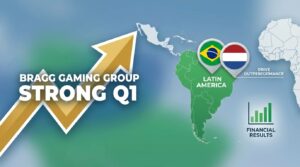
Bragg Gaming Group delivered a notable first quarter in 2025, with its Latin American operations once again emerging as the company’s standout growth engine. Brazil’s continued regulatory opening and market expansion fuelled much of that momentum, while a resurgent performance in the Netherlands added a secondary tailwind. For a mid-cap B2B gaming supplier navigating an increasingly competitive landscape, the geographic mix tells a story worth unpacking.
What Bragg’s Q1 Numbers Signal for B2B iGaming Suppliers
The results reinforce a pattern that has been building over several quarters: regulated market access in high-growth jurisdictions is translating into tangible commercial returns for suppliers positioned early. Before diving into the broader implications, here are the strategic takeaways from Bragg’s latest earnings period.
- Brazil remains the primary growth catalyst within Bragg’s Latin American portfolio, benefiting from the country’s evolving regulatory framework and surging player demand
- The Netherlands contributed a meaningful uplift in Q1, suggesting Bragg’s content and platform integrations are gaining traction in a market that initially proved difficult for many entrants
- Latin America as a region continues to outperform other geographies in Bragg’s revenue mix, a trend that raises questions about how dependent the company’s growth trajectory is on a single continent
- B2B suppliers with early-mover positioning in newly regulated markets are capturing disproportionate share before competitive saturation sets in
Brazil’s Regulatory Tailwind Shows No Sign of Stalling
Brazil’s sports betting and iGaming market has been one of the most closely watched regulatory stories in global gaming over the past two years. The country’s licensing regime, which began taking formal shape in late 2023 and accelerated through 2024, has created a land-grab dynamic among both operators and their technology partners. Bragg has been a direct beneficiary.
The company’s iGaming content and platform solutions have gained distribution across multiple licensed operators in the Brazilian market. That reach matters. In a jurisdiction where consumer adoption is still climbing and operator rosters remain relatively fluid, suppliers embedded early in the stack tend to retain share even as competition intensifies.
Still, the Brazilian opportunity is not without complexity. Regulatory enforcement timelines have shifted more than once, and the tax framework remains a point of industry contention (a distinction regulators have been slow to fully resolve). What Bragg’s Q1 suggests is that, at least on paper, the commercial upside is outpacing the regulatory friction.
A Quieter Rebound in the Netherlands
Less discussed but arguably just as telling is Bragg’s improved performance in the Dutch market. The Netherlands has been a notoriously challenging jurisdiction since its regulated online gambling framework launched in October 2021. Strict advertising rules, a cautious regulator in the Kansspelautoriteit, and a relatively small addressable market have tested the patience of several international operators and suppliers alike.
Yet Bragg appears to have found traction. The Q1 uplift in the Netherlands points to either deeper integration with existing operator partners or new distribution agreements that expanded the company’s content footprint. Which of those factors is dominant remains unclear from the earnings disclosure alone. But the directional signal is positive for a market that many B2B suppliers had quietly deprioritised.
Geographic Concentration: Strength or Vulnerability?
When one region consistently outperforms, the natural question is whether that concentration creates fragility. Latin America has been Bragg’s top-performing market for multiple consecutive quarters now. That consistency is a competitive proof point, but it also means the company’s growth narrative is disproportionately exposed to regulatory and macroeconomic conditions in a handful of countries.
Consider the variables at play:
| Factor | Brazil | Netherlands |
|---|---|---|
| Regulatory maturity | Early-stage, evolving | Established but restrictive |
| Market growth phase | Rapid expansion | Stabilising |
| Competitive intensity | Increasing quickly | Moderate, consolidated |
| Revenue contribution to Bragg | Significant and growing | Smaller but improving in Q1 |
Diversification across European regulated markets could provide a hedge, but the pace at which Bragg can replicate its Latin American success elsewhere will likely determine how investors price the stock over the next twelve months.
How Supplier Positioning Shapes Long-Term Market Share
Bragg’s Q1 results sit within a broader industry dynamic that deserves attention. In B2B iGaming, the window between a market’s regulatory opening and its competitive saturation is narrowing. Suppliers that secure operator partnerships during the licensing phase tend to build switching costs that persist well beyond launch. Content integration, compliance tooling, and localised game portfolios all create friction that discourages operators from swapping providers once live.
This is precisely the playbook Bragg has executed in Brazil. And it mirrors what companies like Evolution, Pragmatic Play, and other tier-one suppliers have done in earlier market openings across Europe and North America. The difference is scale. Bragg operates with a smaller content library and narrower platform footprint than its largest competitors, which means its margin for error in execution is thinner.
What remains less clear is whether Bragg’s current operator relationships in Latin America carry exclusivity provisions or preferred-supplier terms that would insulate the company as larger rivals increase their own presence in the region. That detail, often buried in commercial agreements, could be the difference between sustained outperformance and gradual share erosion.
Frequently Asked Questions
What drove Bragg Gaming’s Q1 performance?
Brazil’s expanding regulated iGaming market was the primary driver, supported by an improved contribution from the Netherlands. Latin America has been Bragg’s strongest region for several consecutive quarters.
Is Bragg Gaming profitable?
Bragg has been focused on revenue growth and market expansion. Profitability metrics vary quarter to quarter, and investors should consult the company’s latest financial filings for the most current figures.
How important is Brazil to the global iGaming supply chain?
Extremely. Brazil represents one of the largest untapped consumer markets for online gambling globally, with a population exceeding 200 million and rapidly growing smartphone penetration. For B2B suppliers, early positioning there is considered a strategic priority across the industry.
Why did the Netherlands improve for Bragg in Q1?
The company has not disclosed granular detail, but the uplift likely reflects expanded content distribution or deeper operator integrations within the Dutch regulated framework. It’s a market where persistence is starting to pay off for suppliers that stayed committed.



