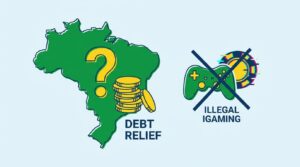
Brazil’s newly launched debt relief initiative, which prohibits enrolled participants from accessing gambling platforms for a full year, has drawn sharp scrutiny from the country’s gaming industry body. The Brazilian Institute of Responsible Gaming (IBJR) argues that unless regulators confront the sprawling illegal igaming market head-on, the program’s restrictions will amount to little more than a symbolic gesture. The warning comes at a moment when Brazil is still calibrating its regulatory framework for legal online gambling, making enforcement gaps especially consequential.
Why Brazil’s Gambling Ban Within Debt Relief May Not Hold
The logic behind the debt relief program’s gambling restriction is straightforward enough: individuals struggling with debt should not be funnelling money into betting platforms. On paper, the one-year ban creates a firewall between vulnerable consumers and financial risk. But the IBJR has pointed to a structural weakness that threatens to undermine the entire mechanism.
Unlicensed igaming operators, which continue to serve a significant share of Brazilian bettors, fall outside the reach of any regulatory enforcement tied to the debt relief program. That means a participant banned from licensed platforms could simply migrate to an unauthorised site with no technical or legal barrier stopping them. The restriction, in practice, only governs the behaviour of compliant operators.
And that asymmetry is the core problem.
What the IBJR’s Warning Signals for Regulated Operators
Before examining the strategic implications, it’s worth framing what this debate reveals about the broader state of play in Brazil’s igaming sector. The country authorised sports betting and online gambling under a 2023 regulatory framework, but implementation has been uneven. Licensed operators now face compliance obligations (including responsible gambling protocols and identity verification systems) that their unlicensed competitors simply ignore. The IBJR’s intervention highlights how this imbalance distorts the market and weakens consumer protection measures simultaneously.
- Licensed platforms bear the enforcement burden alone. Only operators within the regulated perimeter can be compelled to block enrolled debt relief participants, giving unlicensed sites a perverse competitive advantage.
- Consumer protection goals are structurally compromised. If vulnerable individuals can access unregulated gambling with no friction, the program’s public health rationale collapses.
- The IBJR’s position implicitly pressures Brazil’s Secretariat of Prizes and Betting (SPA) to accelerate crackdowns on illegal operators, not just as a market integrity issue but as a social policy imperative.
- Reputational risk for the government is real. A debt relief program that fails to actually shield participants from gambling losses could become a political liability, particularly given the scale of household debt in Brazil.
The Scale of Brazil’s Illegal Igaming Problem
Precise figures on the size of Brazil’s unlicensed gambling market remain elusive. No official estimate has been released by the SPA, though industry analysts have consistently described it as substantial relative to the licensed segment. The IBJR’s responsible gaming advocacy has long centred on the argument that regulation without enforcement creates a two-tier system where bad actors thrive unchecked.
Several hundred domains reportedly offered igaming services to Brazilian consumers before the licensing regime took effect. How many continue to operate without authorisation is a question regulators have not publicly answered. Still, the pattern is familiar across Latin America: regulated markets that fail to suppress illegal supply end up cannibalising their own tax base and consumer protections.
How Behavioural Framing Shapes the Policy Debate
There is a deeper dimension to this story that goes beyond enforcement mechanics. The debt relief program’s gambling ban rests on an assumption about behavioural change: that restricting access to platforms will reduce harmful gambling among financially distressed individuals. Arguably, this reflects a growing recognition among policymakers that financial vulnerability and gambling harm are deeply intertwined, not separate policy silos.
From a behavioural perspective, the effectiveness of any access restriction depends on what psychologists call the “friction cost” of alternatives. When licensed platforms are blocked but unlicensed ones remain a single search query away, the friction cost of continued gambling drops to near zero. The intervention fails not because the intent is wrong, but because the environment hasn’t been reshaped to support the desired outcome. Effective behavioural design requires closing alternative pathways, not just blocking the most visible one.
This principle applies well beyond gambling. Regulatory frameworks that target only compliant actors while leaving non-compliant channels open tend to produce what behavioural economists call a “substitution effect,” where restricted behaviour simply migrates rather than diminishes. Brazil’s situation is a textbook case. The debt relief program needs environmental redesign, not just individual-level restrictions, to achieve its stated goals. That redesign starts with making illegal platforms genuinely difficult to access through domain blocking, payment processing restrictions, and ISP-level enforcement.
Whether Brazilian regulators have the appetite or the technical infrastructure for that kind of crackdown remains an open question.
What Comes Next for Brazil’s Regulatory Approach?
| Regulatory Challenge | Current Status | Likely Next Step |
|---|---|---|
| Licensing enforcement | Ongoing but incomplete; many unlicensed operators still active | Expanded domain blocking and ISP cooperation |
| Debt relief gambling ban | Applies only to licensed platforms | Pressure to extend enforcement to payment processors |
| Responsible gambling standards | Mandated for licensed operators | IBJR pushing for industry-wide adoption benchmarks |
| Consumer data sharing | Limited coordination between debt relief and gambling regulators | Potential for integrated verification systems, though no timeline has been confirmed |
The IBJR’s public stance puts the SPA in a difficult position. Acknowledging the illegal market’s role in undermining the debt relief program means admitting that enforcement has lagged behind policy ambition. Yet ignoring the critique risks allowing a well-intentioned social program to become a case study in regulatory half-measures.
Frequently Asked Questions
What is Brazil’s debt relief gambling ban?
Individuals enrolled in the government’s debt relief program are prohibited from accessing gambling platforms for one year. The restriction is designed to prevent financially vulnerable consumers from compounding their debt through betting.
Why does the IBJR say the ban might not work?
Because unlicensed igaming operators are not subject to the same enforcement mechanisms. Participants blocked from legal platforms can still gamble on unauthorised sites without any barrier, which effectively neutralises the policy’s protective intent.
How large is Brazil’s illegal igaming market?
No official figure has been published. Industry observers describe it as significant, with hundreds of unlicensed domains having operated in the country prior to the regulatory framework’s rollout.
What would effective enforcement look like?
A combination of domain blocking, payment processing restrictions targeting unlicensed operators, and coordination between gambling regulators and the agencies administering the debt relief program. None of these measures are fully operational yet.



