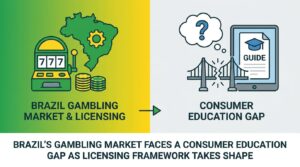
Hugo Baungartner, chief business officer at Grupo Esportes Gaming Brasil, has urged the industry and regulators to invest more heavily in consumer education, arguing that many Brazilian bettors still cannot distinguish between licensed and unlicensed gambling operators. The call comes as Brazil’s regulated sports betting and iGaming market enters a critical phase, with the federal licensing regime now operational but public understanding lagging behind. Baungartner’s comments underscore a tension that has shadowed the market since legislation was first approved: regulation means little if consumers don’t know it exists.
Why Consumer Literacy Matters for Brazil’s Betting Landscape
Before diving into the strategic implications, it’s worth grounding the discussion. Brazil’s regulated gambling market represents one of the largest new addressable audiences globally, with estimates placing the potential player base in the tens of millions. Yet the speed at which regulation has moved has outpaced public awareness, creating a gap that unlicensed operators can exploit. That gap is precisely what Baungartner wants closed.
- Unlicensed operators retain market share when consumers cannot verify which platforms hold valid authorisations from Brazil’s Secretaria de Prêmios e Apostas (SPA).
- Licensed operators face an uneven playing field, absorbing compliance costs that unauthorised competitors simply ignore.
- Regulatory credibility is at stake: a framework that consumers don’t understand is, in practice, a framework that doesn’t fully function.
- Public education campaigns could reduce problem gambling rates by steering players toward platforms with responsible gambling tools and deposit limits.
- Industry-led awareness efforts may prove faster and more targeted than government-driven campaigns, though both are arguably necessary.
The Licensing Regime: What’s Actually in Place
Brazil formalised its sports betting regulatory framework through Law 14.790, signed in late 2023, which established the rules for operator licensing, taxation, and consumer protection. The SPA, housed within the Ministry of Finance, oversees the process. Operators that secured licences were expected to begin operating under the new regime from January 2025, while those without authorisation were to be blocked.
But blocking unlicensed platforms has proven harder than drafting the law. Some operators continue to reach Brazilian consumers through alternative domains, social media advertising, and influencer partnerships that fall outside the immediate reach of enforcement. Baungartner’s point is straightforward: even perfect enforcement cannot substitute for a population that knows what to look for.
And while the government has taken steps (including ordering internet service providers to restrict access to unauthorised sites), the sheer volume of available platforms makes whack-a-mole enforcement a losing proposition without a more informed consumer base.
How Education Gaps Compound Market Risk
The consequences of consumer confusion extend beyond individual bettors losing money on unregulated sites. There are systemic risks. Unlicensed operators typically do not contribute tax revenue, do not comply with anti-money laundering protocols, and do not implement the responsible gambling measures that Brazilian law now requires. Every real spent on an unauthorised platform is a real that bypasses the regulatory architecture entirely.
For Grupo Esportes Gaming Brasil and its portfolio of licensed betting brands, the commercial incentive is obvious. But the public interest argument is genuine too. A market where consumers can identify licensed operators is a market where regulation actually delivers on its stated goals: channelisation, tax collection, and player protection.
Less clear is who should bear the cost of these awareness campaigns. Operators? The SPA? State governments? Baungartner has called for collaboration, though the specifics remain undefined.
A Comparison of Licensed vs. Unlicensed Operator Obligations
| Obligation | Licensed Operators | Unlicensed Operators |
|---|---|---|
| Tax contributions (GGR-based) | Required under Law 14.790 | None |
| Responsible gambling tools | Mandatory (deposit limits, self-exclusion) | Typically absent |
| AML compliance | Full KYC and reporting obligations | No oversight or verification |
| Consumer dispute resolution | Regulated channels available | No formal recourse for players |
| Advertising standards | Subject to SPA and CONAR rules | Often aggressive, unregulated marketing — particularly via social media influencers |
Shaping Consumer Behaviour Through Awareness: An NLP Perspective
Baungartner’s emphasis on education aligns with broader principles from behavioural communication, particularly those rooted in neuro-linguistic programming (NLP). At its core, NLP examines how language, framing, and mental models shape decision-making. In the context of gambling regulation, this matters enormously.
Consider how consumers process risk. Most bettors do not evaluate an operator’s licensing status the way a compliance officer would. They respond to visual cues, brand familiarity, peer recommendations, and the perceived ease of the experience. An unlicensed operator with a polished interface and aggressive welcome bonuses can feel more trustworthy than a licensed platform with a clunky registration flow. That’s not rational, but it is human.
Effective public awareness campaigns would need to anchor the concept of “licensed” to something emotionally resonant, not just legally accurate. NLP practitioners call this reframing: shifting the mental association from bureaucratic jargon to personal relevance. Instead of telling consumers that an operator “holds an SPA licence,” the message might be framed around what that licence protects — their money, their data, their ability to set limits and walk away.
Repetition and consistency matter too. A single government announcement will not rewire consumer habits. What changes behaviour is sustained, multi-channel messaging that meets people where they already are: on social media, in sports broadcasts, inside the betting apps themselves. The language needs to be simple, direct, and anchored in outcomes the bettor cares about. “This site protects your deposit” lands harder than “this site complies with federal regulation.”
Still, there’s a risk of oversimplification. Not every unlicensed operator is predatory, and not every licensed one delivers a superior experience (a distinction regulators have been slow to enforce). The goal isn’t to demonise one category but to give consumers the tools to make informed choices. Framing, in NLP terms, should empower rather than frighten.
Frequently Asked Questions
How can Brazilian consumers check if a gambling operator is licensed?
The SPA maintains a public registry of authorised operators. Consumers can verify a platform’s status by checking this list on the Ministry of Finance’s official website. If an operator does not appear, it has not been granted a licence to operate in Brazil.
What risks do players face on unlicensed platforms?
Players using unauthorised operators have no regulatory recourse if disputes arise over withdrawals, account closures, or bonus terms. These platforms also lack mandatory responsible gambling safeguards, and player funds are not subject to the same protections required of licensed operators.
Why hasn’t enforcement alone solved the problem?
The volume of unlicensed platforms, combined with the ease of creating new domains and marketing through social channels, makes pure enforcement a resource-intensive and reactive strategy. Consumer awareness acts as a complementary layer, reducing demand for unauthorised services rather than only restricting supply.
Is Brazil’s regulatory framework fully operational?
The core legislation and licensing process are in place. Enforcement mechanisms continue to evolve, and secondary regulations on advertising, responsible gambling specifics, and payment processing are still being refined by the SPA.



