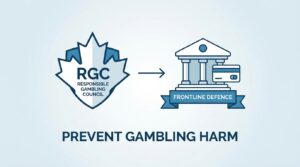
The Responsible Gambling Council (RGC) has formally called on Canadian financial institutions to take a more active role in identifying and preventing gambling-related harm. In a newly released position paper, the council argues that banks and credit card issuers sit on a trove of transactional data that could flag problematic wagering behaviour long before it spirals. With Ontario’s regulated gaming market expanding rapidly, the RGC contends that passive payment processing is no longer sufficient. The paper marks a significant escalation in how Canada’s gambling harm-prevention community views the responsibilities of the financial sector.
What the RGC Position Paper Signals for Financial Institutions
Before diving into the specifics, it’s worth framing the strategic stakes. This isn’t a regulatory mandate — at least not yet. But the RGC’s position paper carries weight in Canadian policy circles, and its recommendations tend to foreshadow where regulatory conversations head next. For banks, payment processors, and fintech firms operating in or adjacent to the gambling space, the implications are concrete and near-term.
- Financial institutions are being asked to integrate responsible gambling protocols directly into their operational frameworks, moving beyond compliance minimums
- Transaction monitoring systems could be repurposed — or enhanced — to detect patterns associated with problem gambling, such as high-frequency deposits to licensed operators or sudden spikes in gambling-related spending
- The RGC specifically highlights credit card issuers, suggesting that extending credit for gambling activity warrants additional scrutiny and potentially new consumer protections
- Ontario’s iGaming market, which has grown substantially since its 2022 launch, serves as the primary backdrop for these recommendations
- Banks that move early on voluntary adoption may position themselves favourably if provincial or federal regulators formalize similar expectations
Why Banks Are Uniquely Positioned — and Uniquely Exposed
The logic behind the RGC’s argument is straightforward. Banks see what operators cannot: the full financial picture of a consumer. A licensed sportsbook knows how much a customer deposits on its platform. It doesn’t know that the same customer deposited similar amounts across four other platforms that week, or that their mortgage payment bounced the day before.
That asymmetry matters.
Financial institutions, in theory, could aggregate these signals and trigger soft interventions — spending alerts, temporary blocks on gambling transactions, or referrals to support services. Some UK-based banks have already moved in this direction (a distinction Canadian regulators have been slow to replicate). Monzo, Starling, and several other challenger banks in Britain now offer voluntary gambling transaction blocks, and Barclays introduced similar features in 2022.
Whether Canadian banks will follow suit voluntarily remains an open question. The Responsible Gambling Council’s advocacy on financial sector engagement adds pressure, but the operational costs of building or retrofitting transaction monitoring systems for gambling-specific triggers are not trivial. And there’s a tension between consumer privacy expectations and the kind of behavioural surveillance these tools require.
Ontario’s Expanding Market Raises the Stakes
Ontario’s regulated iGaming market, overseen by the Alcohol and Gaming Commission of Ontario (AGCO) and operated through iGaming Ontario, has onboarded dozens of licensed operators since April 2022. Total wagers in the province have surged into the billions, and the number of active player accounts continues to climb quarter over quarter.
That growth is precisely what makes the RGC’s timing deliberate. More operators, more products, more consumer touchpoints — all of which increase the surface area for potential harm. The council’s paper doesn’t call for restricting market access. Instead, it argues for building a thicker safety net underneath the expanding ecosystem, with financial institutions forming a critical layer.
| Stakeholder | Current Role | RGC’s Proposed Role |
|---|---|---|
| Banks | Payment processing, account management | Active monitoring for gambling-related financial distress signals; voluntary spending controls |
| Credit Card Issuers | Extending credit, transaction authorization | Restricting or flagging gambling-funded credit use; enhanced disclosure |
| Payment Processors | Facilitating deposits/withdrawals to operators | Data sharing with financial institutions on transaction frequency and volume |
| Regulators (AGCO) | Licensing and operator oversight | Potentially coordinating cross-sector responsible gambling standards that include financial entities |
The Behavioural Science Angle: Reframing Financial Touchpoints
What makes the RGC’s proposal particularly interesting is its implicit reliance on behavioural nudging — a concept rooted in how people actually make decisions under financial stress, not how they ought to. Neuro-linguistic programming and behavioural economics share a foundational insight here: the context in which a choice is presented shapes the outcome far more than the information available at the time.
Consider the moment a consumer initiates a gambling deposit using a credit card at 2 a.m. The decision architecture around that transaction is almost entirely frictionless. No pause, no prompt, no reflection point. The RGC’s framework, if adopted, would insert what behavioural scientists call a “choice interrupt” — a brief, non-judgmental signal that reframes the action. Something as simple as a real-time notification showing cumulative monthly gambling spend can shift a consumer’s internal narrative from “this is just one more bet” to “I’ve spent $1,200 this month on gambling.”
This reframing technique draws on anchoring and pattern interruption, both well-established in behavioural intervention design. The financial institution becomes, in effect, a mirror — not a gatekeeper. Still, the distinction between helpful nudge and paternalistic surveillance is one that consumer advocates will scrutinize closely. Banks that get the framing wrong risk alienating customers. Those that get it right could build genuine trust with a demographic increasingly aware of gambling’s financial risks.
Even so, the effectiveness of these interventions depends heavily on implementation. A poorly timed or overly generic alert is noise. A well-calibrated one, informed by actual spending patterns and delivered at the right moment, can function as a genuine harm-reduction tool. The gap between those two outcomes is where the real design challenge lives.
Frequently Asked Questions
Has the RGC’s position paper created any binding obligations for Canadian banks?
No. The paper is a formal recommendation, not a regulatory instrument. It carries influence in policy discussions but does not impose legal requirements on financial institutions at this stage.
Are any Canadian banks currently offering gambling transaction blocks?
Voluntary gambling blocks are not yet a standard feature among major Canadian banks, though some fintech platforms have explored similar tools. The UK market is considerably further ahead on this front.
How does this relate to Ontario’s iGaming regulations?
Ontario’s AGCO regulates licensed operators, not financial institutions directly. The RGC’s paper argues for a broader, cross-sector approach that would bring banks into the responsible gambling framework — something current provincial regulations do not require.
Could this lead to federal regulation?
Arguably, yes — though the timeline is uncertain. Banking falls under federal jurisdiction in Canada, while gambling regulation is largely provincial. Any formal requirement for banks to implement gambling-specific monitoring would likely need coordination between both levels of government, which tends to move slowly.



