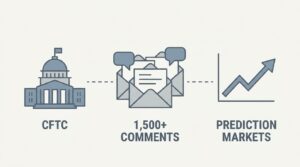
The Commodity Futures Trading Commission has collected more than 1,500 responses to its public requests for comment on the future of prediction markets in the United States. The volume of feedback signals intense interest from market participants, academics, and advocacy groups alike, all eager to shape how the agency approaches what it calls “responsible innovation.” At stake is the regulatory framework that will govern a rapidly expanding asset class sitting at the intersection of derivatives law, political forecasting, and retail speculation. Few recent CFTC consultations have drawn this level of engagement.
What 1,500 Responses Tell Us About the Prediction Markets Debate
The sheer number of submissions reflects a market that has outgrown its niche origins. Before diving into the strategic implications, it is worth recognizing that this comment volume places the prediction markets consultation among the more actively contested CFTC proceedings in recent memory.
- Regulatory appetite is real: The CFTC is actively soliciting input rather than reacting to enforcement triggers, suggesting a proactive posture toward establishing clearer rules for event-based contracts.
- Industry participation is broad: Responses reportedly span exchanges, fintech firms, academic researchers, and consumer advocacy organizations, indicating the issue touches multiple constituencies beyond traditional derivatives traders.
- The political dimension complicates things. Prediction markets tied to elections have drawn particular scrutiny, and the volume of comments likely reflects public sensitivity around that category of contracts.
- Retail interest is accelerating: Platforms offering event contracts to everyday users have grown substantially, and the regulatory outcome here will determine how far that expansion can go on US soil.
- Precedent is being set: Whatever framework emerges from this process will arguably serve as a template for how the CFTC handles novel contract types for years to come.
Why the CFTC Is Moving Now
Prediction markets are not new. But their recent surge into mainstream visibility, driven largely by platforms like Kalshi’s event-based trading platform, has forced regulators to confront questions they previously deferred. The CFTC’s authority over these instruments derives from the Commodity Exchange Act, which grants it jurisdiction over futures and swaps, including event contracts under certain conditions. Yet the boundaries remain contested (a distinction regulators have been slow to enforce).
A key catalyst was the legal battle between the CFTC and Kalshi over congressional election contracts, which a federal court ruled in Kalshi’s favor in 2024. That decision cracked open a door the agency had tried to keep shut, and the current comment-gathering exercise appears designed to reassert some measure of regulatory direction before the market defines its own terms entirely.
Still, the agency’s framing around “responsible innovation” suggests it is not seeking to shut prediction markets down. The language points toward accommodation with guardrails, not prohibition.
How Stakeholders Are Framing Their Positions
Among the 1,500-plus submissions, several fault lines are emerging. Exchanges and platform operators generally advocate for broader contract approval authority and streamlined listing processes. They argue that prediction markets serve a legitimate price-discovery function and that overly restrictive rules push activity offshore or into unregulated channels.
Consumer groups and some academics take a different view. Their concern centers on the potential for prediction markets to function as de facto gambling venues, particularly when contracts are tied to political outcomes or social events with no clear hedging purpose. The distinction between a derivatives market and a betting platform, at least on paper, rests on economic substance. Whether every event contract clears that bar is the harder question nobody has fully answered.
| Stakeholder Group | General Position | Primary Concern |
|---|---|---|
| Exchanges / Platforms | Favor expanded contract types | Regulatory bottlenecks and offshore migration |
| Academic Researchers | Mixed; see informational value | Market manipulation and thin liquidity in niche contracts |
| Consumer Advocacy Groups | Cautious or opposed to certain categories | Gambling-like exposure for retail participants |
| Traditional Derivatives Firms | Broadly supportive with conditions | Maintaining market integrity standards across new products |
The Regulatory Tightrope: Innovation vs. Integrity
What makes this consultation particularly consequential is the tension between two legitimate policy goals. On one side sits the desire to keep innovative financial products within a regulated US framework. On the other, the obligation to prevent speculative instruments from causing consumer harm or undermining public trust in democratic processes. And while the CFTC has historically leaned toward market-friendly interpretations of its mandate, the political sensitivity of election-linked contracts introduces a variable that pure economic analysis cannot resolve.
The agency’s next steps will likely involve synthesizing the comment record into proposed guidance or rulemaking. Given the volume and diversity of input, that process could stretch well into late 2025.
What Remains Less Clear
The CFTC has not indicated whether it plans to draw bright-line categories for permissible and impermissible event contracts, or whether it will adopt a principles-based approach that evaluates contracts case by case. The former offers certainty; the latter offers flexibility. Neither satisfies everyone.
Reframing the Narrative: What Decision-Makers Should Internalize
For executives and compliance teams operating in or adjacent to prediction markets, the psychological framing of this moment matters as much as the legal substance. Regulatory consultations of this scale tend to anchor future expectations. The positions staked out in these 1,500 comments will shape not just the CFTC’s immediate actions but the broader cognitive frame through which prediction markets are understood by policymakers, courts, and the public.
Consider the anchoring effect: once a regulatory body publicly associates prediction markets with “responsible innovation,” it becomes harder for subsequent enforcement actions to characterize the entire category as inherently problematic. Language choices in regulatory proceedings carry forward. They become reference points in litigation, in congressional testimony, and in the internal risk assessments that firms use to decide whether to enter a market at all.
There is also a framing dimension worth noting for market participants crafting their strategies. Those who position prediction markets as tools for information aggregation and risk transfer, rather than as entertainment or speculation vehicles, are aligning with the cognitive frame the CFTC itself has chosen. That alignment is not accidental, and firms that internalize it in their product design, marketing, and compliance architecture will likely find a smoother path through whatever regulatory structure emerges.
Conversely, platforms that lean into the gamification of event contracts may find themselves on the wrong side of a line that has not yet been drawn but is clearly being sketched. The 1,500 comments are the pencil marks.
Frequently Asked Questions
What are prediction markets?
Prediction markets are exchange-traded contracts where participants take positions on the outcome of future events, ranging from economic indicators to elections. They function similarly to derivatives but are tied to real-world occurrences rather than traditional financial assets.
Why is the CFTC involved?
Under the Commodity Exchange Act, the CFTC has jurisdiction over event contracts that fall within the definition of futures or swaps. The agency’s role is to determine which prediction market contracts are permissible and under what conditions they can be offered to US participants.
Will this lead to new regulations?
Possibly. The comment period is a standard precursor to rulemaking or formal guidance, though the timeline and scope remain uncertain. With over 1,500 submissions to process, any resulting action is unlikely before late 2025 at the earliest.
Are election-based prediction contracts legal in the US?
The legal status depends on the specific contract and how courts and the CFTC interpret existing law. A 2024 federal court ruling permitted certain congressional election contracts offered by Kalshi, but the broader regulatory picture is still taking shape.



