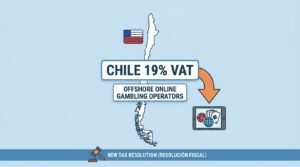
Chile’s tax authority, the Servicio de Impuestos Internos (SII), has formally required all non-resident online gambling operators serving Chilean users to register for and remit a 19% Value Added Tax on digital services. The mandate, issued through Exempt Resolution No. 69, pulls offshore betting, lottery, and casino game providers into the country’s existing simplified digital tax regime. Government projections estimate the measure will yield more than $100 million annually in new fiscal revenue, marking one of the most significant tax policy shifts targeting the iGaming sector in Latin America this year.
What Chile’s New Gambling Tax Framework Means for the Industry
Before diving into the strategic implications, it helps to understand the scale of what’s changing. Chile already taxes digital services provided by non-resident companies, but online gambling had until now occupied a grey zone, neither explicitly included nor formally excluded from the VAT framework. Resolution No. 69 eliminates that ambiguity.
- Revenue target: The Chilean government expects over $100 million per year from applying the 19% VAT to offshore gambling operators, a figure that reflects the growing volume of cross-border digital betting activity in the country.
- Scope of coverage: The resolution applies broadly to remote betting, lottery platforms, casino games, and analogous digital services offered to users physically located in Chile.
- Non-resident operators must now register with the SII, collect VAT at the point of transaction, and remit it directly to Chilean tax authorities.
- Compliance timeline: Operators are expected to act promptly, though the SII has not publicly detailed a grace period or phased enforcement schedule (a distinction that could matter significantly for smaller platforms).
- Regional precedent: Chile joins a growing list of Latin American jurisdictions tightening fiscal controls on digital gambling, following moves by Colombia, Argentina, and Brazil in recent years.
How the Simplified Digital Tax Regime Works
Chile’s simplified regime for taxing non-resident digital service providers was established to capture revenue from global technology and platform companies operating without a physical presence in the country. The mechanism is straightforward, at least on paper: foreign companies register with the SII, charge VAT on transactions with Chilean consumers, and file periodic returns.
What makes this extension notable is the sector it now covers. Online gambling transactions are inherently high-volume and high-frequency, which creates both an opportunity and a compliance burden. A single operator might process thousands of micro-transactions daily across sports betting, slots, and live dealer games. Applying VAT consistently at that scale demands robust payment infrastructure and real-time tax calculation capabilities.
Still, the architecture already exists. Chile modeled its digital services tax on OECD guidelines, and the Servicio de Impuestos Internos digital registration portal has been operational for several years. The question isn’t whether the system can handle gambling operators. It’s whether those operators will comply voluntarily or wait for enforcement actions to force the issue.
Why $100 Million Matters Beyond the Balance Sheet
The projected $100 million in annual revenue isn’t just a fiscal line item. It signals something broader about how Chile views the online gambling market: as a taxable economic activity worth formalizing rather than suppressing.
That framing matters. In jurisdictions where gambling is treated primarily as a vice to be restricted, tax policy tends to follow punitive logic. Chile’s approach here is more pragmatic. By folding offshore operators into an existing, relatively streamlined tax regime, the government avoids creating a separate regulatory apparatus while still capturing significant revenue. And the 19% rate, identical to what applies to streaming services, SaaS platforms, and other digital products, treats gambling as just another digital service.
Whether that equivalence holds up politically remains to be seen.
Competitive Dynamics Across Latin America
Chile’s move arrives at a moment when several Latin American markets are recalibrating their approach to online gambling regulation and taxation. Brazil launched its regulated sports betting market in 2024 with a 12% gross gaming revenue tax. Colombia has operated a licensed online gambling framework since 2016 through Coljuegos. Argentina’s provinces each maintain distinct regulatory regimes, creating a patchwork that operators find both frustrating and expensive to navigate.
| Country | Tax Model | Rate | Status |
|---|---|---|---|
| Chile | VAT on digital services | 19% | Newly mandated via Resolution No. 69 |
| Brazil | GGR tax | 12% | Operational since late 2024 |
| Colombia | GGR tax + licensing fees | Varies | Established framework since 2016 |
| Argentina | Provincial turnover taxes | Varies by province | Fragmented, ongoing reform discussions |
Chile’s VAT-based model differs structurally from the gross gaming revenue taxes used elsewhere. A VAT applies to the full transaction value, not just the operator’s margin, which could make Chile’s effective tax burden on operators considerably heavier than the headline rate suggests.
Compliance Pressure and Operator Response
For large multinational operators already registered under Chile’s digital services regime for other product lines, adding gambling to their VAT obligations is largely an administrative exercise. But for offshore-only gambling brands with no prior Chilean tax footprint, the registration and reporting requirements represent a meaningful new cost center.
Some operators may choose to block Chilean IP addresses rather than comply. Others will absorb the tax or pass it through to consumers via adjusted odds or platform fees. The SII has not yet clarified enforcement mechanisms for non-compliant operators, though payment processor cooperation and ISP-level blocking are tools other jurisdictions have deployed with mixed results.
Frequently Asked Questions
Does this resolution legalize online gambling in Chile?
No. Resolution No. 69 addresses tax obligations for non-resident digital service providers. It does not constitute a licensing or legalization framework for online gambling. Chile’s broader regulatory stance on gambling remains governed by separate legislation.
Which operators are affected?
Any non-resident company offering remote betting, casino games, lotteries, or similar digital gambling services to users located in Chile falls under the mandate. This includes operators based in jurisdictions like Malta, Curaçao, and Gibraltar that serve Chilean players remotely.
How does the 19% VAT compare to taxes in other regulated markets?
The 19% VAT applies to the full transaction amount, not the operator’s net revenue. In practice, this can result in a higher effective tax burden than the gross gaming revenue models used in markets like Brazil or Colombia, where the tax base is the operator’s margin rather than total wagers.
When does enforcement begin?
The resolution has been published, but the SII has not detailed a specific enforcement timeline or transition period. Operators should assume obligations are effective immediately absent further guidance.



