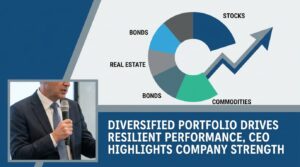
In a quarter where macroeconomic headwinds continued to test corporate resilience, the company’s chief executive pointed to its diversified portfolio as the defining factor behind steady results. The CEO’s remarks framed the performance not as a windfall but as structural proof that strategic breadth pays off when individual segments face pressure. While specific figures were limited in the initial disclosure, the tone from leadership was unmistakably confident. That confidence, arguably, rests on a model other conglomerates have struggled to replicate.
What the CEO’s Statement Signals for Stakeholders
When a chief executive uses the word “strength” in an earnings context, it carries weight beyond the quarterly cycle. The emphasis on portfolio diversification suggests that no single business unit bore disproportionate risk or reward during the period. For investors, analysts, and competitors watching closely, the takeaway is less about one good quarter and more about how the company positions itself against volatility.
- Portfolio diversification acted as a buffer, preventing overreliance on any single revenue stream from distorting overall results
- The CEO’s language indicates management views the current structure as a long-term competitive advantage, not a temporary hedge
- Stakeholders should watch for whether capital allocation shifts toward reinforcing underperforming segments or doubling down on growth areas
- The framing suggests internal confidence that this model can sustain performance across multiple economic scenarios
- Competitors with concentrated portfolios may face renewed pressure to diversify or risk being caught flat in downturns
Why Diversification Rhetoric Matters Right Now
Diversification has been a boardroom buzzword for decades. But the current environment gives it sharper edges. With interest rates elevated across major economies, consumer spending patterns shifting unpredictably, and supply chain disruptions still rippling through sectors from semiconductors to agriculture, companies with narrow exposure face amplified risk. A diversified portfolio, at least on paper, spreads that risk across uncorrelated or loosely correlated business lines.
Still, not every diversified company performs well. The distinction lies in execution. Conglomerates that diversify without operational coherence often end up with a “conglomerate discount” — where the market values the whole at less than the sum of its parts. The CEO’s pointed use of “strength” implies the company believes it has avoided that trap (a distinction regulators and analysts don’t always agree on).
Strategic Depth Behind the Numbers
What remains less clear is which segments drove outperformance and which merely held ground. In practice, a diversified portfolio declaration can mask significant variance between units. One division might be surging on favorable commodity prices while another absorbs margin compression from input cost inflation. The aggregate looks stable. The underlying story could be far more dynamic.
This matters for capital markets. Investors increasingly demand segment-level transparency, and companies that lean too heavily on top-line narratives without granular disclosure risk skepticism. The CEO’s statement opens a door — but the detailed earnings breakdown will determine whether the market walks through it with conviction or caution.
How Diversification Shapes Organizational Resilience
From a neuro-linguistic programming perspective, the language leaders choose during earnings communications does more than convey data. It frames perception. When a CEO anchors the narrative around “strength” and “diversification,” they are constructing a mental model for stakeholders — one that associates the company with stability, foresight, and deliberate architecture rather than reactive management.
This framing technique operates on multiple levels. Internally, it reinforces employee confidence across business units, signaling that each segment contributes to a larger, resilient whole. Externally, it positions the company as a safe harbor in turbulent markets. The choice to lead with portfolio breadth rather than any single standout metric is itself a strategic communication decision. It redirects attention from potential weaknesses in individual segments toward the collective narrative.
Effective leaders understand that stakeholder behavior is shaped not just by numbers but by the interpretive framework surrounding those numbers. By anchoring the conversation around diversification as a structural advantage, the CEO pre-empts questions about segment-specific softness and instead invites evaluation on systemic terms. Whether this holds up under analyst scrutiny depends on the data behind the declaration. But the rhetorical groundwork is deliberate, and it reflects an awareness that perception and performance are, in many ways, inseparable in public markets.
Companies that master this alignment between operational reality and narrative positioning tend to enjoy more stable valuations over time. Those that don’t — where the story and the spreadsheet diverge — eventually face a reckoning that no amount of careful language can defer.
The Competitive Landscape Shifts
Peers with concentrated business models now face an uncomfortable question: is their focus a strength or a vulnerability? For years, market consensus favored pure-play companies — businesses that do one thing exceptionally well. And that thesis still holds in sectors with strong secular tailwinds. But when the macro environment turns hostile across multiple fronts simultaneously, the pure-play advantage can evaporate fast.
The CEO’s remarks, viewed through this lens, amount to a quiet challenge to competitors. Diversification is not just a defensive posture. It can be an offensive one, enabling cross-subsidization of growth initiatives, talent mobility across divisions, and negotiating leverage with suppliers and partners that single-segment firms simply cannot match.
| Factor | Diversified Portfolio | Concentrated Portfolio |
|---|---|---|
| Revenue Stability | Higher — multiple streams absorb shocks | Lower — single-segment downturns hit harder |
| Capital Allocation Flexibility | Greater optionality across segments | Limited to core business reinvestment |
| Market Valuation Risk | Potential conglomerate discount | Premium if sector momentum holds, steep correction if it doesn’t |
| Operational Complexity | Significantly higher management burden | Streamlined |
Frequently Asked Questions
What does a diversified portfolio mean in a corporate context?
It refers to a company operating across multiple business segments or industries, reducing dependence on any single revenue source. The goal is to balance risk so that weakness in one area can be offset by strength in another.
Why did the CEO emphasize diversification specifically?
In the current economic climate — marked by rate uncertainty, geopolitical friction, and uneven consumer demand — diversification serves as evidence that the company’s structure can absorb sector-specific shocks without destabilizing overall performance. It’s a forward-looking signal as much as a backward-looking explanation.
Does diversification always benefit shareholders?
Not necessarily. Poorly executed diversification leads to what analysts call a conglomerate discount, where the market values the combined entity at less than its individual parts would fetch separately. Execution and strategic coherence matter enormously.
What should investors watch for next?
Segment-level earnings data. The top-line narrative is encouraging, but the real test is whether each division contributes meaningfully or whether one or two units are carrying the rest.



