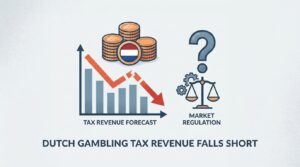
The Netherlands has collected significantly less tax revenue from its regulated gambling market than originally projected, according to a joint report from the Ministry of Finance and the Kansspelautoriteit (Ksa), the country’s gambling regulator. Over the past two years, the shortfall has prompted fresh scrutiny of the Dutch remote gambling framework introduced in October 2021. The findings land at a politically sensitive moment, with ongoing debates about advertising restrictions, licensing conditions, and the channelisation rate of Dutch players toward legal operators.
What the Revenue Gap Reveals About the Dutch Market
Before unpacking the broader implications, the core data point deserves attention. The Dutch government had built its fiscal projections on assumptions about how quickly licensed operators would capture market share from unlicensed competitors and grey-market channels. Those assumptions, at least on paper, have not held.
- Tax receipts from regulated online gambling have underperformed government forecasts for two consecutive years, suggesting either slower-than-expected channelisation or lower player spending within the licensed market.
- The gap between projected and actual revenue raises questions about whether the 29.5% gaming tax rate is suppressing operator competitiveness against unlicensed alternatives.
- Regulatory enforcement actions by the Ksa have intensified, but the persistence of unlicensed operators continues to divert potential tax revenue.
- Advertising curbs introduced in 2023 may have reduced the visibility of legal operators, inadvertently benefiting unregulated platforms
- The report’s timing coincides with broader European discussions about sustainable gambling taxation models, making the Dutch case a reference point for other jurisdictions.
A Tax Rate Under Pressure
The Netherlands levies a 29.5% tax on gross gaming revenue from remote gambling. That rate sits above the European median. Operators have argued, repeatedly, that such a burden limits their ability to offer competitive odds and bonuses compared to unlicensed sites that pay nothing. Whether or not one accepts that framing, the revenue data lends it some empirical weight.
Still, lowering the tax rate carries its own risks. A reduction would need to generate enough additional volume to offset the per-unit revenue loss (a bet regulators and finance ministries are rarely eager to make). And it would invite criticism from public health advocates who view higher taxation as a demand-side brake on gambling participation.
The Dutch government has not signalled any imminent rate adjustment. But the sustained underperformance creates a fiscal argument that will be difficult to ignore indefinitely.
Channelisation and the Unlicensed Market Problem
Channelisation is the metric that matters most here. It measures the share of total gambling activity flowing through licensed, regulated operators versus unlicensed ones. When the Dutch gambling authority first opened the regulated online market, expectations were high that legal operators would quickly dominate. The reality has been messier.
Several factors have slowed channelisation. The Ksa’s licensing process, while thorough, has been criticised for its pace. Some well-known international brands waited months or longer for approval, leaving market share on the table for unlicensed competitors who faced no such delays. Advertising restrictions, tightened significantly since 2023, have further constrained licensed operators’ ability to reach potential customers.
Enforcement against unlicensed operators has increased. The Ksa has issued fines and pursued payment blocking measures. Yet the sheer volume of offshore gambling sites accessible to Dutch players means enforcement remains, in practice, a game of attrition rather than elimination.
How Regulatory Design Shapes Revenue Outcomes
This situation illustrates a tension that extends well beyond the Netherlands. Governments designing regulated gambling markets face a triangular trade-off: maximise tax revenue, protect consumers, and suppress the illegal market. Optimising for one corner of that triangle often weakens performance on the others.
High tax rates generate more revenue per euro wagered legally, but they push price-sensitive players toward cheaper unlicensed alternatives. Strict advertising rules protect vulnerable populations but reduce the visibility advantage that legal operators need to pull players away from grey-market sites. Aggressive enforcement deters some unlicensed operators but requires sustained investment and cross-border cooperation that few regulators can maintain at scale.
The Dutch report, in effect, documents what happens when the balance tips too far toward consumer protection and taxation without sufficient counterweight on channelisation. That is not necessarily a policy failure. It may reflect a deliberate prioritisation. But the fiscal consequences are now measurable.
Broader European Context
Other European jurisdictions are watching. Germany’s fragmented regulatory rollout has encountered similar channelisation challenges. Italy and Spain have taken different approaches to tax rates and advertising, with varying results. The Dutch experience adds another data point to a growing body of evidence suggesting that post-liberalisation revenue projections across Europe have been systematically optimistic.
One question lingers beneath the surface of this report: did the original forecasts account for the behavioural complexity of a market in transition, or were they built on static assumptions about player migration that never reflected how gamblers actually make choices?
Frequently Asked Questions
What is the current gambling tax rate in the Netherlands?
The Netherlands applies a 29.5% tax on gross gaming revenue from licensed remote gambling operators. This rate has been a point of contention among operators who argue it limits their competitiveness.
Why is tax revenue lower than expected?
The shortfall appears linked to slower channelisation of players into the regulated market, combined with the continued presence of unlicensed operators and the impact of advertising restrictions introduced in 2023. Multiple factors are compounding rather than any single cause.
Has the Dutch government proposed changing the tax rate?
No formal proposal to adjust the rate has been announced. However, the persistent gap between forecasted and actual revenue may intensify political pressure to revisit the current framework.
What is channelisation in gambling regulation?
Channelisation refers to the proportion of total gambling activity that occurs through licensed, regulated operators rather than unlicensed or offshore platforms. Higher channelisation generally correlates with better consumer protection and greater tax revenue collection.