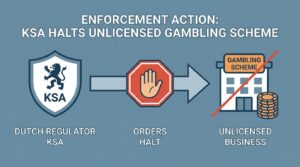
The Kansspelautoriteit (KSA), the Netherlands’ gambling regulatory authority, has taken enforcement action against an unnamed business operator for running what it classified as an unlicensed promotional game of chance. The company’s promotional campaign failed to comply with the country’s Promotional Games of Chance Code, crossing into territory the regulator considers unregulated gambling. What makes this case particularly striking is that the operator refused to comply even after a formal warning and a face-to-face meeting with KSA officials outlining the specific breaches.
Why the KSA’s Enforcement Against Promotional Gambling Matters
Promotional games of chance occupy a legally narrow space in the Netherlands. Businesses can offer prize-based campaigns to market their core products or services, but only within tightly defined parameters. When those boundaries are breached, what looks like a marketing tool becomes, at least on paper, an unauthorised gambling operation. This case underscores the regulator’s willingness to treat promotional overreach with the same seriousness it applies to unlicensed online casinos or sportsbooks.
- Regulatory escalation confirmed: The KSA moved from warning to formal cease-and-desist after the operator explicitly refused to adjust its promotional model, signalling that dialogue alone will not shield non-compliant businesses.
- Promotional campaigns under scrutiny: Any Dutch business using prize-based promotions must now treat the Promotional Games of Chance Code as a binding compliance framework, not a set of guidelines.
- The case sets a precedent for how the KSA handles commercial entities that blur the line between marketing and gambling architecture.
- Unnamed operator, named consequences: While the business has not been publicly identified, the enforcement action itself sends a clear message across sectors that rely on gamified customer engagement.
What the Promotional Games of Chance Code Actually Requires
Dutch law permits promotional games of chance under specific conditions. The campaign must be subordinate to the company’s primary commercial activity. Prizes cannot exceed certain thresholds. And participation must be free or tied to a purchase that the consumer would make regardless of the promotion. These are not abstract principles. They are codified requirements that the Dutch gambling authority KSA actively monitors and enforces.
The operator in question apparently structured its promotion in a way that detached the prize mechanism from legitimate marketing purposes. That detachment is what triggered the KSA’s classification of the activity as unauthorised gambling rather than a permissible promotional tool.
Where Marketing Ends and Gambling Begins
The distinction matters enormously. A supermarket running a scratch-card campaign tied to grocery purchases operates within the code. A business designing a standalone prize game that functions independently of its core product does not. The grey area between these two scenarios is where enforcement risk concentrates, and it is precisely where this operator appears to have positioned itself (a distinction regulators have been slow to enforce until recently).
The Operator’s Refusal and What It Signals
Perhaps the most notable element of this case is the operator’s decision to reject the KSA’s compliance guidance outright. After receiving an initial enforcement warning, the company was invited to a formal meeting where regulators laid out the specific violations. The operator declined to modify its promotional structure.
That refusal forced the KSA’s hand. A cease-and-desist order followed.
Still, the question lingers: why would a business choose confrontation over compliance when the regulatory framework is this explicit? One possibility is that the promotional model was too commercially valuable to restructure without undermining its effectiveness. Another is that the operator genuinely believed its campaign fell within permissible boundaries. Either way, the outcome is the same.
Broader Implications for Gamified Marketing in the Netherlands
This enforcement action arrives at a moment when gamification is embedded in marketing strategies across retail, hospitality, and digital commerce. Spin-the-wheel popups on e-commerce sites, app-based reward games, loyalty programmes with randomised prize elements: all of these sit somewhere on the spectrum between legitimate promotion and regulated gambling. The KSA’s action suggests it is drawing that line more aggressively than many businesses may have anticipated.
Companies operating in the Dutch market should consider several practical steps:
| Compliance Area | Action Required | Risk Level if Ignored |
|---|---|---|
| Prize value thresholds | Audit all promotional prizes against code limits | High — direct code violation |
| Linkage to core product | Ensure promotion is subordinate to primary business activity | High — reclassification as gambling |
| Free participation requirement | Verify no mandatory purchase is required for entry | Medium — consumer protection exposure |
| Documentation and transparency | Maintain records of campaign structure and legal review | Medium — weakens defence in enforcement proceedings |
How Businesses Can Reframe Compliance as Strategic Advantage
Regulatory pressure often triggers a defensive posture. But there is a more productive way to process this kind of enforcement signal. Businesses that proactively align their promotional strategies with the Promotional Games of Chance Code gain something competitors who cut corners do not: operational certainty. When a campaign is designed within clear legal boundaries from the outset, it can scale without the risk of an abrupt shutdown order disrupting customer engagement at its peak.
Framing compliance not as a constraint but as a design parameter shifts how marketing teams approach gamified campaigns. The most effective promotional games are those where the rules of engagement are transparent to both the consumer and the regulator. And in a market where the KSA has demonstrated it will escalate from dialogue to enforcement without hesitation, that transparency arguably becomes a competitive differentiator rather than a burden.
Organisations that invest in legal review at the campaign design stage, rather than retrofitting compliance after launch, reduce their exposure to exactly the kind of enforcement action this unnamed operator now faces. The cost of a pre-launch legal audit is trivial compared to the reputational and operational damage of a cease-and-desist order.
Frequently Asked Questions
Are promotional games of chance legal in the Netherlands?
Yes, but only when they comply with the Promotional Games of Chance Code. The campaign must be tied to a company’s primary commercial activity, prizes must stay within defined limits, and participation generally cannot require a purchase. Businesses that deviate from these conditions risk being classified as operating unauthorised gambling.
What happens if a company ignores a KSA cease-and-desist order?
The KSA has escalating enforcement tools at its disposal, including financial penalties. Continued non-compliance after a formal order can result in significant fines and, depending on the severity, potential criminal referral. The regulator has shown it will not rely on warnings alone.
Does this enforcement action apply only to gambling companies?
No. This case involved a business operator outside the traditional gambling sector. Any company running a promotional game of chance in the Netherlands falls under the KSA’s oversight for that specific activity, regardless of its primary industry.