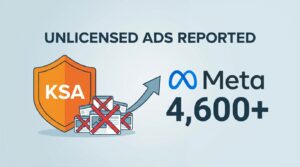
The Kansspelautoriteit (KSA), the Netherlands’ gambling regulator, has flagged more than 4,600 illegal gambling advertisements to Meta during its latest monitoring sweep. The sheer volume of reports underscores how deeply unlicensed operators have embedded themselves in social media ecosystems, particularly Facebook and Instagram. It also signals a shift in KSA’s posture: from periodic enforcement to what increasingly resembles a sustained, industrial-scale campaign against offshore gambling entities targeting Dutch consumers.
What KSA’s Ad Blitz Against Meta Means for the Market
The 4,600-plus reports represent far more than a bureaucratic exercise. They reveal the structural tension between platform-based advertising models and national regulatory frameworks that were never designed for the speed and scale of social media. For industry stakeholders, the implications cut across compliance, platform accountability, and market integrity.
- Scale of unlicensed activity is staggering: Over 4,600 flagged ads in a single monitoring period suggests that unlicensed operators view Dutch-language social media as a high-value acquisition channel, despite the legal risks.
- Meta faces mounting regulatory scrutiny: The KSA’s decision to publicly disclose the volume of reports puts direct pressure on Meta to demonstrate that its ad review systems can filter gambling content effectively.
- Platform enforcement gaps are now a matter of public record, not speculation.
- Licensed operators lose ground: Every unlicensed ad that reaches a Dutch consumer is a competitive distortion. Operators who invested in KSA licences bear compliance costs that their offshore rivals simply ignore.
- Regulatory posture is hardening: This is not a one-off action. The KSA has been building toward mass enforcement, and the ad reporting campaign fits a broader pattern of escalation that includes fines, domain blocking, and payment processing interventions.
From Targeted Research to Mass Enforcement
For years, the KSA’s approach to unlicensed gambling was largely reactive. Complaints would surface, investigations would follow, and penalties would land months later. That model has clearly shifted. The regulator now conducts proactive, systematic monitoring of social media platforms, treating advertising channels as frontline enforcement terrain rather than peripheral concerns.
What changed? In part, the Dutch regulated market itself. Since the Netherlands opened its legal online gambling framework in October 2021, the KSA has faced growing pressure to justify the licensing regime’s value. If unlicensed operators can freely advertise on platforms used by millions of Dutch citizens, the credibility of the entire regulatory architecture erodes. And with it, public trust.
The 4,600 reports to Meta are, arguably, as much a political statement as a regulatory one.
Why Social Media Remains the Weak Link
Platforms like Facebook and Instagram operate global advertising systems that process millions of ad submissions daily. Gambling ads from unlicensed operators often exploit this scale, using localised targeting, short-lived campaigns, and creative variations that evade automated filters. By the time a flagged ad is removed, the operator may have already launched three replacements.
The Dutch gambling authority’s enforcement portal has documented this cat-and-mouse dynamic repeatedly. Still, the question of platform liability remains unresolved in most European jurisdictions (a distinction regulators have been slow to enforce). Meta is not legally classified as a gambling operator, and its obligations under Dutch advertising law differ substantially from those of the advertisers themselves.
That gap matters. It means the KSA can report thousands of ads, but compelling Meta to prevent them at the point of submission requires either new legislation or a negotiated compliance framework that doesn’t yet exist at scale.
How Unlicensed Operators Exploit the System
The mechanics are worth understanding. Unlicensed gambling operators typically use a combination of tactics to reach Dutch audiences through social media:
| Tactic | How It Works | Regulatory Challenge |
|---|---|---|
| Geo-targeted ads | Ads served exclusively to users in the Netherlands based on IP and language settings | Difficult to detect without platform-level access to targeting data |
| Ephemeral campaigns | Ads run for hours or days before being voluntarily pulled | Enforcement timelines are too slow to catch short-lived placements |
| Affiliate-driven content | Third-party affiliates promote unlicensed brands, adding a layer of separation from the operator | Attribution becomes complex; the operator can deny direct involvement |
| Creative rotation | Multiple ad variations submitted simultaneously to bypass pattern-based filters | Automated detection systems struggle with high-volume creative diversity, and manual review at this scale is impractical |
The Broader European Context
The Netherlands is not alone in wrestling with this problem. Regulators across Europe have increasingly turned their attention to the role of tech platforms in facilitating unlicensed gambling promotion. Italy’s ADM, Spain’s DGOJ, and Belgium’s Gaming Commission have all taken steps to address social media advertising by offshore operators, though approaches vary widely.
But the KSA’s willingness to publish specific numbers sets it apart. By disclosing 4,600 reports in a single period, the regulator is effectively building a public evidence base. Whether that evidence eventually supports legislative action at the EU level or feeds into the Digital Services Act’s evolving enforcement framework remains to be seen.
One thing is less ambiguous: the political appetite for holding platforms accountable is growing faster than the legal tools to do so.
What Licensed Operators Should Watch For
For companies holding KSA licences, this enforcement wave carries both risks and opportunities. On one hand, a cleaner advertising environment benefits those who play by the rules. On the other, heightened regulatory attention tends to spill over. When regulators sharpen their tools against unlicensed actors, they often recalibrate expectations for licensed ones too.
Operators active in the Dutch market through Meta’s advertising platforms should anticipate tighter ad approval processes, more granular targeting restrictions, and potentially new reporting obligations. The KSA has signalled that it views advertising compliance as a continuum, not a binary.
Frequently Asked Questions
Why did the KSA report over 4,600 ads to Meta specifically?
Meta operates Facebook and Instagram, two of the most widely used social media platforms in the Netherlands. Unlicensed gambling operators disproportionately target these channels due to their sophisticated ad targeting capabilities and massive Dutch user base. The KSA’s reports reflect where the problem is most concentrated.
Can Meta be fined for hosting unlicensed gambling ads?
Under current Dutch law, the primary liability sits with the advertiser, not the platform. However, the regulatory and political landscape is shifting. The EU’s Digital Services Act introduces new obligations for very large online platforms regarding illegal content, which could eventually change the calculus for Meta and similar companies.
What happens to operators caught advertising without a licence?
Penalties vary. The KSA can impose administrative fines, pursue domain blocking through Dutch ISPs, and coordinate with payment processors to cut off financial flows. Repeat offenders face escalating sanctions, though enforcement against entities based outside the EU remains practically difficult.
Does this affect legal gambling advertising in the Netherlands?
Indirectly, yes. The Netherlands already restricts gambling advertising significantly, including a ban on untargeted online ads. As enforcement against unlicensed operators intensifies, licensed operators may face additional scrutiny on their own advertising practices to ensure full compliance with evolving standards.



