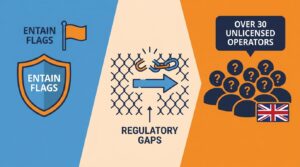
Entain, the parent company behind Ladbrokes and Coral, has raised alarm over more than 30 unregulated gambling operators it says are actively targeting UK audiences. The finding, drawn from the company’s own research, throws a sharp light on the growing presence of unlicensed platforms operating outside the oversight of the UK Gambling Commission. At a time when licensed operators face tightening compliance requirements, the revelation underscores a widening asymmetry between regulated and unregulated corners of the market.
What Entain’s Research Reveals About the Unlicensed Market
Before unpacking the strategic implications, the core findings deserve attention. Entain’s research identified a cluster of offshore and unlicensed operators that appear to be marketing directly to British consumers, often through social media channels, affiliate networks, and search engine advertising. These platforms operate without a UK licence, meaning they fall outside the Gambling Commission’s enforcement perimeter on issues like responsible gambling, anti-money laundering controls, and consumer redress.
- Scale of the problem: Over 30 unregulated operators were identified as targeting UK-based players, a figure Entain describes as conservative given the difficulty of tracking offshore activity comprehensively.
- Consumer protection vacuum: Players using these platforms have no access to the dispute resolution, self-exclusion tools, or deposit limits mandated for licensed operators.
- The unlicensed sites often replicate the look and feel of regulated brands, making it harder for consumers to distinguish between the two.
- Competitive distortion: Licensed operators bear the cost of compliance while unlicensed rivals operate with virtually none, creating an uneven playing field that arguably penalises those who follow the rules.
- Regulatory signal: The disclosure puts pressure on the Gambling Commission and the UK government to address enforcement gaps, particularly as the long-awaited gambling white paper reforms continue to take shape.
Why This Matters Now
The timing is not incidental. UK-licensed operators have spent the past two years adapting to a wave of regulatory tightening, from affordability checks to stake limits and enhanced due diligence requirements. Each measure adds operational cost. And while the intent behind these reforms is sound (a distinction regulators have been slow to reconcile with market realities), the unintended consequence is a growing incentive for some consumers to migrate toward platforms that impose no such friction.
Entain’s disclosure lands at a moment when the industry is actively debating whether stricter regulation, without parallel enforcement against unlicensed operators, risks shrinking the regulated market rather than making it safer.
The Enforcement Challenge Facing UK Regulators
Shutting down offshore operators is notoriously difficult. The Gambling Commission can issue warnings, block payment processing, and request that internet service providers restrict access. But these tools have limits. Operators based in jurisdictions with minimal regulatory cooperation can simply rebrand, shift domains, or route traffic through new channels. The whack-a-mole dynamic is well documented across other regulated sectors, from financial services to pharmaceuticals.
Still, the Commission has not been entirely passive. It maintains a list of unauthorised operators and has pursued enforcement actions against some entities. Whether those efforts match the scale of the problem Entain describes is another question entirely.
One approach gaining traction in policy circles involves closer collaboration between regulators, payment providers, and advertising platforms. If unlicensed operators cannot process deposits from UK-issued cards or purchase ads targeting UK IP addresses, their ability to reach consumers diminishes substantially. That shift matters because it moves enforcement upstream, targeting the infrastructure rather than the operator itself.
How Unlicensed Operators Reach UK Players
| Channel | Method | Regulatory Visibility |
|---|---|---|
| Social media | Paid ads, influencer partnerships | Low — platforms inconsistently enforce gambling ad policies |
| Affiliate networks | Commission-based referral links embedded in content sites | Moderate — some affiliates are licensed, many are not |
| Search engines | SEO and paid search targeting UK gambling keywords | Variable — depends on ad platform enforcement |
| Direct messaging | Telegram groups, WhatsApp promotions | Virtually none |
What This Means for the Broader Industry Landscape
For Entain’s portfolio of licensed UK gambling brands, the message is strategic as much as it is regulatory. By publicly quantifying the unlicensed threat, the company positions itself as a responsible actor while implicitly arguing that compliance costs must be weighed against the risk of driving consumers toward less safe alternatives. It is a framing that other major operators, including Flutter Entertainment and bet365, have echoed in various forms.
Yet not all stakeholders see it the same way. Campaigners for stricter gambling regulation have pushed back on what they view as industry attempts to use the unlicensed market as leverage against tighter rules. Their argument: the existence of unlicensed operators does not justify weakening protections for consumers who remain within the regulated ecosystem.
Both positions hold weight. And resolving the tension between them will likely define the next phase of UK gambling policy.
Reframing Risk: How Operators and Regulators Can Shift the Narrative
From a behavioural perspective, the challenge is partly one of perception. Consumers who migrate to unlicensed platforms often do so not because they seek to evade regulation, but because they encounter fewer barriers to play. The friction introduced by affordability checks or enhanced verification, while designed to protect, can feel punitive to users who do not perceive themselves as at risk. This gap between regulatory intent and consumer experience is where behavioural insight becomes critical.
Operators who invest in clear, transparent communication about why these checks exist tend to retain more customers through the process. Framing responsible gambling tools as empowering rather than restrictive shifts the psychological dynamic. Language matters here: telling a customer “you’re in control of your limits” lands differently than “we are required to verify your affordability.” The first invites agency. The second signals bureaucracy.
Regulators, too, could benefit from reframing their public messaging. Rather than positioning enforcement as punitive, emphasising the tangible consumer harms associated with unlicensed platforms (loss of funds, identity theft, absence of recourse) creates a more compelling case for staying within the regulated market. In practice, this means investing in consumer education campaigns that meet players where they already are: on social media, in search results, and within the digital environments where unlicensed operators recruit.
The most effective deterrent against unlicensed migration may not be enforcement alone. It may be making the regulated experience good enough that consumers see no reason to leave.
Frequently Asked Questions
What does it mean for a gambling operator to be “unlicensed” in the UK?
An unlicensed operator is one that offers gambling services to UK consumers without holding a licence from the UK Gambling Commission. These operators are not subject to UK rules on responsible gambling, data protection, or anti-money laundering, and consumers using them have no regulatory recourse if something goes wrong.
Can UK players be penalised for using unlicensed gambling sites?
Under current UK law, the regulatory burden falls on operators, not individual consumers. Players are not typically prosecuted for using unlicensed platforms, though they forfeit the protections that come with regulated sites.
How many unlicensed operators target the UK market?
Entain’s research identified over 30, but the actual number is likely higher. Offshore operators frequently change domains and branding, making comprehensive tracking difficult even for regulators with dedicated resources.
What is the Gambling Commission doing about it?
The Commission maintains a public register of unauthorised operators and has tools including payment blocking and ISP restrictions. Whether these measures are sufficient given the scale of the problem remains an open and contested point across the industry.