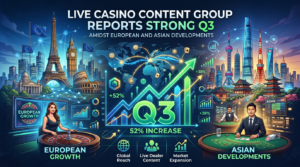
In a move that underscores the growing convergence between content creation and platform distribution, the company has launched its first dedicated igaming studio alongside a broader slate of new additions to its portfolio. The studio represents a deliberate pivot from licensing third-party content to building proprietary games in-house. For an operator that has historically leaned on partnerships, this is not a minor adjustment. It is a structural bet on vertical integration.
What This Studio Launch Means for the Business
The decision to invest in a proprietary igaming studio carries implications that extend well beyond product diversification. Below are the strategic takeaways worth tracking:
- Margin control: Developing games internally eliminates revenue-sharing arrangements with third-party providers, potentially improving gross margins on every spin and hand dealt.
- Content differentiation: In a market saturated with reskinned slots and table games, exclusive titles offer a genuine competitive edge that aggregated libraries simply cannot replicate.
- Speed to market increases when the studio sits under the same corporate umbrella as the distribution platform.
- Data feedback loops: Owning both the content and the player interface creates tighter analytics cycles, allowing game mechanics to be refined based on real-time behavioral data rather than quarterly reports from external suppliers.
- Regulatory positioning: Proprietary content gives the company direct oversight of compliance features such as responsible gambling triggers, RTP transparency, and jurisdictional customization.
Why Vertical Integration Is Gaining Traction in iGaming
The igaming sector has, for years, operated on a relatively fragmented model. Operators ran platforms; studios built games; aggregators stitched the two together. That model worked when the priority was breadth of catalog. But the economics have shifted. Player acquisition costs have climbed sharply across regulated markets, and retention now hinges less on volume and more on the quality and exclusivity of the experience.
Several major operators have already moved in this direction. Flutter Entertainment, for instance, has invested in proprietary content through its global portfolio of brands, recognizing that exclusive games drive longer session times and higher lifetime value per player. Evolution Gaming built an empire on the premise that owning the studio gives you pricing power. And while not every operator can replicate that scale, the logic holds at smaller levels too.
What remains less clear is whether the company’s studio will focus on slots, live dealer formats, or something more experimental. Each carries different capital requirements and regulatory hurdles.
The Talent and Technology Question
Building a studio from scratch is not simply a matter of hiring a few game designers and licensing a math engine. It requires a layered investment in creative talent, certification infrastructure, and scalable technology stacks that can handle multi-jurisdictional deployment. The company will need to attract experienced game mathematicians (a notoriously scarce talent pool in the industry), UX designers who understand the psychology of play, and compliance engineers who can navigate the patchwork of global licensing regimes.
That last point deserves emphasis. A game certified for the UK market under Gambling Commission standards may require significant rework to meet Malta Gaming Authority or Ontario’s iGaming requirements. Studios that underestimate this fragmentation tend to burn through launch timelines quickly.
How Player Psychology Shapes Studio Strategy
One dimension often underexplored in industry coverage is how neuro-linguistic programming principles and behavioral psychology inform modern game design. Successful igaming studios do not just build games that look good. They engineer experiences that align with how players process reward, risk, and anticipation at a cognitive level.
Consider the role of anchoring. When a player sees a near-miss on a slot reel, their brain registers it not as a loss but as proximity to a win, which sustains engagement. The framing effect matters too: presenting a bonus round as “unlocked” rather than “triggered” subtly shifts the player’s sense of agency. These are not manipulative tricks when deployed responsibly; they are design choices rooted in how humans naturally interpret sequences and outcomes.
Proprietary studios have a distinct advantage here. They can A/B test these psychological levers directly against their own player base, iterating on sound design, visual pacing, and reward scheduling without waiting for a third-party provider’s development cycle. The feedback loop is tighter, and arguably more honest, because the operator sees both the game data and the player behavior data in one view.
Rapport-building with players also shifts when the content feels native to the platform. Players develop brand associations with specific game mechanics, art styles, or bonus structures. Over time, this creates a form of platform loyalty that transcends any single title.
What Comes Next
The studio’s first releases will be closely watched, not just for commercial performance but for signals about the company’s longer-term content strategy. Will it pursue high-volatility slots aimed at experienced players, or lean toward casual formats designed to broaden the demographic base? The answer will reveal whether this is a margin play or a growth play.
Still, the launch itself sends a clear message to competitors and suppliers alike: the company intends to own more of its value chain. In an industry where differentiation is increasingly difficult to sustain through third-party catalogs alone, that ambition is, at minimum, well-timed.
Frequently Asked Questions
What is a dedicated igaming studio?
A dedicated igaming studio is an in-house game development operation owned and operated by a platform or operator, rather than outsourced to a third-party content provider. It handles everything from concept design to regulatory certification.
Why are operators building their own studios instead of licensing games?
The short answer: margins and exclusivity. Licensing third-party games means sharing revenue and offering the same content competitors already carry. Proprietary studios solve both problems simultaneously, though they require significant upfront investment in talent and technology.
How does this affect players?
Players can expect more exclusive titles that are tailored to the specific platform’s audience. In practice, this often translates to games with tighter integration into loyalty programs, faster feature updates, and mechanics designed around actual player behavior on that platform rather than generic market assumptions.