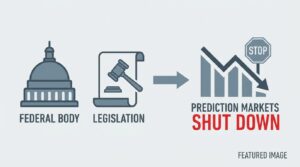
A federal body has publicly characterized recently introduced legislation as the “most aggressive” effort yet to eliminate prediction markets in the United States. The move signals an intensifying regulatory battle over platforms that allow users to wager on the outcomes of real-world events, from elections to economic indicators. With prediction markets gaining mainstream traction following high-profile election cycles, the stakes for operators, investors, and regulators have never been sharper. What unfolds next could determine whether this asset class survives in its current form on American soil.
Why This Legislative Push Matters for Prediction Market Operators
Before diving into the specifics, it helps to frame the broader significance. Prediction markets sit at an uncomfortable intersection of finance, gambling, and information science. Regulators have struggled for years to classify them consistently, and that ambiguity has allowed platforms to grow rapidly (a distinction regulators have been slow to enforce). The new legislation, however, represents a departure from piecemeal enforcement actions toward a comprehensive statutory prohibition.
- Direct threat to platform viability: If enacted, the law would effectively bar U.S.-based prediction market operators from offering contracts on certain event categories, particularly political outcomes.
- Regulatory precedent: The legislation could establish a framework that other jurisdictions adopt, compounding the impact well beyond U.S. borders.
- Investor confidence in the sector faces immediate pressure, with several venture-backed platforms reportedly reassessing their U.S. growth strategies.
- Consumer access narrows: Retail participants who have used these markets as hedging or information-gathering tools would lose a channel that, at least on paper, served a legitimate analytical function.
- The bill’s language appears broad enough to capture decentralized prediction protocols, not just centralized exchanges.
The Regulatory Landscape That Led Here
Prediction markets have operated in a gray zone for over a decade. The Commodity Futures Trading Commission (CFTC) has historically exercised jurisdiction over event contracts, approving some while blocking others. Kalshi, one of the most prominent regulated platforms, won a federal court ruling in 2024 that allowed it to list election-related contracts. That victory, while celebrated by market proponents, arguably accelerated the legislative backlash now taking shape.
And while the CFTC’s approach has been case-by-case, this new bill seeks to bypass that incremental process entirely. Lawmakers backing the legislation have framed prediction markets as thinly veiled gambling operations that erode public trust in democratic institutions. The federal body’s own characterization of the bill as the “most aggressive” attempt yet suggests even regulators recognize the shift in tone.
Still, not all market participants agree on this point. Some industry voices argue the legislation is a reaction to a single election cycle rather than a measured policy response. Whether that framing holds up under committee scrutiny remains an open question.
How Platforms Like Kalshi and Polymarket Are Positioned
The two names most frequently associated with prediction markets tell very different stories. Kalshi’s regulated prediction exchange has built its model around CFTC compliance, investing heavily in legal infrastructure to operate within existing frameworks. Polymarket, by contrast, has leaned into decentralized architecture and largely served non-U.S. users following earlier regulatory friction.
The proposed legislation threatens both models, albeit differently. For Kalshi, a statutory ban could render its regulatory investments moot overnight. For decentralized platforms like Polymarket, enforcement becomes technically harder but politically easier to justify if a clear statute exists.
| Factor | Kalshi | Polymarket |
|---|---|---|
| Regulatory model | CFTC-regulated, centralized | Decentralized, primarily non-U.S. users |
| Exposure to proposed ban | High — direct statutory conflict | Moderate — enforcement complexity, but political vulnerability increases |
| Revenue impact | Potentially existential for U.S. operations | Limited near-term; long-term risk if global regulators follow |
| Legal strategy | Likely to challenge constitutionality | May rely on jurisdictional arbitrage |
What the Industry’s Response Reveals About Its Maturity
One telling detail: the prediction market industry has not mounted a unified lobbying front. Individual platforms have issued statements, and trade associations adjacent to fintech have weighed in, but there is no coordinated campaign comparable to what the cryptocurrency sector assembled during its own regulatory battles in 2022 and 2023. That gap matters. Legislative fights are won through organized advocacy, not press releases.
The absence of a cohesive industry voice may reflect how young and fragmented the sector remains. Or it may signal that some operators are quietly preparing to relocate rather than fight.
Reframing the Narrative: Information Markets vs. Gambling
Proponents of prediction markets have long argued that these platforms generate uniquely valuable information. Academic research from institutions including the University of Iowa, which operated one of the earliest prediction markets, has demonstrated that event contracts can outperform polls and expert forecasts in certain conditions. The informational defense is arguably the strongest card the industry holds. But it requires a level of public education that has not yet occurred at scale.
Legislators pushing the ban have effectively controlled the framing: gambling dressed up as data science. Reversing that perception demands more than white papers. It demands stories, endorsements from credible non-industry voices, and evidence that ordinary citizens benefit. Whether the industry can pivot to that kind of communication before the bill advances through committee is, in practice, the most consequential variable right now.
Frequently Asked Questions
What are prediction markets?
Prediction markets are platforms where participants buy and sell contracts tied to the outcome of future events. Prices reflect the collective probability assessment of those outcomes, functioning as a real-time forecasting mechanism.
Would this legislation ban all prediction markets?
The bill’s scope appears broad, targeting event contracts related to political outcomes and potentially extending to other categories. However, the final text and any amendments during committee review will determine exact boundaries. Much depends on how “event contract” gets defined in the statute.
Can decentralized prediction markets be shut down?
Technically, decentralized protocols are harder to shut down than centralized exchanges. But regulators can target front-end interfaces, payment on-ramps, and U.S.-based participants. Enforcement is difficult, not impossible.
How does this compare to crypto regulation?
There are parallels in the jurisdictional ambiguity and the tension between innovation and consumer protection. Yet prediction markets face an additional layer of political sensitivity that crypto largely does not, particularly around election-related contracts.



