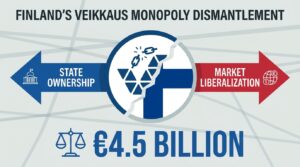
Finland’s political establishment is fracturing over the future of Veikkaus, the state-owned gambling operator, as the country moves toward ending its decades-old monopoly model. A parliamentary survey conducted by national broadcaster Svenska Yle reveals deep ideological splits on whether the government should retain full ownership, pursue partial divestiture, or sell the enterprise outright before the decade closes. At stake is an operator valued at an estimated €4.5 billion, one that currently channels roughly €450 million in annual gaming surplus directly into state coffers.
What the Veikkaus Ownership Debate Means for Finland’s Gambling Future
The survey results expose something more than routine policy disagreement. They signal a fundamental rethinking of how Finland views state participation in commercial gambling, a sector undergoing regulatory transformation across the European Union. Before diving into the strategic implications, here are the critical takeaways from the emerging political landscape:
- A €4.5 billion enterprise valuation makes any ownership decision consequential for Finland’s public finances, particularly given the operator’s annual €450 million contribution to the treasury
- Parliamentary opinion is split three ways: full state retention, partial privatisation, and complete divestiture, with no single position commanding a clear majority
- The monopoly dismantlement timeline creates urgency, as structural decisions about Veikkaus will shape how Finland’s licensed gambling market develops
- Finland’s approach could set a precedent for other Nordic and EU member states still operating under state monopoly frameworks
- Whoever controls Veikkaus post-reform will inherit both a dominant market position and significant regulatory obligations tied to responsible gambling mandates
The Numbers Behind the Political Friction
Sector specialist Jari Vähänen’s operational figures frame the debate in stark financial terms. Veikkaus generates approximately €450 million annually for the Finnish state, a revenue stream that funds education, culture, sports, and social welfare programmes. That figure alone makes the operator a fiscal pillar. But the enterprise valuation, estimated at roughly ten times the annual surplus, introduces a different calculus entirely.
A full sale at €4.5 billion would deliver an enormous one-time windfall. Yet it would also sever a recurring income stream that successive Finnish governments have relied upon for decades. Partial divestiture offers a middle path (though not without its own complications around governance, dividend policy, and regulatory independence). And retaining full ownership while opening the market to competition raises the question of whether Veikkaus can compete effectively against private operators unburdened by public-interest mandates.
None of these options is cost-free.
Why the Monopoly Model Is Ending
Finland’s gambling monopoly has faced mounting pressure from multiple directions. EU single-market principles have long sat uncomfortably alongside exclusive state licensing arrangements, and the growth of cross-border online gambling has eroded the practical enforceability of monopoly protections. Finnish consumers already access offshore operators in significant numbers, a reality that undermines the channelisation rationale underpinning the monopoly.
The shift toward a licensing system aligns Finland with the trajectory already taken by Sweden, Denmark, and the Netherlands. Sweden’s experience is particularly instructive: when Svenska Spel lost its monopoly in 2019, the transition produced both a surge in licensed competition and persistent challenges with unlicensed offshore operators. Finland’s policymakers are watching those outcomes closely, even as they disagree on what role Veikkaus should play in a competitive Finnish gambling market.
Ideological Lines and Coalition Arithmetic
The Svenska Yle survey maps the divide along broadly predictable ideological lines, but with notable exceptions. Parties on the centre-left tend to favour retaining state ownership, citing public health protections and the social funding model. Centre-right and liberal factions lean toward partial or full privatisation, arguing that market competition drives efficiency and that the state’s role should be regulatory, not operational.
Still, coalition dynamics complicate any clean reading. Finland’s multi-party system means that gambling policy will likely be shaped by compromise rather than conviction. What remains less clear is whether any coalition configuration can deliver a stable, long-term ownership framework before the monopoly formally ends. Delay itself carries risk: market uncertainty depresses valuation, deters potential investors, and leaves Veikkaus in strategic limbo.
Reframing the Decision: Beyond Revenue Arithmetic
Much of the public discourse has centred on financial returns, and understandably so. But reducing the Veikkaus question to a revenue optimisation problem misses several layers of complexity that will arguably matter more over time.
Consider the responsible gambling dimension. State-owned operators typically face stronger political pressure to invest in harm prevention, self-exclusion tools, and advertising restraint. Private operators, while subject to regulatory requirements, optimise for shareholder returns. The tension between commercial viability and public health outcomes is not theoretical; it plays out in every European market that has transitioned from monopoly to licensing. Finland’s decision about Veikkaus ownership will, in practice, determine how much leverage the state retains over gambling harm reduction once competition arrives.
There is also the question of institutional knowledge. Veikkaus holds deep operational data on Finnish gambling behaviour, player risk profiles, and market dynamics. That dataset has value beyond its commercial application. Whether it remains under state control or transfers to private hands carries implications for research, public policy, and regulatory enforcement that extend well past the balance sheet.
What Happens If Finland Gets This Wrong?
The stakes extend beyond Finland’s borders. Nordic gambling regulation has historically functioned as a bellwether for broader European policy trends. A botched transition, whether through premature privatisation, regulatory capture, or a failure to establish competitive market conditions, would reverberate across jurisdictions still weighing their own monopoly reforms.
Conversely, a well-executed transition that balances fiscal sustainability, market competition, and player protection could offer a template. The challenge is that no country has yet managed all three simultaneously without significant trade-offs.
Frequently Asked Questions
What is Veikkaus?
Veikkaus is Finland’s state-owned gambling operator, currently holding a monopoly on most forms of gambling in the country. It contributes approximately €450 million annually to the Finnish state budget.
Why is Finland ending its gambling monopoly?
Pressure from EU single-market principles, the growth of cross-border online gambling, and the practical difficulty of enforcing monopoly protections in a digital environment have all contributed. Finland is moving toward a licensing model similar to those adopted by Sweden and Denmark.
How much is Veikkaus worth?
According to sector specialist Jari Vähänen, Veikkaus has an estimated enterprise value of approximately €4.5 billion, roughly ten times its annual gaming surplus.
When will the monopoly end?
The Finnish government is working toward dismantling the monopoly before the end of the decade, though the precise timeline remains subject to political negotiation and legislative process.
Could Veikkaus be privatised?
That is one of three options under active political debate. Parliamentary opinion is divided between full state retention, partial divestiture, and complete sale. No single position currently holds a majority, and the outcome will likely depend on coalition negotiations.



