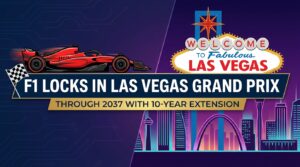
Formula 1 has finalised a 10-year contract extension with Nevada authorities to keep the Las Vegas Grand Prix on the championship calendar through at least 2037. The deal, negotiated alongside the Clark County Commission and the Las Vegas Convention and Visitors Authority (LVCVA), transforms what began as a short-term operational arrangement into a permanent fixture of the F1 season. The night race, staged on the 6.2-kilometre Las Vegas Strip Circuit, will continue with F1 serving as both commercial rights holder and primary event promoter.
What the 10-Year Deal Means for F1’s American Strategy
This extension is more than a calendar decision. It signals a deliberate, long-horizon commitment to the U.S. market at a time when American interest in Formula 1 has surged, driven in part by the cultural reach of Netflix’s Drive to Survive and the broader expansion of live sports entertainment. The agreement anchors Las Vegas alongside Austin and Miami as the third permanent American race, giving F1 an unprecedented three-venue footprint in a single country.
Before unpacking the broader implications, here are the strategic takeaways that matter most for stakeholders watching this space.
- Revenue certainty for a decade: A 10-year horizon gives F1, local businesses, and infrastructure investors a planning window that short-term contracts simply cannot provide. Sponsorship packages, hospitality builds, and broadcast deals can now be structured against a guaranteed event timeline.
- Clark County’s economic anchor: The Las Vegas Grand Prix generated an estimated $1.5 billion in economic impact during its inaugural 2023 edition. Locking in the race through 2037 effectively creates a recurring annual economic engine for the region.
- F1 retains full promotional control, an unusual arrangement in a sport where local promoters typically bear financial risk. That structure keeps strategic and operational leverage squarely with Liberty Media.
- Competitive positioning against rival motorsport properties: With three U.S. races secured long-term, F1 deepens its moat against NASCAR, IndyCar, and emerging EV racing series competing for American eyeballs and sponsor dollars.
How the Promoter Model Differs in Las Vegas
Most Formula 1 races operate under a traditional promoter model, where a local entity pays a hosting fee to F1 and assumes the financial risk of ticket sales, logistics, and event delivery. Las Vegas breaks that mould. F1 itself acts as the promoter, absorbing both the risk and the upside. That’s a meaningful distinction (and one that not every team principal or rival promoter views favourably).
By retaining promotional control, Formula 1’s commercial operation under Liberty Media captures a larger share of gate revenue, on-site hospitality income, and local sponsorship activations. The trade-off is capital exposure: F1 invested heavily in permanent pit-lane facilities and circuit infrastructure ahead of the 2023 debut, reportedly spending upwards of $500 million on venue construction alone.
Whether that investment pays back over a 10-year window depends on sustained ticket demand and the broader health of the Las Vegas tourism economy. Still, the early indicators are favourable.
The Strip Circuit: Infrastructure and Urban Disruption
The 6.2-kilometre street circuit threads through the heart of the Las Vegas Strip, passing landmarks like the Bellagio, Caesars Palace, and the MSG Sphere. Setting up and dismantling a temporary race circuit in one of the world’s busiest entertainment corridors is logistically punishing. Road closures, construction timelines, and noise ordinances all require coordination across multiple municipal agencies.
A 10-year commitment arguably makes that coordination easier. Permanent infrastructure elements, such as pit buildings and grandstand foundations, reduce annual setup costs and compress the disruption window. Clark County officials have pointed to the long-term deal as a framework for more efficient urban planning around the event.
| Aspect | Short-Term Deal (Pre-Extension) | 10-Year Extension (Through 2037) |
|---|---|---|
| Planning horizon | Year-to-year negotiations | Decade-long infrastructure and sponsorship certainty |
| Promoter model | F1 as promoter | Unchanged; F1 retains full control |
| Infrastructure investment | High upfront, uncertain payback | Amortised over 10+ events |
| Economic impact | ~$1.5B (2023 estimate) | Projected to compound with repeat tourism and expanded hospitality capacity |
What Drives Long-Term Value for Nevada?
For the LVCVA and Clark County, the calculus extends well beyond race-weekend economics. Las Vegas has spent decades positioning itself as a global events capital, hosting everything from CES to major boxing title fights. An annual Formula 1 race adds a recurring, globally televised tentpole that reinforces the city’s brand in markets across Europe, the Middle East, and Asia-Pacific.
Tourism data from the 2023 race showed hotel occupancy rates exceeding 95% during the event weekend, with average nightly rates climbing significantly above seasonal norms. The Las Vegas Convention and Visitors Authority’s tourism development strategy now explicitly references the Grand Prix as a pillar event alongside the NFL’s Super Bowl and the upcoming FIFA World Cup matches scheduled for 2026.
And while the headline economic figures are impressive, what remains less clear is how the benefits distribute across the local workforce. Service-sector employees, small business owners along the Strip corridor, and independent hospitality operators don’t always capture the same windfall that headline GDP numbers suggest.
Frequently Asked Questions
How long is the new Las Vegas Grand Prix contract?
The extension covers 10 years, keeping the race on the F1 calendar through at least 2037.
Who promotes the Las Vegas Grand Prix?
Unlike most F1 races, Formula 1 itself serves as the event promoter, retaining both financial risk and revenue upside rather than licensing the event to a local organiser.
What was the economic impact of the first Las Vegas Grand Prix?
The inaugural 2023 race generated an estimated $1.5 billion in economic impact for the Las Vegas region, according to figures cited by local authorities. Independent verification of that number has drawn some scrutiny, though the directional scale is broadly accepted.
How many F1 races does the United States now host?
Three. Austin (Circuit of the Americas), Miami (Miami International Autodrome), and Las Vegas (Las Vegas Strip Circuit) collectively give the U.S. the largest national allocation on the F1 calendar.



