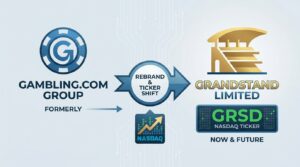
Gambling.com Group Limited is shedding its corporate identity in favour of a new name: Grandstand Limited. The rebrand, announced alongside a ticker symbol change on the Nasdaq Global Market from “GAMB” to “GRSD,” signals a deliberate pivot. The company, long associated with affiliate performance marketing in the online gambling space, now positions itself as a diversified operator spanning sports data analytics, content publishing, media distribution, and entertainment tools. It’s a move that reframes the business for investors and partners alike.
What the Rebrand Tells Us About Grandstand’s Strategic Direction
Corporate name changes in publicly traded companies rarely happen on a whim. They tend to follow sustained internal shifts that the old brand can no longer contain. For Grandstand, the catalyst is clear: the company has been steadily building out capabilities well beyond its origins as a gambling affiliate network. Its portfolio now includes sports data platform RotoWire, odds comparison tool OddsJam, and review portals like Gambling.com’s flagship review site and Casinos.com.
Yet none of those consumer-facing brands are changing. That’s a critical distinction (and one that some observers may overlook). The rebrand applies strictly at the corporate parent level, which means the company is protecting the equity built into its consumer properties while giving itself room to grow into adjacent verticals without the baggage of a name that pigeonholes it.
- Ticker transition from GAMB to GRSD takes effect on the Nasdaq Global Market, altering how institutional investors categorise and screen the stock
- Consumer brands, including Gambling.com, Casinos.com, OddsJam, and RotoWire’s sports data and fantasy tools, retain their existing identities
- The name “Grandstand” deliberately evokes a broader entertainment and sports positioning rather than a single vertical
- Structural expansion into sports data and media distribution has arguably outpaced the old corporate identity for some time
Why a Name Change Carries Weight on Nasdaq
Ticker symbols matter more than most people think. Algorithmic screening tools, ETF inclusion criteria, and sector-based fund mandates all rely partly on how a company presents itself. A ticker like GAMB anchored the company to gambling in the minds of compliance-filtered institutional portfolios. GRSD loosens that association.
Whether this translates into broader institutional interest remains to be seen. But the mechanics are straightforward: by decoupling the corporate identity from a single regulated vertical, Grandstand opens the door to capital that might have previously screened it out on ESG or sector-exclusion grounds alone.
The Portfolio Behind the New Name
| Brand | Function | Status Post-Rebrand |
|---|---|---|
| Gambling.com | Affiliate review portal for online gambling operators | Unchanged; continues under existing brand |
| Casinos.com | Casino-focused comparison and review platform | Unchanged |
| OddsJam | Odds comparison and sports betting analytics tool | Unchanged; operates independently |
| RotoWire | Sports data, fantasy sports projections, and editorial content across major leagues | Unchanged; a key growth asset within the broader Grandstand ecosystem |
Each of these properties serves a distinct audience segment. Together, they form a stack that covers the full lifecycle of a sports bettor or fantasy player: from research and data consumption through to operator selection and wagering. That vertical integration is arguably the real story here, not the name itself.
How Rebranding Shapes Perception and Market Positioning
Names carry cognitive weight. In behavioural terms, the shift from “Gambling.com Group” to “Grandstand” reframes how stakeholders mentally categorise the business. This isn’t cosmetic. Research in applied psychology consistently shows that category labels influence how decision-makers assess risk, opportunity, and relevance. A company named after a single activity gets mentally filed under that activity, regardless of how diversified its operations actually are.
Grandstand, by contrast, invokes a physical and metaphorical vantage point. It suggests spectatorship, entertainment, and breadth. For investors scanning a watchlist, for regulators reviewing a corporate filing, and for potential acquisition targets evaluating a suitor, that framing shift matters. It subtly repositions the company from “gambling affiliate” to “sports and entertainment platform operator.”
And while the company hasn’t disclosed whether the rebrand accompanies any operational restructuring, the timing aligns with a broader industry pattern. Several performance marketing firms in the iGaming space have been expanding their data and media capabilities, seeking to reduce dependency on affiliate commission models that are vulnerable to regulatory and operator-side margin compression. Grandstand’s move fits that trajectory, though the company’s specific roadmap beyond the name change has not been detailed publicly.
Broader Industry Context
The U.S. sports betting market continues to mature rapidly. State-by-state legalisation has created a patchwork of regulatory environments, and the companies that thrive tend to be those capable of operating across multiple value chain layers rather than occupying a single niche. Performance marketing alone, while profitable, faces headwinds: operator consolidation, tighter bonus regulations, and growing competition from in-house marketing teams at major sportsbooks.
By building out sports data and content capabilities, Grandstand hedges against those pressures. Still, the question of whether a name change translates into a genuine strategic moat depends on execution, not branding.
Frequently Asked Questions
Will the Gambling.com website change its name?
No. The rebrand applies only at the corporate parent level. Gambling.com, Casinos.com, OddsJam, and RotoWire all continue operating under their current consumer-facing brands.
When does the new Nasdaq ticker take effect?
The company has confirmed the transition from GAMB to GRSD on the Nasdaq Global Market, though a specific effective date should be verified through official Nasdaq filings or the company’s investor relations page.
Why did the company choose “Grandstand” as its new name?
The name reflects the company’s expansion beyond gambling-specific affiliate marketing into a broader ecosystem that includes sports data, media, and entertainment. It positions the corporate identity to match the actual scope of its operations.
Does this rebrand affect how the company is regulated?
A corporate name change does not alter the regulatory obligations of any subsidiary. Each operating brand remains subject to the licensing and compliance requirements of the jurisdictions in which it operates. What it may change is how the parent entity is perceived by regulators encountering it for the first time.



