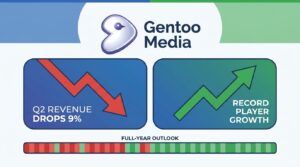
Gentoo Media has revised its full-year guidance downward after posting a 9% year-on-year decline in second-quarter revenue, a result that caught parts of the market off guard given the company’s simultaneous report of stronger player acquisition and record engagement metrics. The disconnect between top-line performance and operational momentum raises pointed questions about monetisation efficiency and the sustainability of growth-at-scale strategies in the current digital media landscape. Investors responded swiftly, and the stock saw notable pressure in the sessions following the announcement.
What Gentoo Media’s Revenue Miss Signals for Digital Media Operators
Before diving into the specifics, the broader pattern here deserves attention. A company reporting record user intake alongside shrinking revenue is not just a Gentoo Media story. It reflects a structural tension facing digital media businesses that have prioritised volume over yield. The key takeaways from this quarter carry implications well beyond one earnings report:
- Revenue fell 9% year-on-year in Q2, prompting a full-year outlook reduction that suggests management does not expect a rapid reversal in the second half
- Player intake reached new highs, yet average revenue per user (ARPU) appears to have compressed significantly enough to offset volume gains
- The lowered guidance implies margin pressure may persist, particularly if customer acquisition costs remain elevated against declining per-user monetisation
- For competitors and investors alike, the result underscores that user growth without proportional revenue conversion is a warning sign, not a consolation
- Management’s willingness to cut guidance mid-year, rather than waiting for Q3 data, hints at internal visibility into headwinds that may not yet be fully priced in
The Numbers Behind the Downgrade
A 9% revenue decline in a quarter where player numbers climbed to record levels creates an arithmetic problem that is hard to explain away. The gap points directly at weakening ARPU, which in digital media and gaming-adjacent businesses often traces back to one of three causes: pricing pressure from competitors, a shift in user mix toward lower-value segments, or reduced spending intensity among existing cohorts.
Gentoo Media’s digital entertainment platform has been expanding its reach across multiple markets, and that expansion may itself be part of the issue. New users acquired in less mature or more price-sensitive geographies tend to generate lower initial revenue. Whether those users eventually migrate to higher-value behaviour remains an open question (and one the company has not addressed in detail publicly).
Still, the decision to lower full-year expectations rather than frame Q2 as an anomaly tells us something. Management clearly sees this as more than a one-quarter blip.
Why Record Engagement Didn’t Translate
This is arguably the most uncomfortable part of the report. Record engagement should, in theory, create more monetisation opportunities. More time on platform, more interactions, more chances to convert attention into revenue. That it didn’t work that way here suggests the engagement is happening in areas of the product that carry lower commercial density, or that the company’s monetisation infrastructure hasn’t kept pace with where users are actually spending their time.
There’s a parallel worth noting. Across the broader digital media sector, several operators have reported similar dynamics in 2024 and into 2025: usage metrics climbing while revenue per session or per user stagnates or declines. The pattern is particularly acute in markets where regulatory changes have constrained certain promotional or pricing mechanisms. Whether Gentoo Media faces specific regulatory headwinds in any of its operating jurisdictions has not been confirmed, but the timing aligns with tightening oversight in several European and Latin American markets.
Strategic Implications and What Comes Next
For Gentoo Media, the path forward likely involves a recalibration. Prioritising user volume without a corresponding monetisation strategy is a model that works in early-stage growth phases but becomes a liability at scale. The company will need to demonstrate, probably by Q3 or Q4 reporting, that it can convert its enlarged user base into revenue growth, or at minimum stabilise ARPU.
Investors and analysts will be watching several indicators closely:
| Metric | Q2 Signal | What to Watch in H2 |
|---|---|---|
| Revenue Growth | -9% YoY | Whether the decline narrows or accelerates |
| Player Intake | Record highs | Retention rates and cohort quality beyond initial sign-up |
| ARPU | Implied compression | Any disclosed figures or directional commentary from management |
| Full-Year Guidance | Lowered | Whether further revisions follow, or if the new range holds |
| Cost of Acquisition | Not disclosed in detail | Efficiency ratios relative to lifetime value projections |
Reframing Growth: Volume Versus Value in Digital Media
The Gentoo Media situation offers a case study in a tension that runs through much of the digital economy right now. Growth narratives built on user counts and engagement minutes can mask deteriorating unit economics. And when the mask slips, as it did here, the market’s reaction tends to be sharp because the underlying assumption, that more users equals more revenue, gets challenged all at once rather than gradually.
What makes this particularly instructive is the speed of the recalibration. Companies that lower guidance proactively, before being forced to by a catastrophic miss, generally retain more credibility with institutional investors. But credibility alone doesn’t solve the structural question: can Gentoo Media extract more value from each user without degrading the experience that attracted record numbers in the first place? That balance is notoriously difficult to strike. Operators who push too hard on monetisation risk churn. Those who don’t push hard enough risk exactly what happened this quarter.
The broader digital media sector should take note. In an environment where user acquisition costs continue to rise and regulatory frameworks tighten across key markets, the companies that will outperform are those that solve the monetisation equation first, not those that simply accumulate the largest user bases. Gentoo Media has the scale. What it needs now is the yield.
Frequently Asked Questions
Why did Gentoo Media lower its full-year outlook?
The company cut its guidance after Q2 revenue dropped 9% year-on-year. Despite record player intake and strong engagement, the revenue decline indicated that user growth was not translating into proportional financial performance, prompting management to reset expectations for the remainder of the year.
How can a company have record users but declining revenue?
This typically happens when average revenue per user falls faster than user numbers rise. New users may come from lower-spending segments, or existing users may reduce their spending intensity. It can also reflect monetisation strategies that haven’t adapted to shifting user behaviour on the platform.
What should investors focus on in the next earnings cycle?
Retention rates for newly acquired players, any disclosed ARPU trends, and whether the revenue decline stabilises or deepens. Cost of acquisition relative to user lifetime value will also be critical, though Gentoo Media has not provided granular detail on this metric to date.