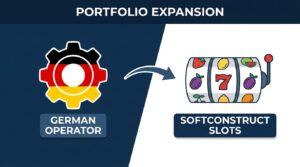
A German-licensed operator has moved to broaden its gaming library by integrating slot titles from SoftConstruct’s portfolio. The partnership brings a fresh batch of content to the regulated German market, where operators continue to compete aggressively for player attention through supplier diversification. While the deal’s financial terms remain undisclosed, the strategic intent is clear: tap into SoftConstruct’s growing catalogue to differentiate in a market shaped by strict regulatory constraints.
What This Partnership Signals for Germany’s iGaming Landscape
Germany’s regulated online gambling environment, governed under the Glücksspielstaatsvertrag (GlüStV) framework, imposes tight restrictions on game design, stake limits, and advertising. Operators working within these boundaries have limited levers to pull when it comes to standing out. Content supply agreements like this one have become one of the few reliable mechanisms for competitive differentiation. Here’s what matters most about this move:
- Catalogue depth as a retention tool: Adding SoftConstruct’s slots gives the operator a wider content spread, which in practice tends to correlate with longer session times and improved player retention metrics.
- Germany’s compliance requirements mean not every supplier’s content qualifies for the market. SoftConstruct’s inclusion suggests its titles meet the technical and regulatory thresholds set by German authorities.
- Supplier diversification reduces dependency: Relying on a handful of major studios creates concentration risk. Bringing in a brand like SoftConstruct hedges against that.
- Market positioning ahead of further regulatory clarity: With German regulators still refining enforcement approaches, operators building broader supplier networks now may be better positioned when the framework stabilises.
SoftConstruct’s Expanding European Footprint
SoftConstruct, the technology group behind the BetConstruct gaming and betting platform, has been steadily pushing into regulated European jurisdictions. The company’s slot vertical, while perhaps less prominent than its sportsbook infrastructure, has gained traction with operators seeking content that doesn’t come from the same five or six dominant studios.
That matters. In a market where player acquisition costs keep climbing, offering titles players can’t find on every competing site creates a tangible edge. SoftConstruct’s approach to game mechanics and visual design tends to lean toward a younger demographic (a distinction not every legacy supplier has managed to make), which aligns with the audience profile many German operators are chasing.
Still, the German market presents its own complications. The €1 spin limit, mandatory five-second pause between spins, and prohibition on autoplay features all constrain how slot games can function. Any supplier entering this space must adapt its product accordingly, and the compliance overhead is not trivial.
How Germany’s Slot Market Compares
| Feature | Germany (GlüStV) | UK (UKGC) | Malta (MGA) |
|---|---|---|---|
| Maximum stake per spin | €1 | Under review (proposed £2–£5 for online) | No fixed cap |
| Spin interval | 5 seconds minimum | No mandated interval yet | No mandated interval |
| Autoplay | Prohibited | Permitted with limits | Permitted |
| Advertising restrictions | Strict; limited hours and channels | Tightening progressively | Moderate, with self-regulatory codes |
| Licensing body | GGL (Gemeinsame Glücksspielbehörde der Länder) | UK Gambling Commission | Malta Gaming Authority |
The Psychology Behind Content Diversification
From a behavioural standpoint, the decision to integrate new slot suppliers isn’t purely a commercial calculation. It reflects an understanding of how players interact with choice architecture. When a platform presents a broader, more varied selection of games, it triggers what psychologists call the “exploration impulse.” Players are more likely to engage with a platform that feels rich with possibility, even if they ultimately return to a handful of favourites.
Operators who grasp this dynamic tend to frame new game additions not as inventory expansion but as experience renewal. The language used in lobby placement, the sequencing of new releases, and even thumbnail design all contribute to a perception of freshness. And perception, arguably, drives behaviour more reliably than objective quality metrics in digital entertainment.
There’s a subtler layer here too. Anchoring effects play a role: when a player sees a new studio name alongside familiar ones, the unfamiliar brand inherits credibility by association. SoftConstruct benefits from appearing alongside established suppliers in a licensed German lobby, while the operator benefits from the novelty factor. Both sides gain something that’s difficult to quantify but easy to observe in engagement data.
What remains less clear is whether these content partnerships translate into measurable revenue uplift at the per-title level, or whether their value is primarily structural, keeping the overall platform competitive rather than driving standalone performance.
Frequently Asked Questions
What does SoftConstruct offer in the gaming space?
SoftConstruct operates across multiple verticals including sportsbook technology, live casino, and slot game development. Its BetConstruct platform serves as the primary B2B distribution channel for its gaming products across regulated markets worldwide.
Are SoftConstruct’s slots compliant with German regulations?
Their inclusion on a German-licensed platform indicates the titles meet the technical requirements under the GlüStV framework, including stake limits and spin interval rules. Compliance certification would have been a prerequisite for integration.
Why do German operators keep adding new slot suppliers?
Regulatory constraints in Germany limit how operators can differentiate through bonuses or advertising. Content variety has become one of the primary competitive levers available. More suppliers means more unique titles, which helps with both acquisition and retention.
How strict is Germany’s online gambling regulation compared to other European markets?
Germany sits at the stricter end of the spectrum. The €1 stake cap, five-second spin pause, and autoplay ban go further than most comparable jurisdictions. Enforcement through the GGL has been gradually intensifying since the framework took effect.



