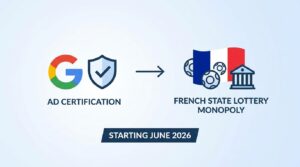
Google will update its global Gambling and Games advertising policy to accommodate France’s unique regulatory structure, effective 29 June 2026. The change allows operators of the French statutory lottery monopoly to apply for advertising certification on the platform for the first time. It marks a targeted expansion of eligibility within what remains one of the most tightly controlled digital ad verticals in Europe. And while the policy shift is narrow in scope, its implications ripple across both the French gambling market and the broader framework Google uses to manage regulated advertising worldwide.
What This Policy Shift Means for France’s Gambling Ad Landscape
Before diving into the specifics, it helps to understand why this matters beyond a procedural tweak. France operates a dual-track gambling regime: a competitive licensing system for online sports betting and poker, and a state monopoly for lottery and certain other games of chance. Until now, Google’s certification framework in France effectively sidelined monopoly operators from running paid search and display campaigns through its ad platform. That gap is closing.
- State monopoly operators gain formal ad access: For the first time, entities operating under France’s statutory lottery monopoly can apply for Google advertising certification, placing them on equal footing with licensed private operators in terms of digital visibility.
- Certification is not automatic. Operators must complete Google’s corporate verification process and secure explicit approval before entering live ad auctions.
- The update reflects Google’s broader pattern of aligning ad policies with sovereign regulatory frameworks rather than applying blanket restrictions across jurisdictions.
- Competitive dynamics shift: Private licensed operators, who previously enjoyed exclusive access to Google’s gambling ad inventory in France, now face a new category of competitor in paid digital channels.
- The effective date of 29 June 2026 gives all stakeholders roughly a year to prepare, though early movers in the certification pipeline may gain positioning advantages.
How Google’s Certification Gatekeeping Works
Google does not simply flip a switch. Its gambling ad certification process functions as a layered compliance filter, requiring applicants to demonstrate regulatory standing, corporate legitimacy, and adherence to platform-specific creative standards. For French monopoly operators, this means submitting documentation that confirms their status under national law, passing identity and entity verification checks, and agreeing to Google’s advertising content restrictions (a distinction regulators have been slow to enforce independently at the platform level).
The process is deliberately friction-heavy. Google treats gambling as a “restricted” ad category globally, meaning even eligible operators face tighter targeting rules, geographic limitations, and creative review requirements compared to advertisers in less regulated sectors. In practice, certification can take weeks, and rejection rates for incomplete or non-compliant applications remain significant across markets.
Still, the barrier is navigable for well-resourced state entities. La Française des Jeux (FDJ), the primary operator of France’s national lottery, already maintains a sophisticated digital marketing infrastructure. The certification requirement is less a hurdle and more a formality for an organisation of that scale.
Why Now? Regulatory Pressure and Market Timing
Google’s decision did not emerge in a vacuum. France’s gambling regulator, the Autorité Nationale des Jeux (ANJ), has been progressively tightening oversight of digital advertising practices in the sector. The ANJ has pushed for greater parity between state and private operators in how they reach consumers online, arguing that asymmetric ad access distorts market dynamics and undermines regulatory coherence.
There is also a commercial calculus at play. France represents one of Europe’s largest regulated gambling markets, with gross gaming revenue exceeding €13 billion annually. Excluding a major segment of that market from paid digital channels meant Google was leaving ad revenue on the table. The policy update addresses both the regulatory alignment question and the commercial opportunity simultaneously.
Broader Implications for Platform-Level Gambling Ad Governance
What makes this update worth watching beyond France is the precedent it sets for how global ad platforms accommodate national monopoly structures. Most of Google’s gambling ad policies are built around licensing-based frameworks, where operators hold competitive permits issued by a regulator. Monopoly structures, by contrast, derive their authority from statute rather than competitive tender. Integrating them into a certification system designed for licensed operators required Google to adapt its eligibility logic at a structural level.
That adaptation could serve as a template. Several European jurisdictions maintain state monopolies or quasi-monopolies in gambling, including Finland (until its recent reform), Norway, and parts of the Swiss market. Whether Google extends similar policy updates to those markets depends on a mix of regulatory pressure, commercial incentive, and political will.
Less clear is how this affects the broader debate around advertising responsibility. Monopoly operators often argue they channel gambling demand toward safer, state-supervised products. Critics counter that expanding their digital advertising footprint simply increases overall gambling exposure. Google’s policy is agnostic on that question; it certifies eligibility, not social impact.
What Operators and Advertisers Should Prepare For
With roughly twelve months before the policy takes effect, several practical steps deserve attention:
| Stakeholder | Action Required | Timeline Consideration |
|---|---|---|
| French monopoly operators | Initiate Google corporate verification and certification application | Begin Q3 2025 to allow for processing delays |
| Private licensed operators | Reassess paid search strategy and bidding budgets in anticipation of new auction competition | Budget planning for H2 2026 |
| Agencies and media buyers | Update client guidance on French gambling ad inventory dynamics and certification pathways | Immediate advisory updates recommended |
| ANJ / Regulators | Monitor compliance of newly certified entities with national advertising codes | Ongoing from June 2026 |
Frequently Asked Questions
Does this mean all French gambling operators can now advertise on Google?
No. The update specifically extends eligibility to operators of the French statutory lottery monopoly. Private operators already had a certification pathway, and unlicensed entities remain excluded entirely. The change is additive, not a blanket liberalisation.
Will the certification process differ for monopoly operators compared to licensed ones?
Google has not indicated a separate track. Monopoly operators will undergo the same corporate verification and certification application process, though the documentation required to demonstrate regulatory standing will naturally differ given their statutory rather than licence-based authority.
Could this policy change affect other European markets with state gambling monopolies?
Arguably, yes. The structural adaptation Google made for France could be replicated elsewhere. But each market presents different regulatory and political conditions, so extension is plausible rather than guaranteed.
What happens if an operator fails certification?
They cannot run gambling ads on Google’s platform. Rejection does not carry a public penalty, but it does block access to one of the most significant digital advertising channels available. Reapplication is typically possible after addressing the deficiencies Google identifies.



