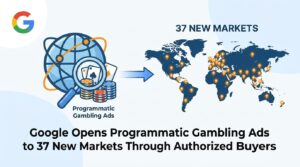
Google has significantly broadened the reach of online gambling and social casino advertisers by expanding access through its Authorized Buyers programmatic marketplace to 37 additional countries. The move, which quietly rolled out in recent weeks, marks one of the largest single expansions of gambling ad inventory the company has permitted on its demand-side infrastructure. For operators, affiliates, and ad-tech intermediaries in the iGaming sector, the policy shift recalibrates where and how digital acquisition budgets can be deployed at scale.
What Google’s 37-Market Expansion Means for iGaming Advertisers
The expansion isn’t merely a geographic footnote. It reshapes the competitive landscape for programmatic gambling advertising in markets that were previously either restricted or entirely off-limits through Google’s own pipes. Here’s what matters most:
- Scale of access: 37 new countries now permit online gambling and social casino ads via Authorized Buyers, dramatically increasing the addressable programmatic inventory for licensed operators.
- Programmatic-first strategy: Operators who have relied on direct buys or non-Google DSPs in these regions can now consolidate spend through a single marketplace, potentially reducing cost-per-acquisition.
- Compliance requirements remain jurisdiction-specific, meaning advertisers must still hold valid licenses and meet Google’s certification criteria before campaigns go live.
- Social casino inclusion: The expansion covers not just real-money gambling but also social casino formats, opening doors for a category that often faces ambiguous regulatory treatment (a distinction regulators have been slow to enforce in several of the newly added markets).
- Ad-tech intermediaries and affiliate networks operating across multiple geographies stand to benefit disproportionately from centralized access.
How Authorized Buyers Fits Into Google’s Gambling Ad Framework
Google’s Authorized Buyers platform, formerly known as DoubleClick Ad Exchange, functions as the company’s real-time bidding marketplace connecting demand-side platforms with publisher inventory across the Google Display Network, YouTube, and partner sites. For gambling advertisers specifically, access to this marketplace has historically been tightly controlled, limited to a handful of mature regulatory environments like the United Kingdom, parts of the European Union, and select U.S. states.
The 37-market expansion suggests a deliberate strategic recalibration. Google appears to be responding to two converging pressures: growing regulatory clarity in emerging gambling jurisdictions, and intensifying competition from rival ad platforms that have been more permissive with iGaming inventory. Meta, for instance, has operated gambling ad programs in several markets where Google previously held back.
Still, Google’s certification process remains arguably the most stringent among major platforms. Advertisers must demonstrate valid licensing, geo-targeting compliance, and adherence to responsible gambling messaging standards before gaining approval. That barrier, at least on paper, filters out unlicensed operators. Whether enforcement keeps pace with the expanded footprint is another question entirely.
Which Markets Are Now in Play?
Google has not published a single consolidated list of all 37 newly added countries in a press release format, but filings and policy documentation point to a mix of Latin American, African, Asian, and Eastern European jurisdictions. Several of these markets have enacted or updated gambling legislation within the past 18 months, which likely triggered Google’s reassessment.
| Region | Estimated New Markets Added | Regulatory Maturity |
|---|---|---|
| Latin America | 8–10 | Mixed; Brazil’s regulated framework launched in 2025 |
| Africa | 6–8 | Varies widely; Kenya and Nigeria among the more established |
| Eastern Europe | 5–7 | Several EU-aligned frameworks in place |
| Asia-Pacific | 4–6 | Largely restricted; exceptions include the Philippines and select others |
| Other (Middle East, Oceania) | Remainder | Highly jurisdiction-dependent; limited real-money gambling in most cases |
Brazil deserves particular attention. The country’s newly operational regulatory regime for online betting has turned it into one of the most watched markets globally, and Google’s advertising platform opening programmatic channels there aligns with a wave of operator launches targeting Brazilian bettors.
The Compliance Layer That Operators Cannot Ignore
Expanded access does not mean relaxed standards. Google requires gambling advertisers to complete a certification process that verifies licensing status in each target jurisdiction. Campaigns must be geo-fenced to prevent ad delivery in markets where the advertiser lacks authorization. And creative assets must comply with responsible gambling guidelines, including age-gating and problem gambling disclosures.
For multi-market operators, this creates an operational challenge that is easy to underestimate. Managing certification across dozens of jurisdictions, each with its own licensing body and advertising code, demands dedicated compliance infrastructure. Smaller operators or affiliates without that capacity may find the theoretical access difficult to convert into live campaigns.
What remains less clear is how Google will handle enforcement at the edges. In markets where regulatory frameworks are new or under-resourced, the gap between licensed and unlicensed operators can be narrow and hard to verify externally.
Strategic Implications for Operators and Affiliates
The expansion carries several downstream effects worth tracking. First, increased programmatic supply in these 37 markets will likely compress CPMs for gambling inventory in the short term, as more inventory becomes available before advertiser demand fully catches up. That window won’t last. As major operators activate campaigns, auction density will rise and so will costs.
Second, affiliates who have built traffic in these regions through SEO and organic channels now face a more competitive paid-media environment. Operators with deep pockets can bid directly for the same audiences that affiliates have cultivated over years. The dynamic isn’t new, but the scale is.
And third, the social casino category’s inclusion opens a parallel track. Social casino apps, which monetize through in-app purchases rather than real-money wagering, have historically occupied a grey zone in advertising policy. Their explicit inclusion in this expansion gives developers a clearer path to programmatic distribution, particularly in markets where real-money gambling remains prohibited but social gaming does not.
Frequently Asked Questions
Do advertisers need separate Google certification for each country?
Yes. Google’s gambling ad certification is jurisdiction-specific. Advertisers must demonstrate valid licensing and comply with local advertising regulations for every market they intend to target. A single certification does not grant blanket access across all 37 newly opened countries.
Does this expansion apply to YouTube inventory as well?
Authorized Buyers provides access to inventory across the Google Display Network, YouTube, and partner sites. However, YouTube placements for gambling ads carry additional creative and targeting restrictions that vary by market.
Are sports betting operators included in this expansion?
Sports betting falls under Google’s broader online gambling advertising category. Provided an operator holds the requisite license and passes certification, sports betting campaigns are eligible in the newly added markets, though specific product restrictions may apply depending on local law.
What about crypto-based gambling platforms?
Google’s policy on cryptocurrency gambling remains restrictive. Platforms that exclusively use cryptocurrency for deposits and withdrawals face additional scrutiny, and many do not qualify for certification under current guidelines. The 37-market expansion has not altered that stance.



