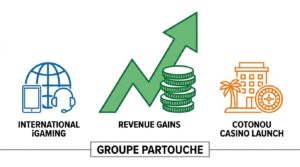
Groupe Partouche, the French land-based casino and igaming operator, has posted revenue growth underpinned by two distinct engines: expanding online gaming operations outside France and the recent opening of its casino in Cotonou, Benin. The results signal a deliberate geographic diversification strategy at a time when the French domestic market faces regulatory headwinds and intensifying competition. For an operator historically rooted in France’s physical casino landscape, the shift carries strategic weight.
What Partouche’s Latest Numbers Reveal About Its Growth Strategy
Before diving into the specifics, the broader pattern here matters. Partouche is no longer betting solely on its legacy French operations to carry performance. The company’s revenue trajectory now leans on two pillars that barely registered in its portfolio a few years ago: international digital gaming and a foothold in West Africa.
- Online gaming revenues outside France have become a measurable contributor to top-line growth, suggesting Partouche’s international igaming licensing and market-entry efforts are gaining traction.
- The Cotonou casino in Benin represents a rare brick-and-mortar expansion into sub-Saharan Africa, a region where regulated casino markets remain underdeveloped but demand is rising.
- Domestic French casino operations, while still the core of the business, appear to be growing at a slower pace relative to these newer segments.
- The combination of digital and physical expansion outside France positions Partouche to reduce concentration risk in a single regulated market.
The Cotonou Bet: Why Benin?
Opening a casino in Cotonou is not the kind of move that makes headlines in Las Vegas or Macau. But it should. Benin’s economic growth rate has consistently outpaced the West African average in recent years, and Cotonou, the country’s largest city and economic hub, has seen significant infrastructure investment aimed at attracting tourism and foreign capital. Partouche’s decision to plant a flag there reflects a calculated read on where emerging-market casino demand is heading.
What remains less clear is how quickly the Cotonou property can reach profitability. Operating costs in sub-Saharan Africa carry their own complexities (a distinction that balance sheets rarely capture cleanly), from currency volatility to regulatory frameworks still being formalized. Still, the early revenue contribution suggests the property is drawing traffic, and Partouche appears willing to absorb the ramp-up period.
International iGaming: Where the Margin Story Gets Interesting
Partouche’s online gaming push beyond French borders arguably represents the more scalable opportunity. France’s igaming market, while substantial, operates under a licensing regime that limits product offerings and imposes significant tax burdens on operators. By contrast, several European and African jurisdictions offer more favorable regulatory conditions for online casino and sports betting products.
The company has not disclosed a granular breakdown of which international markets are driving its igaming growth. That opacity makes it difficult to assess sustainability. Are these revenues coming from newly licensed markets with long runways, or from mature jurisdictions where customer acquisition costs are climbing? The answer shapes whether this growth compounds or plateaus.
And while Partouche’s digital revenues remain modest compared to pure-play igaming giants, the operator’s hybrid model offers something those competitors lack: a physical brand presence that can anchor customer trust in markets where online gambling regulation is still earning public confidence. Groupe Partouche’s integrated casino and digital gaming operations give it a dual-channel advantage that few mid-cap operators can replicate.
How This Fits the Broader European Operator Landscape
Partouche is not alone in looking beyond home borders. Across Europe, land-based operators have spent the past five years scrambling to build or acquire digital capabilities, often through partnerships or bolt-on acquisitions. The pressure is structural: younger demographics gamble differently, and regulators in mature markets keep tightening advertising and product rules.
But Partouche’s approach differs from peers in one notable respect. Rather than pursuing large-scale M&A to buy igaming market share, the company has grown organically in select markets. That keeps balance sheet risk lower, though it also means slower scaling.
| Growth Driver | Geographic Focus | Revenue Impact | Strategic Risk |
|---|---|---|---|
| Domestic French casinos | France | Core but slower growth | Regulatory tightening, competition |
| International igaming | Multiple jurisdictions | Growing contributor | Market-specific licensing uncertainty |
| Cotonou casino | Benin, West Africa | Early-stage revenue | Currency risk, operational complexity |
The Framing Effect in Operator Strategy Communication
There is something worth examining in how Partouche presents these results, and it connects to a broader principle in how businesses shape stakeholder perception. In neuro-linguistic programming terms, the framing effect dictates that the way information is structured influences how it is received. Partouche’s emphasis on international growth channels rather than domestic stagnation is not accidental. It anchors investor attention on momentum rather than maturity.
This kind of strategic framing is common across the gaming sector, but operators that do it well tend to sustain higher valuation multiples relative to their actual earnings trajectory. The language of growth, when paired with even modest supporting data, activates forward-looking cognitive patterns in analysts and investors. Partouche’s narrative discipline here is tight: lead with what is expanding, contextualize what is stable, and avoid dwelling on what is contracting. Whether the underlying economics fully justify the optimism is a separate question, one that upcoming quarterly disclosures will need to address more directly.
Operators across regulated industries increasingly recognize that perception management is not spin. It is a core competency. The ones that master it tend to attract capital on better terms, recruit stronger executive talent, and negotiate regulatory relationships from a position of narrative strength rather than defensive posture.
Frequently Asked Questions
Where is Groupe Partouche expanding outside France?
The company has opened a casino in Cotonou, Benin, and is growing its online gaming operations in multiple international jurisdictions beyond the French market, though specific countries have not been publicly detailed.
Is Partouche’s igaming business profitable?
Partouche has pointed to revenue gains from international igaming, but has not broken out profitability metrics for this segment separately. Given the costs associated with market entry and licensing, margin clarity will likely emerge over subsequent reporting periods.
Why did Partouche choose Benin for a new casino?
Cotonou is Benin’s economic center, and the country has experienced above-average GDP growth in West Africa. The regulated casino market there remains relatively uncrowded, offering first-mover positioning in a region with rising consumer spending power.



