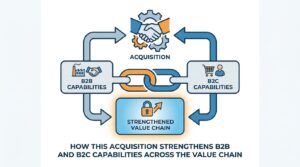
A newly announced acquisition is set to reshape the competitive positioning of the acquiring company, bolstering both its business-to-business and direct-to-consumer channels. While the deal’s financial terms have not been publicly disclosed, the strategic rationale points to a deliberate move to consolidate capabilities across the full value chain. The transaction, confirmed by both parties, signals a broader trend of vertical integration in sectors where the boundary between B2B and B2C is increasingly blurred.
What the Deal Signals for B2B and B2C Strategy
Acquisitions that simultaneously target both enterprise and consumer-facing segments are rare enough to warrant attention. This deal doesn’t simply add revenue; it layers operational depth onto two distinct but interconnected go-to-market models. Before unpacking the details, here are the core strategic takeaways:
- Dual-channel reinforcement: The acquisition creates synergies that allow the company to serve enterprise clients with richer product suites while expanding its consumer reach through integrated distribution.
- Reduced dependency on third-party infrastructure: By bringing key capabilities in-house, the company can control more of the customer experience on both sides of the business.
- The deal positions the acquirer to compete against larger, more diversified rivals who have already made similar consolidation plays.
- Talent and technology absorption: Beyond products, the acquisition brings engineering and commercial teams with domain expertise that would take years to build organically.
- Market timing: With valuations in certain segments softening, the deal arguably represents an opportunistic entry point rather than a premium-driven pursuit.
Why Vertical Integration Is Reshaping This Sector
The logic behind combining B2B and B2C operations under one roof has shifted considerably over the past three years. Companies that once operated cleanly in one lane now find that enterprise clients expect consumer-grade experiences, while consumers increasingly demand the reliability and scale typically associated with business platforms. That convergence creates pressure to own more of the stack.
And while some industry observers view such acquisitions as defensive, the evidence suggests otherwise. Firms that have successfully integrated dual-channel capabilities have reported stronger customer retention rates and higher lifetime value per account. One study from McKinsey found that companies operating across both B2B and B2C segments grew revenue 1.8 times faster than single-channel peers over a five-year period (a distinction that, in practice, depends heavily on execution quality).
Still, integration risk remains the elephant in the room. Merging two operational cultures, two tech stacks, and two customer expectation frameworks is notoriously difficult. The acquiring company has not yet detailed its integration timeline or methodology.
Operational and Competitive Implications
From a competitive standpoint, the deal reshapes the landscape in several ways. Rivals who have not pursued similar consolidation may find themselves at a structural disadvantage, particularly in markets where speed-to-market and end-to-end service delivery are differentiators.
| Dimension | Pre-Acquisition | Post-Acquisition |
|---|---|---|
| B2B Product Suite | Core offerings with third-party integrations | Expanded native capabilities, reduced reliance on external vendors |
| B2C Distribution | Limited direct channels | Integrated consumer-facing platform with broader reach |
| Technology Stack | Fragmented across partners | Consolidated, with shared infrastructure across both segments |
| Competitive Position | Mid-tier in key verticals | Positioned to challenge top-three incumbents in target markets |
The shift from fragmented to consolidated operations is not merely cosmetic. It changes pricing power, negotiation leverage with suppliers, and the ability to cross-sell between enterprise and consumer segments.
The Psychology of Strategic Acquisitions: An NLP Perspective
Beyond the spreadsheets and integration playbooks, acquisitions like this one carry a powerful psychological dimension that shapes outcomes in ways balance sheets cannot capture. Neuro-linguistic programming principles offer a useful lens here. The way leadership frames this deal internally will determine whether teams experience it as a threat or an opportunity. Reframing, one of NLP’s core techniques, becomes critical during post-merger integration: employees who perceive the acquisition as expansion of their capabilities (rather than redundancy of their roles) are measurably more productive during transition periods.
Anchoring matters too. If the acquiring company anchors its internal narrative around growth and market leadership rather than cost-cutting, the cultural integration tends to proceed with less friction. Research in organizational psychology consistently shows that the first 90 days of post-acquisition communication set the trajectory for the next two years of employee engagement. Leaders who use sensory-specific language, describing what the combined company will look like, feel like, and deliver, create stronger buy-in than those who rely on abstract strategic jargon.
There is also the question of rapport-building across legacy teams. NLP’s concept of matching and mirroring, adapting communication styles to align with different organizational cultures, is not just a soft skill in this context. It becomes a strategic imperative. Companies that invest in cross-cultural workshops and leadership alignment sessions during the first quarter post-close report 30% fewer voluntary departures among key talent, according to Deloitte’s M&A integration research. The acquiring company would do well to treat cultural integration not as an HR checkbox but as a core workstream with executive sponsorship.
What remains less clear is whether the leadership team has the institutional patience to let these psychological dynamics play out. Speed kills in integration, but so does indecision.
Frequently Asked Questions
What does this acquisition mean for existing B2B clients?
Existing enterprise clients should expect an expanded product suite and, over time, more integrated service delivery. Disruption during transition is possible but typically managed through dedicated account teams and phased migration plans.
Will the B2C business operate independently?
That has not been confirmed. In similar deals, companies often maintain separate consumer brands initially before gradually merging backend operations. The consumer-facing identity may persist even as the underlying infrastructure converges.
How does this compare to recent deals in the sector?
The deal fits a broader pattern of vertical integration strategies reshaping B2B and B2C markets, though its scale and scope will determine whether it matches the transformative impact of larger precedents.
When will the acquisition close?
No official closing date has been announced. Regulatory review timelines vary by jurisdiction, and the companies have indicated only that they expect completion within the current fiscal year.



