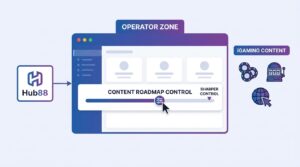
Hub88, the B2B platform provider operating under the Yolo Group umbrella, has rolled out a new capability within its Operator Zone portal designed to hand operators more granular control over how they plan, prioritise, and deploy igaming content. The feature targets a persistent pain point in the aggregation space: the gap between what operators want on their roadmaps and what they can actually manage in real time. By embedding roadmap tools directly into the client-facing portal, Hub88 is making a bet that self-service infrastructure will become a competitive differentiator in an increasingly crowded aggregation market.
What the Operator Zone Update Actually Delivers
At its core, the new feature gives Hub88’s operator partners the ability to shape their own content integration timelines without relying on back-and-forth communication with account managers. Operators can now view available game providers, request integrations, and track the status of content launches from within a single dashboard. That sounds straightforward. In practice, though, most aggregation platforms still handle content scheduling through manual coordination, spreadsheets, or fragmented ticketing systems (a distinction the industry has been slow to address).
Hub88 describes the update as giving clients “greater control” of their igaming content roadmaps. The language is deliberately broad, but the operational implication is specific: reduced dependency on intermediary steps, faster go-live cycles, and a clearer line of sight into what’s coming next from the supplier pipeline.
Why Self-Service Tools Are Gaining Strategic Weight in Aggregation
The aggregation layer in igaming has matured considerably over the past three years. Operators no longer evaluate platform partners solely on catalogue size. Speed of integration, transparency of process, and the ability to customise content strategies without bottlenecks now carry real weight in procurement decisions.
Hub88’s move reflects that shift. And while the company isn’t the first to invest in operator-facing portals, the emphasis on roadmap autonomy signals a broader trend: aggregators competing less on volume and more on workflow efficiency.
- Operators increasingly demand real-time visibility into integration pipelines, not just post-launch reporting
- Manual content scheduling creates friction that slows time-to-market for new game launches
- Self-service portals reduce operational overhead for both the aggregator and the operator
- The feature positions Hub88 closer to a SaaS-style delivery model, where the client controls the pace
Still, the question of whether operators will fully adopt these tools depends on execution. A portal is only as useful as the data flowing through it.
Competitive Landscape and Market Positioning
Hub88 operates in a segment where rivals like Softswiss, EveryMatrix, and Digitain are all investing heavily in platform UX and operator tooling. The Hub88 igaming aggregation platform has historically leaned on speed and technical flexibility as differentiators, particularly in crypto-friendly markets. This latest update extends that positioning into the operational layer.
| Feature | Traditional Aggregation Model | Hub88 Operator Zone Approach |
|---|---|---|
| Content scheduling | Manual, via account management | Self-service within portal |
| Roadmap visibility | Periodic updates or reports | Real-time dashboard access |
| Integration requests | Email or ticketing systems | Direct submission through Operator Zone |
| Go-live tracking | Often fragmented across tools | Centralised status tracking, single view |
Not every operator will find this level of control necessary. Smaller brands with limited content strategies may prefer a managed approach. But for mid-to-large operators running multi-market portfolios, the ability to steer their own roadmap without waiting on a third party is arguably non-trivial.
How Operator Autonomy Reshapes the Aggregator-Client Dynamic
There’s a subtler dimension to this kind of product development that goes beyond feature lists. When an aggregator gives operators direct control over content planning, it changes the psychological contract between the two parties. The operator shifts from being a recipient of a managed service to an active participant in platform configuration. That reframing matters.
From a behavioural standpoint, operators who feel ownership over their integration roadmap are more likely to engage deeply with the platform, explore new providers proactively, and commit to longer partnerships. This mirrors principles well understood in decision architecture: when people perceive agency in a process, their satisfaction with outcomes increases, even when the outcomes themselves are identical. Hub88 may not frame it this way publicly, but the design logic behind Operator Zone carries that imprint.
The feature also reduces what behavioural economists call “friction costs.” Every email exchange, every status request, every delayed response from an account manager introduces micro-frustrations that compound over time. By collapsing those touchpoints into a self-directed interface, Hub88 removes barriers that, while individually small, collectively erode operator confidence in the platform’s responsiveness. In a market where switching costs between aggregators are declining, that kind of experiential advantage can quietly become a retention mechanism.
Whether this translates into measurable client growth for Hub88 remains to be seen. The company has not disclosed adoption metrics for the Operator Zone portal, nor has it published data on how the feature affects integration timelines. What it has done is place a clear stake in the ground: the future of aggregation is not just about having the games, but about who lets the operator drive.
Frequently Asked Questions
What is Hub88’s Operator Zone?
Operator Zone is Hub88’s client-facing portal where igaming operators can manage integrations, track content launches, and now shape their own content roadmaps directly through the platform.
How does this feature differ from standard aggregation services?
Most aggregators handle content scheduling through manual processes involving account managers and ticketing systems. Hub88’s update moves that control into a self-service dashboard, letting operators act without waiting on intermediaries. The difference is operational speed and transparency, not catalogue access.
Which operators benefit most from this kind of tool?
Mid-to-large operators managing content across multiple regulated markets stand to gain the most. Smaller operators with simpler content needs may find a managed service sufficient.



