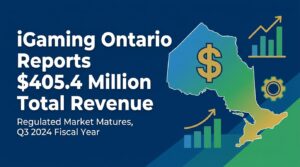
iGaming Ontario, the subsidiary of the Alcohol and Gaming Commission of Ontario responsible for overseeing the province’s regulated online gambling market, has reported total igaming revenue of $405.4 million in its latest disclosure. The figure signals continued growth in what has become Canada’s most closely watched regulated digital gambling jurisdiction. Ontario’s open-market model, which launched in April 2022, now hosts dozens of licensed operators competing across sports betting, casino, and poker verticals.
What $405.4 Million Tells Us About Ontario’s Trajectory
The revenue number, while headline-worthy on its own, carries deeper strategic weight for operators, investors, and regulators tracking North America’s evolving igaming landscape. Here are the key takeaways:
- Ontario’s regulated market continues to pull revenue away from the grey and offshore segments, validating the province’s licensing framework at least on paper
- $405.4 million in total igaming revenue positions Ontario as one of the highest-grossing regulated online gambling markets in North America
- The competitive, multi-operator model is generating scale that single-provider provincial systems in other parts of Canada have struggled to match
- Sustained revenue growth strengthens the case for other Canadian provinces considering similar regulatory approaches
- Operator density in the market raises questions about long-term margin sustainability, particularly for smaller entrants
How Ontario’s Model Differs
Most Canadian provinces funnel online gambling through government-run monopolies. Ontario broke from that pattern. By opening the market to private, licensed operators under iGaming Ontario’s regulatory oversight framework, the province created a competitive environment that mirrors structures seen in parts of Europe and, increasingly, in U.S. states like New Jersey and Michigan.
That decision has drawn major international operators to the province, alongside homegrown brands and niche platforms targeting specific player demographics. The result: a market caught between rapid expansion and the regulatory fine-tuning that inevitably follows.
Still, not every stakeholder views the model with the same enthusiasm. Land-based casino operators in Ontario have raised concerns about cannibalization, arguing that digital competition erodes foot traffic without proportional reinvestment in local communities. Whether those concerns reshape policy remains an open question.
Revenue in Context: Where Ontario Sits Across North America
Placing the $405.4 million figure alongside comparable jurisdictions helps frame its significance. The table below offers a rough comparison with select North American regulated igaming markets.
| Jurisdiction | Market Model | Approximate Annual iGaming Revenue |
|---|---|---|
| Ontario | Open, multi-operator | $405.4M (latest reported period) |
| New Jersey | Licensed operators tied to land-based casinos | ~$2B+ annually |
| Michigan | Licensed operators tied to tribal/commercial casinos | ~$1.9B+ annually |
| Pennsylvania | Licensed operators tied to land-based casinos | ~$1.5B+ annually |
| British Columbia (PlayNow) | Government monopoly | Significantly lower per capita output |
Ontario’s numbers, while trailing mature U.S. states that have had regulated igaming for a decade, are notable given the market’s relative youth. And the comparison with British Columbia’s single-provider PlayNow platform underscores the revenue gap between open and closed models (a distinction regulators in provinces like Alberta are presumably watching closely).
Responsible Gambling and Regulatory Pressure
Revenue growth of this magnitude invites scrutiny. iGaming Ontario has implemented responsible gambling requirements for all licensed operators, including mandatory self-exclusion tools, deposit limits, and advertising standards. But enforcement consistency across a market with this many participants is arguably the harder challenge.
Ontario’s Registrar has already taken action against operators for non-compliance, and the regulatory posture appears to be tightening rather than relaxing. Advertising restrictions, in particular, have become a flashpoint. The province moved to limit certain types of igaming advertising following public backlash over the volume of gambling promotions during live sports broadcasts.
What remains less clear is how effectively these measures translate into measurable harm reduction outcomes. Revenue figures tell one story. Player protection metrics tell another, and those numbers receive far less public attention.
Reframing the Narrative: Growth Beyond the Numbers
Revenue milestones like $405.4 million tend to dominate headlines, but the underlying dynamics shaping Ontario’s market deserve equal attention. Operator consolidation is already underway. Several smaller brands that entered the market during its initial wave have either scaled back operations or exited entirely, unable to sustain customer acquisition costs in a crowded field. The operators that remain are investing heavily in product differentiation, loyalty ecosystems, and live dealer content to retain players.
Technology infrastructure is evolving in parallel. Payment processing, identity verification, and geolocation compliance have all matured since the market’s 2022 launch, reducing friction for both operators and players. These backend improvements rarely make news, yet they are foundational to the market’s ability to scale without proportional increases in regulatory risk.
For the broader North American igaming sector, Ontario functions as a proving ground. Its open-market structure, combined with a population base of roughly 15 million, offers a dataset that regulators and operators elsewhere will study for years. Whether the province’s model gets replicated across Canada depends not just on revenue performance but on how well the regulatory framework adapts to challenges that only emerge at scale.
Frequently Asked Questions
What does iGaming Ontario do?
iGaming Ontario is a subsidiary of the Alcohol and Gaming Commission of Ontario. It conducts and manages the province’s regulated internet gaming market, overseeing operator compliance, responsible gambling standards, and market integrity.
How much revenue has Ontario’s igaming market generated?
The latest reported total igaming revenue stands at $405.4 million, reflecting the continued expansion of Ontario’s multi-operator regulated market since its April 2022 launch.
Can any company operate in Ontario’s igaming market?
No. Operators must register with iGaming Ontario and meet strict regulatory requirements covering areas such as responsible gambling, anti-money laundering, and player fund protection. The barrier to entry is substantial, and not every applicant secures approval.
Is Ontario’s model likely to expand to other provinces?
There is no confirmed timeline for other provinces adopting a similar open-market framework. However, Ontario’s revenue trajectory and competitive dynamics are being closely monitored by policymakers in several jurisdictions across Canada.