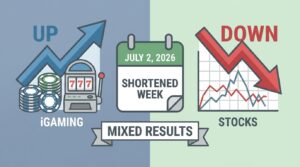
A shortened U.S. trading week, cut by the Independence Day holiday on July 3, produced uneven results across the iGaming sector. Ace Alliance’s latest stock snapshot, covering June 29 through July 2, 2026, tracked selected public companies spanning betting, gaming, lottery, and casino affiliate segments. Larger-cap names generally held firm or edged higher, while mid-tier and small-cap stocks faced selling pressure. The four-day window offered just enough data to reveal where institutional confidence sits heading into the second half of the year.
What the Shortened Week Revealed for iGaming Investors
Holiday-shortened weeks tend to compress volatility into fewer sessions, and this one followed that pattern. With U.S. markets dark on Friday, trading volumes likely thinned by midweek as institutional desks wound down early. That context matters: price moves in low-volume environments can overstate or understate real sentiment. Still, the directional signals from this week are worth parsing carefully, particularly for companies navigating regulatory shifts and evolving competitive dynamics across North America and Europe.
- Large-cap resilience: Several of the sector’s biggest names closed the week higher, suggesting continued institutional appetite for established operators with diversified revenue streams.
- Mid-tier softness: Companies in the middle of the market-cap spectrum showed more vulnerability, a pattern that often reflects rotation rather than fundamental deterioration.
- Small-cap stocks bore the brunt of the selling, though whether this reflects sector-specific concerns or broader risk-off positioning remains an open question.
- Holiday compression: The truncated schedule amplified moves in both directions, making week-over-week comparisons slightly less reliable than a full five-session period.
- The previous snapshot covered June 22–26, and comparing the two weeks shows no dramatic shift in sector-wide momentum — more of a pause than a pivot.
Large-Cap Operators: Steady Hands in a Quiet Market
The larger publicly traded iGaming companies continued to benefit from what has been a broadly constructive first half of 2026. Operators with exposure to multiple regulated U.S. states, combined with established European footprints, tend to attract capital during periods of uncertainty. That dynamic played out again this week. Investors appear to be pricing in the likelihood that regulatory expansion in the U.S., while slower than some projected, remains directionally positive for scaled operators.
What remains less clear is whether these valuations already reflect the next wave of state-level approvals, or if there is still upside to capture. Arguably, the market has grown more efficient at pricing regulatory catalysts in advance, which compresses the post-announcement pop that earlier movers enjoyed in 2023 and 2024.
Why Scale Keeps Winning
Operational leverage in iGaming is not abstract. Companies that can spread technology costs, marketing spend, and compliance infrastructure across more jurisdictions generate structurally better margins. This week’s price action reinforced that thesis. The gap between large and small operators, at least on paper, continues to widen in public markets.
Mid-Tier and Small-Cap Pressure Points
Not every company in the Ace Alliance iGaming stock tracking group moved in the same direction. Mid-tier names, those with market capitalizations roughly between $500 million and $2 billion, showed more dispersion. Some held steady. Others gave back gains accumulated earlier in June.
For small-cap iGaming stocks, the week was harder. Thin liquidity around a holiday amplifies downside moves, and several names in the affiliate and lottery-adjacent segments traded lower. Whether this reflects genuine fundamental concern or simply the mechanical effect of reduced buyer interest during a short week is a distinction worth watching in the sessions ahead.
How Sector Rotation Shapes iGaming Valuations
One underappreciated dynamic in iGaming equity markets is the role of sector rotation among generalist funds. When broader tech or consumer discretionary sectors rally, capital sometimes flows out of niche verticals like online gambling. And while iGaming has carved out a more distinct identity among institutional investors over the past three years, it still competes for allocation dollars against larger, more liquid sectors.
This week’s mixed performance may partly reflect that competition. U.S. equity indices were broadly stable heading into the holiday, which can paradoxically reduce urgency to hold positions in smaller sectors. The result: a market caught between two frameworks, one that values iGaming’s growth trajectory and another that treats it as a tactical allocation rather than a core holding.
Reading the Signals: What Investors Should Watch Next
The coming weeks bring a fuller trading calendar and, critically, the approach of Q2 earnings season. For iGaming companies, earnings reports in late July and August will provide the first concrete look at how the sector performed during the traditionally strong spring sports calendar and the early summer period.
| Factor | Current Signal | Potential Impact |
|---|---|---|
| U.S. state-level regulatory pipeline | Moderate activity; no major new approvals pending | Limited near-term catalyst for expansion-driven upside |
| Q2 earnings expectations | Consensus estimates generally stable | Beats could reignite mid-cap interest; misses would deepen the large/small divergence |
| European regulatory environment | Ongoing compliance tightening in several markets | Margin pressure for operators with heavy EU exposure, though larger firms absorb this more easily |
| Macroeconomic backdrop | Interest rates stable, consumer spending resilient | Supportive for discretionary spending categories including online gambling |
The Psychology Behind iGaming Investment Decisions
Beyond the numbers, investor behavior in niche sectors like iGaming is shaped by cognitive patterns worth understanding. Anchoring bias, for instance, leads many investors to fixate on a stock’s 52-week high or IPO price rather than its current fundamentals. In a sector where regulatory news can shift valuations overnight, this tendency creates both risk and opportunity.
Confirmation bias plays a role too. Investors bullish on U.S. sports betting expansion tend to selectively weight positive regulatory signals while discounting setbacks. The reverse applies to skeptics. Recognizing these patterns (a discipline borrowed from behavioral finance and neuro-linguistic programming frameworks) can sharpen decision-making. Reframing how one processes sector news, consciously separating signal from narrative, is arguably more valuable than any single data point.
Visualization techniques, often associated with NLP, have practical applications here as well. Investors who mentally rehearse different scenarios, a state approving mobile wagering, a major operator missing earnings, a regulatory crackdown in a key European market, tend to react more deliberately when those events materialize. The goal is not prediction. It is preparedness. And in a sector where headline risk is constant, the ability to respond rather than react separates disciplined capital from reactive capital.
Even the language investors use internally shapes outcomes. Framing a portfolio loss as a “learning cost” rather than a “failure” changes the emotional weight of the experience, which in turn affects subsequent decisions. For iGaming investors navigating a volatile and still-maturing public market, that kind of cognitive reframing is not a luxury. It is infrastructure.
Frequently Asked Questions
Why were U.S. markets closed on July 3, 2026?
U.S. stock exchanges observed the Independence Day holiday on Friday, July 3, since July 4 fell on a Saturday. This shortened the trading week to four sessions.
Which iGaming segments performed best during this period?
Large-cap operators with diversified geographic exposure generally closed higher. Mid-tier and small-cap names, particularly in the affiliate and lottery-adjacent categories, faced more selling pressure.
How does a shortened trading week affect stock analysis?
Fewer sessions mean lower overall volume, which can exaggerate price movements in both directions. Week-over-week comparisons should be interpreted with that caveat in mind, especially for less liquid names.
When will Q2 2026 earnings provide more clarity?
Most publicly traded iGaming companies report Q2 results in late July through mid-August. Those reports will offer the first detailed look at performance during the spring sports season and early summer.