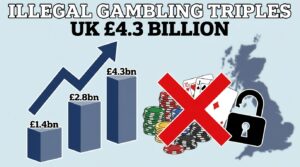
The Betting and Gaming Council (BGC) has published data revealing that illegal gambling activity in the United Kingdom has reached what it describes as a critical threshold, with bets placed through unlicensed operators now approaching £4.3 billion ($5.4 billion). That figure has tripled since 2019 and doubled over the past two years alone. The surge coincides with a period of intensifying regulatory reform in the licensed sector, raising pointed questions about whether tighter rules are inadvertently fuelling the black market they aim to suppress.
What the BGC’s Numbers Actually Signal for the UK Gambling Sector
The trajectory here is not subtle. A threefold increase in five years, with acceleration in the most recent period, suggests something structural rather than incidental is at work. Before unpacking the regulatory dynamics, the core business implications deserve attention.
- Revenue displacement is accelerating: Licensed operators are losing market share not to competitors, but to entirely unregulated platforms operating beyond the reach of UK enforcement.
- Player protection frameworks are being bypassed at scale: Unlicensed operators offer none of the responsible gambling safeguards mandated under the Gambling Act 2005 and its subsequent amendments.
- The doubling in just two years points to a tipping point where consumer migration to offshore sites may become self-reinforcing, driven by word-of-mouth and aggressive digital marketing from illegal platforms.
- Regulatory credibility is under pressure: If the Gambling Commission cannot stem this flow, the entire reform agenda risks being undermined by its own unintended consequences.
- Tax revenue losses compound the problem, reducing the fiscal argument for maintaining a regulated market at all (a distinction policymakers have been slow to confront).
How Tighter Regulation May Be Pushing Bettors Offshore
The BGC’s argument is straightforward, even if politically uncomfortable: as the licensed market faces stricter affordability checks, stake limits, and advertising restrictions, a segment of consumers is migrating to platforms that impose none of these constraints. The Betting and Gaming Council’s advocacy for proportionate regulation has long centred on this risk. And the data now appears to support the concern.
Still, the picture is more layered than a simple cause-and-effect narrative. Unlicensed operators have grown more sophisticated in recent years. Many mimic the branding and user experience of legitimate sites, making it harder for consumers to distinguish between regulated and unregulated platforms. Some operate through cryptocurrency payment rails that sit outside traditional banking oversight. Others exploit social media channels and encrypted messaging apps to recruit customers directly.
What remains less clear is how much of the £4.3 billion represents genuinely displaced demand from the legal market versus new demand that might never have entered the regulated ecosystem at all.
The Enforcement Gap: Why Shutting Down Illegal Operators Isn’t Simple
Enforcement against offshore gambling operations is notoriously difficult. The UK Gambling Commission can issue warnings, block payment processing, and request ISP-level domain blocking. But these tools have limits. Operators based in jurisdictions with minimal regulatory cooperation can reappear under new domains within hours. VPN usage among consumers further complicates detection.
Consider the scale involved. A market approaching £4.3 billion suggests hundreds, possibly thousands, of individual operators and affiliate networks. The Commission’s enforcement budget, while not publicly broken down to this level of specificity, was not designed for a problem of this magnitude. That mismatch between the scale of illegal activity and the resources allocated to combat it is arguably the most pressing structural issue facing UK gambling regulation today.
Comparative Enforcement Approaches
| Country | Primary Enforcement Tool | Estimated Black Market Share | Outcome |
|---|---|---|---|
| United Kingdom | Payment blocking, domain blocking | Growing rapidly (BGC data) | Enforcement struggling to keep pace |
| Italy | ISP blocking with financial penalties | Estimated 15–20% | Partial containment, ongoing challenges |
| Sweden | Channelisation targets with licensed incentives | Approximately 25% post-reform | Mixed results; regulatory recalibration underway |
| Australia | Active prosecution and ISP blocking | Smaller but persistent | More aggressive stance, higher enforcement costs |
Sweden’s experience after its 2019 re-regulation is particularly instructive. Strict initial rules drove channelisation rates down before authorities loosened certain requirements to pull consumers back into the licensed market.
Why Consumer Behaviour Shifts Faster Than Policy
There is a behavioural dimension to this problem that pure enforcement cannot address. When consumers perceive the legal product as excessively restricted, the psychological barrier to seeking alternatives drops. This is not unique to gambling. It mirrors patterns seen in alcohol prohibition, tobacco regulation, and even financial services where overly rigid compliance frameworks push activity into shadow markets.
Framing matters enormously here. Licensed operators are required to present friction at every stage: identity verification, deposit limits, cooling-off periods, reality checks. Each of these serves a legitimate protective purpose. But cumulatively, they create a user experience that some consumers experience as adversarial rather than protective. Unlicensed platforms, by contrast, frame themselves as frictionless and unrestricted. That contrast, in practice, functions as a powerful marketing message even without explicit advertising.
The challenge for regulators is calibrating intervention so that protections remain robust without creating such a stark experiential gap between legal and illegal products that the latter becomes the path of least resistance. Getting that balance wrong doesn’t just cost revenue. It costs the very consumer protection the rules were designed to deliver.
Frequently Asked Questions
How large is the illegal gambling market in the UK?
According to the BGC’s latest data, bets placed with unlicensed operators are approaching £4.3 billion ($5.4 billion), having tripled since 2019.
Why has illegal gambling grown so quickly?
Multiple factors are at play, including tighter regulations on licensed operators, the growing sophistication of offshore platforms, and the availability of payment methods like cryptocurrency that sit outside traditional banking oversight. The BGC argues that disproportionate regulatory burdens on the legal market are a significant driver, though the full picture involves consumer behaviour shifts and enforcement limitations as well.
Are consumers protected when using unlicensed gambling sites?
No. Unlicensed operators are not subject to UK Gambling Commission oversight and offer none of the responsible gambling safeguards required of licensed platforms.
What can regulators do about it?
Current tools include payment blocking, domain blocking, and public warnings. But offshore operators can reconstitute quickly, and the enforcement budget has not scaled with the problem. Some industry voices advocate for recalibrating licensed-market rules to improve channelisation rates, though this remains politically contentious.



