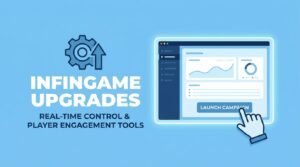
iGaming aggregator Infingame has rolled out a significant overhaul of its promotional campaign infrastructure, equipping online casino operators with far more granular control over how they design, launch, and adjust player engagement strategies. The upgrades centre on the company’s Challenges and Tournaments tools, which now support mid-campaign modifications and highly customisable logic. In a market where differentiation increasingly hinges on promotional agility, the timing of these enhancements is deliberate.
What Infingame’s Promotional Overhaul Means for Operators
The core shift here is structural. Rather than locking operators into pre-configured campaign templates that run on fixed parameters, Infingame now allows real-time adjustments to promotional mechanics while a campaign is live. That’s a meaningful departure from how most aggregator-level promotional tools have traditionally functioned (a distinction the industry has been slow to address at the platform layer).
Before diving into the specifics, here’s what matters most from a business perspective:
- Mid-campaign flexibility: Operators can modify promotional logic, reward structures, and eligibility criteria without pausing or restarting a campaign, reducing downtime and player friction.
- Granular lifecycle management: The tools now cover the full promotional lifecycle, from initial design through deployment, monitoring, and refinement.
- Operators no longer need to rely on rigid, pre-packaged marketing systems that limit creative and strategic options.
- Competitive positioning: In saturated markets, the ability to react to player behaviour data in real time is arguably the sharpest edge an operator can hold.
- Reduced dependency on third-party campaign tools: By consolidating promotional management within the aggregator layer, Infingame reduces operational complexity for its partners.
Why Real-Time Campaign Adjustment Changes the Calculus
Consider the typical promotional cycle. An operator designs a tournament, sets the rules, launches it, and waits. If engagement underperforms or player behaviour shifts mid-event, the options have historically been limited: either let it run and absorb the inefficiency, or pull it entirely and take the reputational hit. Neither outcome is good.
Infingame’s updated toolset breaks that binary. Operators can now tweak reward tiers, adjust qualification thresholds, or recalibrate challenge mechanics while players are actively participating. The practical effect is that campaigns become living systems rather than static constructs. And while this sounds like a feature that should have existed years ago, the technical complexity of maintaining promotional integrity during live modifications is non-trivial.
What remains less clear is how Infingame handles edge cases where mid-campaign changes could affect players who already qualified under previous rules. Fairness logic in these scenarios tends to be where promotional flexibility meets regulatory scrutiny.
Challenges and Tournaments: The Two Pillars
The upgrades span two distinct but complementary product lines within Infingame’s aggregation platform.
| Feature | Challenges | Tournaments |
|---|---|---|
| Campaign type | Individual player goals and milestones | Competitive, leaderboard-driven events |
| Real-time editing | Yes, including reward logic and eligibility | Yes, including scoring parameters and prize pools |
| Primary use case | Retention and re-engagement | Acquisition and high-value player activation |
| Customisation depth | Full control over triggers, conditions, and payouts | Adjustable formats, durations, and qualification rules with broader scope |
Both tools now share a unified management interface, which simplifies the operational burden for marketing teams that previously had to juggle separate dashboards.
How Promotional Agility Reshapes Operator Strategy
The broader context here matters. iGaming markets across Europe, Latin America, and parts of Asia are experiencing regulatory tightening alongside intensifying competition. Operators face a dual pressure: comply with increasingly prescriptive bonus and advertising rules while still finding ways to differentiate their player experience.
Promotional tools that allow precise, auditable control over every parameter of a campaign serve both objectives simultaneously. An operator in a jurisdiction that caps bonus values, for instance, can adjust mid-campaign to stay compliant without scrapping the entire promotion. That kind of surgical control has direct cost implications.
Still, technology alone doesn’t solve the strategic challenge. The operators who benefit most from these tools will be those with data teams capable of interpreting real-time engagement signals and translating them into actionable campaign adjustments. The tool enables speed. The insight has to come from elsewhere.
Framing the Shift Through Behavioural Design
There’s a dimension to these upgrades that extends beyond pure marketing mechanics. Effective promotional campaigns in iGaming are, at their core, exercises in behavioural design. They rely on principles closely aligned with Neuro-linguistic Programming concepts: anchoring expectations, creating progressive commitment loops, and calibrating reward timing to sustain engagement without triggering fatigue.
When an operator can adjust a challenge’s difficulty curve in real time based on observed player drop-off rates, they’re essentially applying a feedback loop that mirrors how NLP practitioners calibrate communication based on response signals. The player who abandons a challenge at step seven out of ten might not need a bigger reward. They might need a different framing of the next milestone, a recalibrated sense of proximity to the goal. Infingame’s tools, at least on paper, now make that kind of nuanced adjustment operationally feasible.
This matters because player psychology in competitive gaming environments is not static. A leaderboard that felt motivating on day one can feel discouraging by day three if the gap between positions widens beyond what a player perceives as recoverable. The ability to restructure scoring parameters or introduce catch-up mechanics mid-tournament addresses this directly. It’s not just a technical feature. It’s a retention architecture built on behavioural feedback.
Operators who understand these dynamics and pair them with Infingame’s flexible tooling stand to build promotional ecosystems that feel responsive rather than mechanical to the player. And in an industry where player trust and perceived fairness increasingly drive long-term value, that distinction carries weight.
Frequently Asked Questions
What specific tools did Infingame upgrade?
The upgrades apply to its Challenges and Tournaments promotional tools, both of which now support real-time campaign editing and deeper customisation of rules, rewards, and eligibility criteria.
Can operators change a live campaign without disrupting player experience?
According to Infingame, yes. The updated system allows modifications to promotional logic while campaigns are active, though the handling of edge cases involving players who qualified under prior rules has not been detailed publicly.
Who benefits most from these changes?
Operators with active data and marketing teams who can interpret real-time engagement metrics will extract the most value. The tools provide the mechanism; the strategic advantage depends on how they’re used.
Is this relevant to regulated markets?
Particularly so. Granular control over bonus parameters and promotional terms gives operators a clearer path to maintaining compliance in jurisdictions with strict bonus or advertising regulations, without abandoning campaigns entirely when rules shift.



